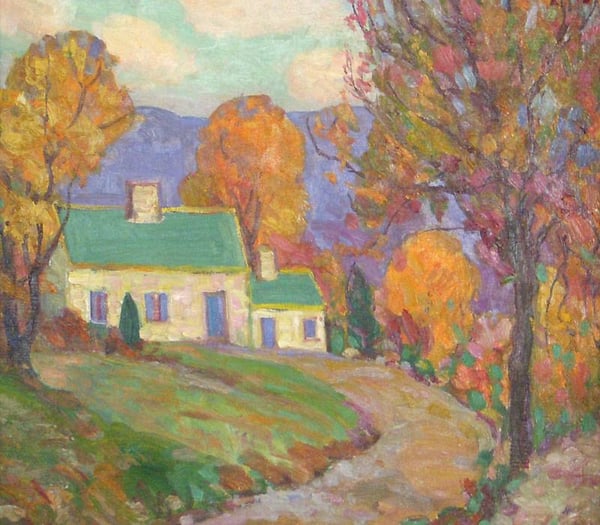
Lumberville
Fern Coppedge の Lumberville の専門的な分析
スタイル:Impressionism · ジャンル:landscape
Expert Analysis: "Lumberville" by Fern Coppedge
As an Impressionist landscape, Fern Coppedge’s "Lumberville" epitomizes the movement’s core ideals while asserting a distinctly American identity. Painted within the Pennsylvania Impressionist tradition—often called the New Hope School—this work captures the rural charm of Bucks County through the lens of light, color, and atmospheric immediacy.
Significance within Impressionism and Its Period:
-
Americanization of the Style – Coppedge adapts French Impressionist principles to depict the unpretentious beauty of the Delaware River valley. Instead of Parisian boulevards or haystacks in Normandy, "Lumberville" offers a quiet, vernacular scene: a small village on the river, likely showing the interplay of sunlight on water, foliage, and architecture. This localization marks the work as part of a broader early-20th-century movement to define a native American aesthetic within the Impressionist framework.
-
Mastery of Light and Atmosphere – True to Impressionist technique, Coppedge uses broken brushwork and a high-keyed palette to capture shifting light. The painting likely emphasizes reflections on the canal or river, the dappled shadows of trees, and a sense of ephemeral weather—key concerns for the Impressionist eye. Her handling of color temperature (warm sunlit patches against cool shadows) demonstrates her absorption of plein-air observation.
-
Contribution as a Female Impressionist – Coppedge was one of the few women in the fiercely competitive Pennsylvania Impressionist circle. Her success in exhibiting alongside male peers (e.g., at the annual Phillips Mill exhibitions) underscores her significance: "Lumberville" not only represents her technical skill but also her role in expanding the canon of American landscape painting during a period when women artists were often marginalized. The work stands as a testament to her perseverance and her sensitive yet confident vision.
-
Evocation of Place and Tranquility – The genre of landscape here is not merely documentary; it is an emotional record. Coppedge’s rendering of Lumberville—likely with its historic covered bridge, calm canal, and unassuming houses—radiates a sense of timeless harmony. This aligns with the Impressionist goal of preserving a fleeting impression, but it also carries a nostalgic, regionalist undertone that would later influence American Scene painting.
In sum, "Lumberville" is significant as a confident American Impressionist work that merges European brushwork with a distinctly local, lyrical sensibility. It exemplifies Coppedge’s achievement as a female artist navigating a male-dominated movement and contributes a quiet, luminous document of early 20th-century Pennsylvania pastoral life.
視覚的に類似
構図やパレットが近い作品 20 件
Marblehead
Maurice Prendergast
The Artist's House through the Trees (also known as Autumn Afternoon)
John Henry Twachtman
Apple Trees in Blossom
Kazimir Malevich
October
Willard Metcalf
Summer
John Henry Twachtman
Czóbel Béla , Szentendre Törökvölgy
Bela Czobel
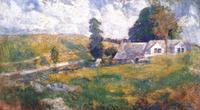
Summer Late
John Henry Twachtman
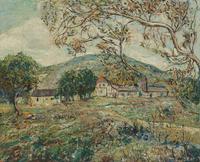
The Red Turret
Ernest Lawson
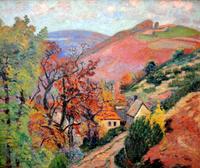
Mountain Landscape - Pontgibaud, village in Peschadoire
Armand Guillaumin
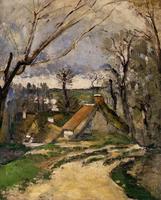
Cottages of Auvers
Paul Cezanne
Country House
Mihnea Cernat
Winter
Ernest Lawson
Beyond the Trees
Abraham Manievich
Le Sentier près des maisons
Léo Gausson
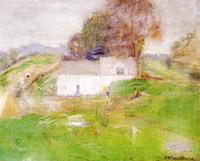
Twachtman's House
John Henry Twachtman
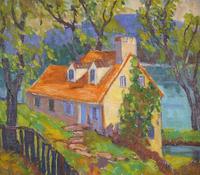
Lumberville Cottage
Fern Coppedge
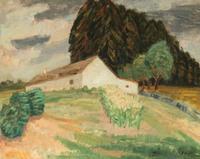
Berény Róbert, Falusi Táj. 1937
Berény Róbert
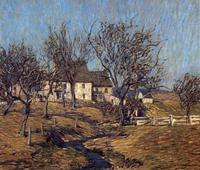
The Brook
Robert Spencer
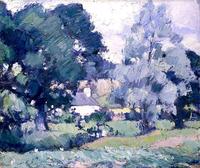
Summer New Abbey
Samuel Peploe
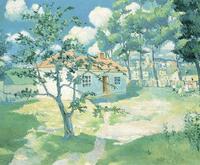
Spring
Kazimir Malevich