Analisi esperta di Aerial Act di Louis Schanker
Stile: Cubism · Genere: figurative
Expert Analysis: "Aerial Act" by Louis Schanker
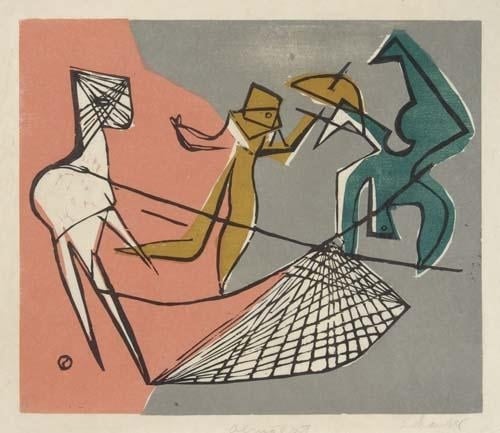
This work represents a distinctive fusion of European Cubist formalism with a distinctly American figurative subject—the circus or performance arena. In "Aerial Act," Schanker applies Cubism’s core strategies—fragmentation of form, multiple simultaneous viewpoints, and a flattened, geometrically structured space—to a dynamic, human-centered scene. The genre is figurative, but the Cubist treatment pushes the subject toward abstraction: the aerial performer is likely broken into intersecting planes and facets, with the surrounding apparatus (trapeze, rigging, audience) similarly reduced to angular, interlocking shapes. This synthesis reveals what is most significant about the piece within its style and period.
Significance within Cubism and its American Context:
-
Bridging European Avant-Garde and American Modernism – Schanker was part of a generation of American artists who absorbed Cubism from European masters (Picasso, Braque, Léger) but adapted it to indigenous themes. "Aerial Act" avoids still-life or studio subjects, instead capturing the energy, motion, and spectacle of popular entertainment—a subject that resonates with American cultural identity. This move helped democratize Cubism, making it accessible and relevant to a modern American audience.
-
Dynamic Figuration – While many Cubist works are static (portraits, instruments), Schanker’s choice of an aerial act injects a sense of motion and precarious balance. The fragmentation of the figure serves not just to deconstruct form but to suggest multiple moments in a single instant: the body in mid-flight, the tension of the catch, the arc of the dive. This aligns Cubist geometry with the transient, athletic grace of the performer, making the painting a study in controlled chaos.
-
Rhythmic Composition – The title "Aerial Act" implies verticality and centrifugal forces. Schanker likely uses overlapping triangular and curvilinear planes to echo the swoop of a trapeze or the spiral of a fall. This rhythmic, almost musical use of form links Cubism to the contemporaneous interest in synchronizing visual art with modern life—machines, speed, performance.
In sum, "Aerial Act" is significant not as a pure Cubist manifesto but as a hybrid: a figurative American Cubism that retains the style’s analytical rigor while celebrating the kinetic vitality of the human body in performance. It exemplifies how Cubism evolved beyond its Parisian origins to address new subjects, asserting that fragmentation and multiple perspectives could capture not just objects, but lived, moving experience.
Genere
Stile
Visivamente simili
20 opere con composizione e palette affini
Wall Handball (study)
Louis Schanker
Three Figures
Louis Schanker
Kneeling nude
Theo van Doesburg
The beach in Garoupe
Pablo Picasso
Vajda Lajos . .,.
Vajda Lajos
Le bal Musette
Georges Valmier
Polo
Louis Schanker
Untitled
Afro
Painter and his model
Pablo Picasso
Forms in Action
Louis Schanker
Study in Green and Black
Louis Schanker
Abstract figures
Walter Battiss
Untitled
Emiliano Di Cavalcanti
Untitled
Charles Lapicque
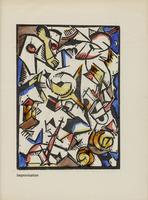
Improvisation (plate, Page 11) from the Periodical Der Schwarze Turm, Vol. 1, No. 3 (July 1919)
Georg Tappert
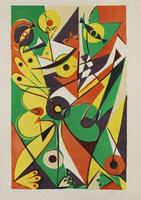
Oberon
Ernst Wilhelm Nay
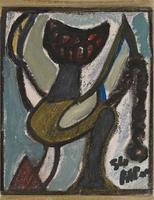
Untitled
Jean-Michel Atlan
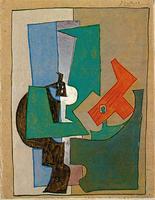
Pedestal
Pablo Picasso
Summer (In Memory of James Budd Dixon)
Frank Lobdell
Naturaleza Muerta Con Tijeras
Maria Blanchard