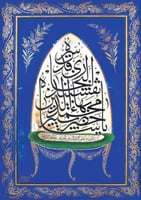
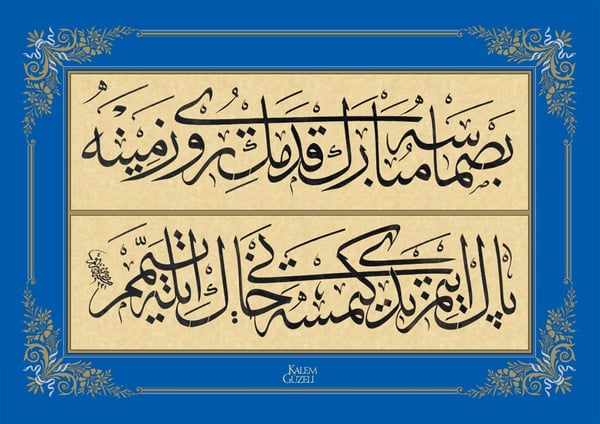
Levha - Beyit
Analisi esperta di Levha - Beyit di Mustafa Rakim
Stile: Ottoman Period · Genere: calligraphy
This work, "Levha - Beyit" by Mustafa Rakim (1757–1826), stands as a landmark in Ottoman calligraphy—a field where the written word becomes a transcendent visual art. Rakim is revered as the father of the celi sülüs script (large, monumental thuluth), and this levha (decorative panel) exemplifies his revolutionary synthesis of calligraphic precision with painterly composition.
Significance within the Ottoman Period:
- Innovation in Celi Sülüs: Rakim perfected a previously rigid style, introducing dramatic proportional shifts, tapered strokes, and "cloud-like" spacing between letters. This gave the text a dynamic, almost three-dimensional rhythm unknown in earlier classical Ottoman works.
- Fusion of Calligraphy and Imagery: In "Levha - Beyit," the Arabic/Turkish couplet is arranged not as a linear text but as a balanced, abstract composition. Rakim often integrated floral or vegetal motifs (hatayi, rumi) into the letters themselves—a hallmark of the Ottoman Baroque style he pioneered. The letterforms seem to breathe, with ascenders curling into leaf-like forms and descenders flowing into decorative stems.
- Spiritual & Poetic Resonance: The beyit (couplet) likely conveys a mystical or devotional message. Rakim’s script transforms the words into a visual meditation: the thick, commanding vertical strokes (elif) evoke divine presence, while the delicate curves (sin, nūn) suggest the bowing of the soul. This interplay of power and grace made his work ideal for mosque panels, imperial decrees, and literary albums.
- Historical Legacy: Rakim directly influenced the next two centuries of Ottoman and Turkish calligraphy. His celi sülüs became the standard for imperial monuments, from the Süleymaniye Mosque to modern Turkish banknotes. "Levha - Beyit" is a pristine example of calligraphy as a fine art, where legibility serves beauty, and beauty serves the sacred.
In short, this work is significant because it captures Rakim’s genius for turning the Quranic-Arabic script into a visual symphony, embodying the Ottoman aesthetic ideal that art, faith, and poetry are one.
Visivamente simili
20 opere con composizione e palette affini
Levha
Mustafa Rakim
Celi Sülüs
Mustafa Rakim
Muttasıl Müfredat
Mustafa Rakim
Untitled
Ahmed Karahisari
Muttasıl Müfredat
Mustafa Rakim
Sura Al-An'am written in Muhaqqaq, Thuluth and Naskh calligraphic styles
Ahmed Karahisari
Levha - Ayet-i Kerîme
Mustafa Rakim
Kıta - Hadis-i Şerîf
Sheikh Hamdullah
Kıta - Hadis-i Şerîf
Mustafa Rakim
Levha - Kelime-i Tevhid
Mustafa Rakim
A large size mushaf
Ahmed Karahisari
Epitaph
Sheikh Hamdullah
Levha - Dua
Mustafa Rakim
Kıta-
Sheikh Hamdullah
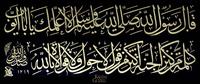
Levha - Hadis-i Şerîf
Mustafa Rakim
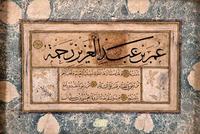
Kıta
Sheikh Hamdullah
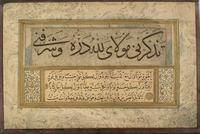
Untitled
Sheikh Hamdullah
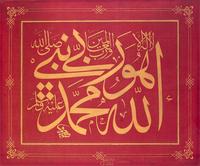
Allah - Muhammed (A.S.)
Mustafa Rakim
Untitled
Sheikh Hamdullah
Murakka (calligraphic album)
Hafiz Osman