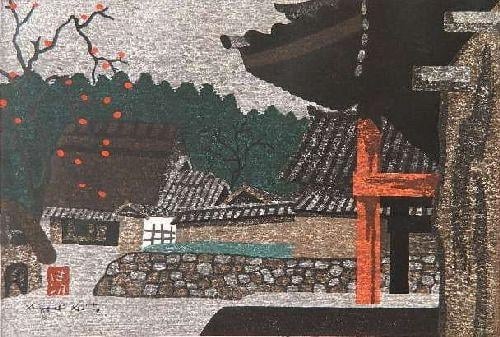
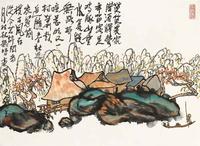
Village Scene with Temple
Expertenanalyse zu Kiyoshi Saitos Village Scene with Temple
Stil: Sōsaku hanga · Genre: cityscape
As an expert art historian, I can provide an insightful analysis of "Village Scene with Temple" by Kiyoshi Saito, based solely on the supplied structured facts.
Formal Analysis and Stylistic Significance
The work is a cityscape—specifically a village scene featuring a temple—executed in the Sōsaku hanga style. This genre choice is significant because Sōsaku hanga artists often elevated everyday landscapes and vernacular architecture to the level of high art, treating the quiet, lived-in environment with the same gravity as a formal portrait or historical narrative.
Kiyoshi Saito is recognized as a key figure in the modern Sōsaku hanga movement. Unlike the traditional ukiyo-e collaboratives where designers, carvers, and printers were distinct, Sōsaku hanga ("creative prints") demanded the artist personally carve and print the work. Saito was celebrated for his bold, simplified forms and a particularly sensitive use of color—often subdued, earthy tones or unexpected, muted harmonies.
In "Village Scene with Temple," the significance lies in how Saito likely captures a timeless Japanese atmosphere through the lens of a modern, individualistic printmaking technique. The genre (cityscape) allows him to structure the composition using flat planes of color, geometric abstraction, and a deliberate omission of excessive detail—hallmarks of his style. The temple, a symbol of tradition, is rendered not as a nostalgic or picturesque postcard, but as a formal, almost architectural block that anchors the spatial organization.
Significance Within Its Period
The work exemplifies the core ethos of the Sōsaku hanga movement: the artist’s complete personal expression from conception to final print. Saito's treatment of a historically "humble" subject—a village temple—as a subject worthy of modern, Western-influenced abstraction demonstrates the movement’s break from the commercial, illustrative past of ukiyo-e.
By combining a traditional Japanese motif with a distinctly modern, artist-driven technique, "Village Scene with Temple" becomes a significant artifact of mid-20th-century Japanese art. It shows how Sōsaku hanga artists like Saito forged a new identity for Japanese printmaking—one that was simultaneously deeply local (in its subject matter) and universally modern (in its formal language). The work stands as a testament to the movement’s ability to find profound visual poetry in the everyday, and to elevate the individual artist's hand and mind over the mechanized reproduction of a collective workshop.
Genre
Stil
Visuell ähnlich
20 Werke mit ähnlicher Komposition und Farbpalette
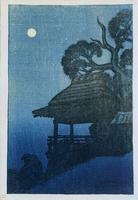
Evening Scene at Ishiyama Temple
Ito Shinsui
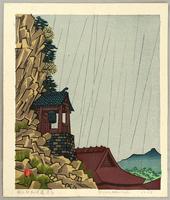
Rakan Temple at Yabakei
Unichi Hiratsuka
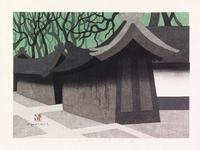
Ryoanji Kyoto
Kiyoshi Saito

Ancient City Nara
Kiyoshi Saito
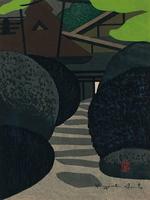
Shisen-do, Kyoto (B)
Kiyoshi Saito
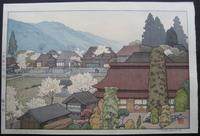
Village of Plums
Toshi Yoshida
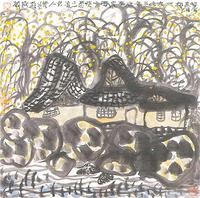
Pastoral Scene at Dusk
Li Huasheng
114. Bikuni Bridge in Snow
Hiroshige
Miyoshin-ji Kyoto (A)
Kiyoshi Saito
Untitled
Kiyoshi Saito
Winter in Aizu (50)
Kiyoshi Saito
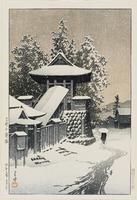
Bell Tower at Mt. Kôya
Hasui Kawase
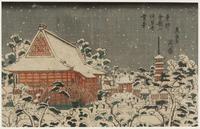
Snow Scene at Sensô-ji Temple at Kinryûzan in the Eastern Capital
Keisai Eisen
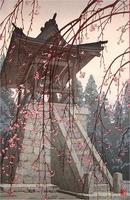
Heirinji Temple Bell
Toshi Yoshida
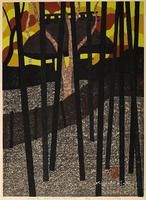
Gio-Ji Autumn Kyoto
Kiyoshi Saito
Kozu, Osaka
Hasui Kawase
In a Temple Yard
Hiroshi Yoshida
Hodogaya, Shinkame Bashi, Station 5
Hiroshige
Benzaiten Shrine at Inokashira in Snow
Hiroshige
Landscapes
Li Huasheng