Analyse experte de Shisen-do, Kyoto (B) de Kiyoshi Saito
Style : Sōsaku hanga · Genre : landscape
Expert Analysis:
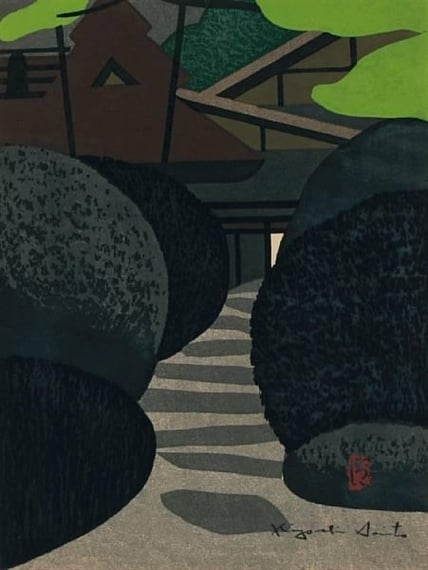
Kiyoshi Saito’s “Shisen-do, Kyoto (B)” is a quintessential example of the Sōsaku hanga (“creative print”) movement, which revolutionized Japanese printmaking in the 20th century by insisting that the artist personally carve, ink, and print the work—rejecting the traditional division of labor (artist, carver, printer). Saito, one of the movement’s leading figures, brings a distinctly modern sensibility to a classic landscape subject.
Significance within Sōsaku hanga:
- Artist as sole creator: Unlike the ukiyo-e tradition, Saito’s hand is evident in every mark. The bold, simplified forms and the deliberate use of woodgrain patterns (often left visible) emphasize the materiality of the woodblock itself, a hallmark of Sōsaku hanga’s expressive, process-driven aesthetic.
- Fusion of tradition and modernity: The subject—the historic Shisen-dō hermitage in Kyoto, famous for its mossy garden and contemplative atmosphere—is rendered with a reductionist, almost abstract geometry. Dark, sweeping lines frame the architecture and foliage, while muted earth tones (ochre, olive, charcoal) create a serene, hazy atmosphere. This balances Eastern compositional restraint (asymmetry, negative space) with Western-style flat planes and textured surfaces.
- Emotional resonance: Saito’s approach elevates a specific locale into a universal meditation on stillness and transience—key themes in both Zen aesthetics and modern printmaking. The print’s quiet power lies in its tension between precise structure (the hermitage’s roof, tree trunks) and organic, hand-carved irregularities.
Genre context:
As a landscape, “Shisen-do, Kyoto (B)” avoids picturesque detail in favor of impressionistic mood. Saito’s layering of thin color blocks and his characteristic use of bokashi (graduated tone) evoke mist and filtered light, capturing the site’s contemplative spirit. This work is significant for demonstrating how Sōsaku hanga artists reimagined traditional Japanese scenery not as nostalgic postcards, but as intimate, personal visions—each print a unique artifact of the artist’s direct intervention.
Visuellement similaire
20 œuvres à la composition et à la palette proches
Village of Plums
Toshi Yoshida
Rainy Night at Maekawa
Hasui Kawase
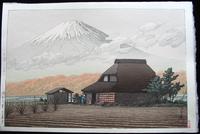
Mount Fuji from Narusawa in Autumn
Hasui Kawase
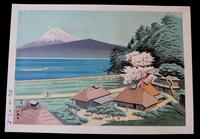
Spring View of Mount Fuji
Asano Takeji
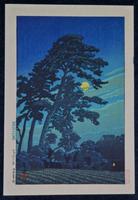
Full Moon at Magome
Hasui Kawase
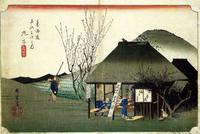
Mariko Mabutsu Chaya
Hiroshige
Aizu Winter
Kiyoshi Saito
Snow at Shirochi
Hasui Kawase
Untitled
Kiyoshi Saito
Dawn at Isawa in the Kai province
Katsushika Hokusai
Fuji from Mizuchubo
Shotei Takahashi
Shimomeguro
Katsushika Hokusai
Autumn in Hakone Museum
Toshi Yoshida
Farmhouse Under Snowy Trees
Hasui Kawase
114. Bikuni Bridge in Snow
Hiroshige
Gio-Ji Autumn Kyoto
Kiyoshi Saito
Landscape with two falconers
Katsushika Hokusai
Enoshima in the Sagami province
Katsushika Hokusai
Hodogaya, Shinkame Bashi, Station 5
Hiroshige
The Tea plantation of Katakura in the Suruga province
Katsushika Hokusai