Expertenanalyse zu Maki Hakus 72-44
Stil: Sōsaku hanga · Genre: abstract
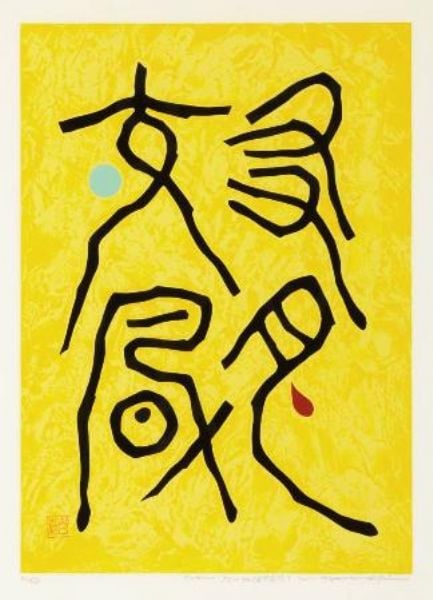
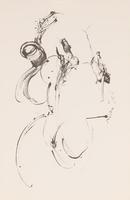
Artwork: "72-44" by Maki Haku
Style: Sōsaku hanga (Creative Print Movement)
Genre: Abstract
Expert Analysis
Maki Haku’s "72-44" stands as a compelling example of the Sōsaku hanga movement’s radical departure from traditional Japanese printmaking. In Sōsaku hanga, the artist takes on the roles of designer, carver, and printer—unlike the collaborative ukiyo-e model—investing each print with an intensely personal, gestural quality. Here, Haku works within abstraction, a genre that allows him to foreground materiality and process over representation.
The title “72-44” likely designates the year of creation (1972) and a print series number, aligning with Haku’s practice of naming works systematically rather than descriptively. This numbering emphasizes the work’s conceptual nature: it is not a depiction of an external subject but an exploration of form, texture, and the expressive potential of the carved woodblock.
Within the Sōsaku hanga context, Haku’s abstract vocabulary is significant for how it reinterprets calligraphic and seal-script traditions. His compositions often feature bold, character-like shapes that hover between legible signs and pure visual rhythm, bridging ancient Japanese aesthetic principles with mid-20th-century international abstraction. In "72-44," the interplay of positive and negative space, the rough impasto-like ink surface (achieved by deeply carved blocks and layered printing), and the dynamic asymmetry reflect the movement’s emphasis on material honesty—the wood grain, blade marks, and ink buildup are left visible as integral parts of the image.
What makes "72-44" remarkable within the Sōsaku hanga period is its confidence in non-objective expression. By the 1970s, Haku had fully synthesized traditional craft with modernist abstraction, creating works that feel both ancient and avant-garde. The print’s restrained palette (likely monochrome or limited earth tones) and rigorous compositional balance demonstrate a mastery of simplifying complex visual ideas—a hallmark of his mature style. In doing so, "72-44" exemplifies how Sōsaku hanga artists like Haku expanded the boundaries of Japanese printmaking, proving that abstraction could carry the same weight of cultural legacy as figuration or landscape.
Genre
Stil
Visuell ähnlich
20 Werke mit ähnlicher Komposition und Farbpalette
Schwarz vor Grau und Gelb
Fritz Winter
Green
Bradley Walker Tomlin
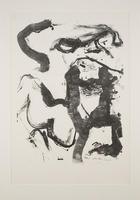
Figure at Gerard Beach
Willem de Kooning
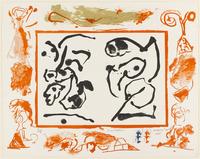
Amsterdam
Pierre Alechinsky
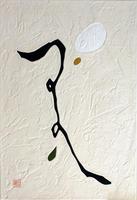
Poem 70-66
Maki Haku
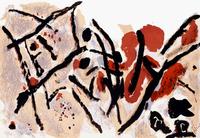
Composition
Pierre Tal-Coat
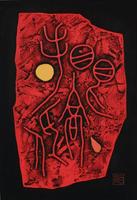
Poem 90-47
Maki Haku
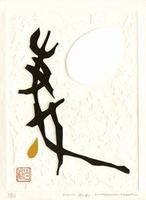
Poem 69-41
Maki Haku
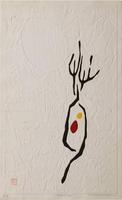
Untitled
Maki Haku
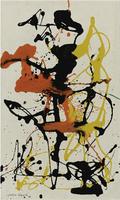
Number 26
Jackson Pollock
Untitled
Paolo Scheggi
A Next... Amitie
Guido Molinari
Contemplation
Paul Klee
Untitled
Jean Miotte
Composizione
Giulio Turcato
African Tale
Willi Baumeister
L`Accueil
Maurice Esteve
L`Accueil
Maurice Esteve
Adam and Eve (4)
Pietro Lazzari
Tacarigüeña
Oswaldo Vigas