Maki Haku の Poem 70-66 の専門的な分析
スタイル:Sōsaku hanga · ジャンル:abstract
Expert Analysis of Maki Haku’s Poem 70-66
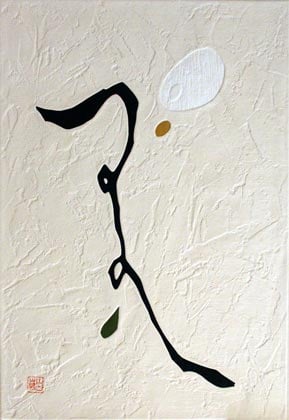
Maki Haku’s Poem 70-66 is a seminal work within the Sōsaku hanga (“creative print”) movement, notable for its radical synthesis of traditional Japanese calligraphy and postwar abstract expressionism. The piece exemplifies the movement’s core ethos—that the artist is the sole creator, carver, and printer—while pushing the boundaries of the woodblock medium into pure abstraction.
Significance within Style and Period
-
Integration of Text and Gesture
The title “Poem” signals the work’s debt to classical shodō (calligraphy), but Maki transforms literary text into a purely visual language. The bold, black brush-like strokes are not legible characters; instead, they are abstracted gestures that evoke the rhythm and energy of writing without semantic meaning. This aligns with the Sōsaku hanga interest in individual expression and the rejection of the division of labor seen in traditional ukiyo-e. -
Material and Tactile Quality
Maki’s characteristic kare-hanga (dry-brush woodcut technique) is central to Poem 70-66. By carving thin, uneven grooves into the wood and printing with dry ink, he mimics the texture of bristle marks on paper. This creates a physical, almost three-dimensional surface—a hallmark of the “creative print” artist’s insistence on the hand of the maker, distinguishing the work from mass-produced prints. -
Transcultural Dialogue
While rooted in Japanese aesthetics, Poem 70-66 engages with Western abstract art of the 1960s (e.g., Franz Kline’s black-and-white calligraphic abstraction). Maki’s work is not mere imitation; he reframes the gestural energy through the discipline of woodcarving, achieving a dialogue between Eastern materiality and Western spontaneity. This cross-cultural synthesis is a key reason for the work’s enduring significance. -
Emotional Force through Restraint
The stark contrast of black ink on an untouched paper ground, combined with the asymmetrical, explosive mark, generates a sense of movement and tension. The work’s power lies in its economy: a single, charged stroke can convey both the tradition of the ink brush and the freedom of postwar abstraction. Here, Sōsaku hanga reaches its goal of individual artistic voice, where the print is not a reproduction but a unique, hand-wrought statement.
In summary, Poem 70-66 is significant as a masterful fusion of calligraphic heritage and avant-garde abstraction, executed through the distinctive hands-on processes that define Sōsaku hanga. It stands as a testament to Maki Haku’s ability to make the woodblock a vehicle for personal, gestural expression, securing its place in the history of modern Japanese printmaking.
ジャンル
スタイル
視覚的に類似
構図やパレットが近い作品 20 件
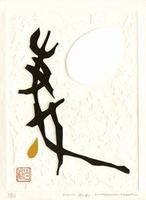
Poem 69-41
Maki Haku
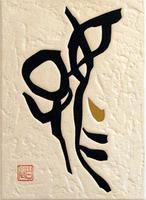
Poem 69-42
Maki Haku
Poem 69-52
Maki Haku
Work 73-45
Maki Haku
Poem 69-8
Maki Haku
Poem 69-53
Maki Haku
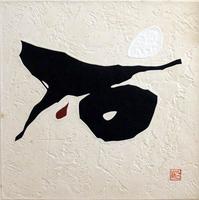
Poem 70-4
Maki Haku
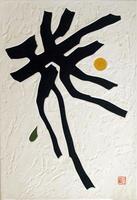
Poem 70-63
Maki Haku
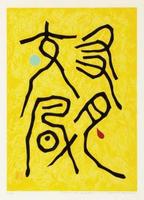
72-44
Maki Haku
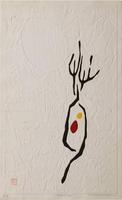
Untitled
Maki Haku
Poem 69-26
Maki Haku
Figure
Maki Haku
Poem 68-55
Maki Haku
Beyond
Kazuaki Tanahashi
Grass
Maki Haku
Poem 71-84
Maki Haku
Poem 69-3
Maki Haku
Poem 71-39
Maki Haku
Composition
Pierre Tal-Coat
Poem 70-3
Maki Haku