Analisi esperta di Poem 68-41 di Maki Haku
Stile: Sōsaku hanga · Genere: abstract
Expert Analysis of Maki Haku’s Poem 68-41 (Sōsaku hanga, Abstract)
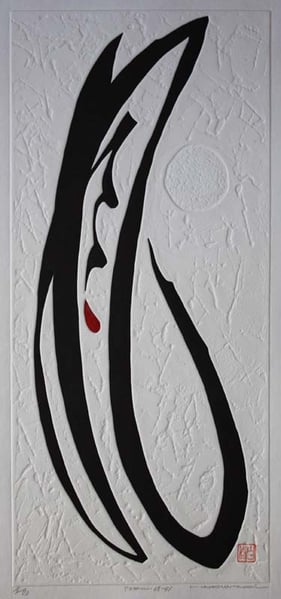
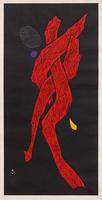
Maki Haku’s Poem 68-41 stands as a masterwork of the Sōsaku hanga (“creative print”) movement, which rejected the traditional ukiyo-e division of labor in favor of the artist’s complete control over designing, carving, and printing. Within this context, Haku’s abstract prints are significant for their radical fusion of ancient Japanese calligraphic forms with modernist abstraction, challenging both Western and Eastern print conventions.
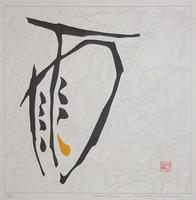
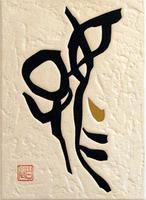
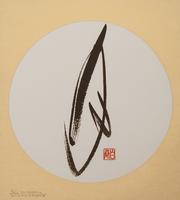
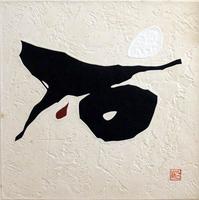
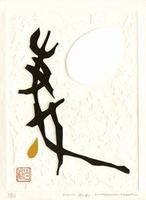
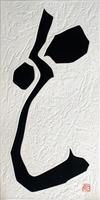
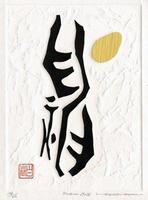
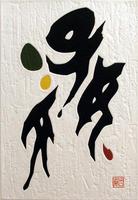
The work belongs to Haku’s celebrated “Poem” series, where he transforms fragmented kanji characters into pure visual poetry. Here, the “calligraphy” becomes illegible—reduced to bold, gestural black strokes that hover against a textured, often gold-leaf or embossed ground. This interplay of positive and negative space mirrors the silent rhythm of haiku, yet the imagery is entirely non-representational.
What makes Poem 68-41 historically important:
- Sōsaku hanga autonomy: Haku carved and printed the block himself, using techniques like kento registration and baren rubbing to achieve subtle tonal variations—a hallmark of the “print as original art” ethos.
- Material innovation: The print likely incorporates burnished gold or silver leaf and heavy embossing, creating a sculptural surface that catches light differently with each viewing. This elevates the print from mere reproduction to a tactile, object-like presence.
- Abstract calligraphy: By deconstructing written characters into abstract marks, Haku bridges East Asian ink-painting traditions and Western art informel. The strokes evoke both the speed of Sumi-e and the spontaneity of Abstract Expressionism, yet remain rooted in a distinctly Japanese sense of ma (interval) and yohaku (empty space).
Poem 68-41 thus exemplifies how Sōsaku hanga artists redefined the print as a unique, expressive medium—equal to painting or sculpture—while securing Haku’s reputation as a pioneer of abstract woodblock printing. Its significance lies in its quiet but radical fusion of heritage and modernity, where a single brushed mark can contain centuries of cultural meaning, rendered anew through the discipline of the carving knife.
Visivamente simili
20 opere con composizione e palette affini
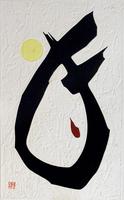
Poem 71-62
Maki Haku
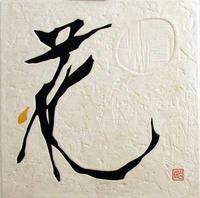
Poem 69-52
Maki Haku
Poem 69-53
Maki Haku
Poem 69-42
Maki Haku
Moon
Maki Haku
Poem 70-4
Maki Haku
Poem 69-41
Maki Haku
Work 73-45
Maki Haku
Poem 69-26
Maki Haku
Poem 71-84
Maki Haku
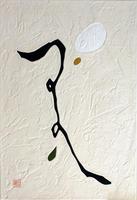
Poem 70-66
Maki Haku
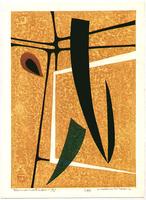
Emanation - 71
Maki Haku

esmaeil rezaei
Esmaeil Rezaei
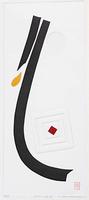
Poem 68-51
Maki Haku
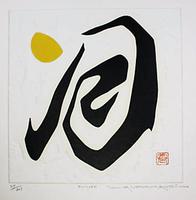
Moon
Maki Haku
Untitled
Karl Otto Gotz
Work 75-17 (Step)
Maki Haku
Harmony (Wa)
Maki Haku
Figure
Maki Haku
Poem 71-90, Woman
Maki Haku