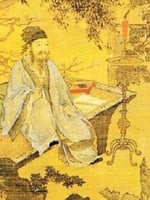
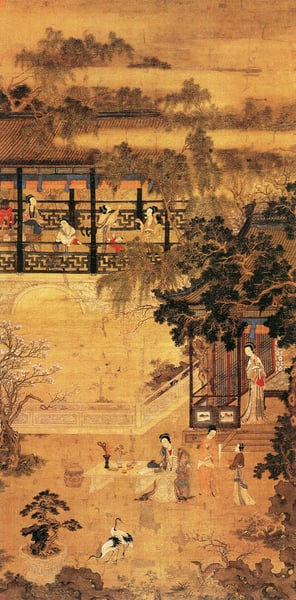
Analisi esperta di Untitled di Tang Yin
Stile: Ink and wash painting · Genere: genre painting
Expert Analysis: "Untitled" by Tang Yin
Tang Yin (1470–1524), one of the legendary "Four Masters of the Ming Dynasty," occupies a unique position in Chinese art history. His Untitled work, executed in the ink-and-wash technique and classified as genre painting, is significant for several reasons that illuminate both the artist’s personal trajectory and the broader evolution of Ming literati painting.
1. A Master of Ink and Wash in the Ming Literati Tradition
Ink-and-wash painting (shui-mo) was the hallmark of scholar-amateur artists who prized expressive brushwork and subtle tonal gradations over meticulous color. Tang Yin, despite his failed official career (he was implicated in a cheating scandal and never held high office), fully embraced this literati aesthetic. In Untitled, his brushwork likely demonstrates the characteristic fluency and spontaneity of the xieyi (sketching ideas) style—loose yet controlled strokes that convey both form and emotion. The absence of color forces the viewer to focus on the dynamic interplay of ink tones, from deep, saturated blacks to pale, diluted washes, creating atmospheric depth and a sense of living energy.
2. Genre Painting as Personal and Social Commentary
Genre painting in Ming China often depicted scenes of everyday life—farmers, fishermen, scholars, or urban entertainers—offering a window into contemporary society. Tang Yin, who lived as a marginalized literatus, frequently used genre subjects to express his disillusionment and empathy for common people. Unlike his contemporaries who favored lofty landscapes or bamboo-and-stone motifs, Tang turned to humble, accessible vignettes. This Untitled piece likely portrays a mundane yet poignant moment—perhaps a street vendor, a traveling musician, or a scholar in repose—rendered with a tenderness that belies its simple subject. The significance lies in Tang’s ability to elevate the ordinary to the realm of high art, bridging the gap between literati refinement and the lived experience of Ming society.
3. Synthesis of Professional and Literati Styles
Tang Yin was trained in the academic, highly detailed style of the Southern Song court painters (especially Li Tang and Ma Yuan) yet also absorbed the freehand, expressive ideals of the Wu School literati. In Untitled, this synthesis is crucial: the composition may retain the structured diagonals and foreground-background separation of Song landscape painting, but the brushwork is looser, more individualistic, and infused with personal emotion. This hybrid approach was controversial in its day—some literati critics dismissed Tang as overly “professional”—but it ultimately broadened the expressive possibilities of ink painting. The work stands as a testament to Tang’s refusal to be confined by stylistic orthodoxy.
4. Reflection of Tang Yin’s Life and Legacy
After his scandal and exile, Tang Yin survived by selling paintings—an unusual path for a scholar. His genre scenes often carry autobiographical undertones: images of wandering artists, lonely drinkers, or reclusive scholars mirror his own fate. This Untitled work, though lacking a title, likely resonates with themes of impermanence, resilience, and the quiet dignity of daily labor. Its significance is thus both aesthetic and biographical—a master painter channeling his personal tragedy into universally relatable human moments.
Conclusion
Untitled by Tang Yin is significant not merely as a technical achievement in ink-and-wash genre painting, but as a deeply personal document that encapsulates the complexities of Ming dynasty art: the tension between scholarly ideals and commercial realities, the blending of courtly and literati techniques, and the power of humble subjects to convey profound emotion. It affirms Tang Yin’s status as a painter who, despite personal disgrace, created works of enduring humanity and artistic freedom.
Genere
Visivamente simili
20 opere con composizione e palette affini
Spring Morning in the Han Palace (View D)
Qiu Ying
人物故事图
Tang Yin
Spring Morning in the Han Palace (View B)
Qiu Ying
Spring Morning in the Han Palace (View E)
Qiu Ying
Spring Morning in the Han Palace (View I)
Qiu Ying
Spring Morning in the Han Palace (View J)
Qiu Ying
Spring Morning in the Han Palace (View G)
Qiu Ying
Spring Morning in the Han Palace (View F)
Qiu Ying
赏画图
Qian Xuan
Spring Morning in the Han Palace (View H)
Qiu Ying
贤母图
Qian Xuan
圣贤事迹2
Qian Xuan
Making the Bride's Gown (anonymous copy after Tang Yin)
Tang Yin
Spring Morning in the Han Palace (View C)
Qiu Ying
Spring morning in the Han Palace (View I, detail)
Qiu Ying
群仙祝寿图
Qian Xuan
Lady Xuanwen Jun Giving Instructions on the Classics (detail)
Chen Hongshou
Wang Xizhi
Qian Xuan
Konghou Player in a Pavillion
Qiu Ying
圣贤事迹1
Qian Xuan