Analisi esperta di Spring Morning in the Han Palace (View I) di Qiu Ying
Stile: Gongbi · Genere: genre painting
Expert Art Historical Analysis: "Spring Morning in the Han Palace (View I)" by Qiu Ying
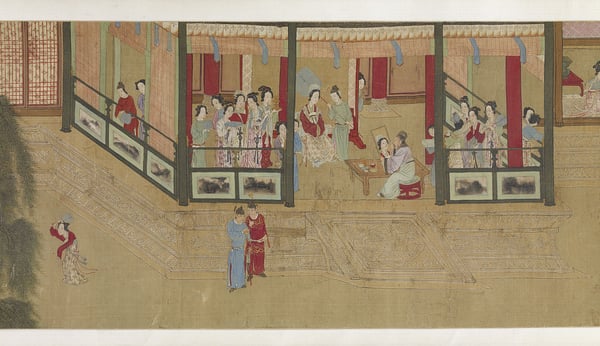
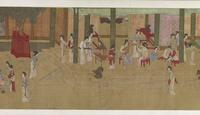
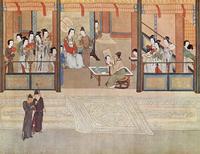
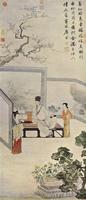
This work stands as a supreme exemplar of the gongbi (meticulous brushwork) tradition, a style that demands extraordinary precision, vivid color, and intricate detail. Painted during the Ming dynasty, Qiu Ying’s piece anchors itself in the genre painting category, yet it transcends mere documentation of daily life. Instead, it offers a poetic, idealized vision of courtly existence in the Han dynasty—a historical period often romanticized by Ming literati as a golden age of culture and refinement.
Significance within the Gongbi Style
Qiu Ying’s mastery of gongbi is evident in the flawless delineation of figures, architecture, and natural elements. Every leaf, architectural tile, and silk robe is rendered with a disciplined, hair-thin brushstroke, layered with translucent mineral pigments (such as azurite, malachite, and vermilion). This technique not only showcases technical virtuosity but also creates a luminous, almost otherworldly surface—a hallmark of the artist’s reputation as one of the “Four Masters of Ming Dynasty.” The painting’s sustained freshness of color owes much to his use of high-quality mineral paints and careful layering, a practice that distinguishes gongbi from looser ink-wash styles.
Significance as Genre Painting
As a genre painting, "Spring Morning in the Han Palace" goes beyond simple depiction of aristocratic leisure. It embeds a narrative of seasonal renewal (spring) and imperial harmony. The composition is carefully orchestrated: palace ladies, attendants, and scholars engage in refined activities—gazing at blossoms, playing instruments, or strolling through terraces—all set within a meticulously constructed garden-palace space. This is not a snapshot of reality but a constructed ideal, reflecting the Ming court’s own nostalgia for Han dynasty elegance. The work thus serves as a visual allegory of virtuous rule and cultural flourishing, aligning with the Confucian value of “art as moral instruction.”
What Makes It Exceptional
- Historical Indexing: By choosing a Han dynasty theme, Qiu Ying connects his contemporary Ming audience to a revered past, reinforcing dynastic legitimacy and cultural continuity.
- Technical Brilliance: The sheer density of detail—from the patterned railings to the delicate folds of silk—showcases the artist’s unparalleled control, making this a benchmark for later gongbi painters.
- Atmospheric Harmony: Despite the complex staging, the painting achieves a serene, balanced rhythm. The soft spring light, suggested through subtle washes and gold accents, unifies the scene, evoking a timeless, poetic mood.
In sum, "Spring Morning in the Han Palace (View I)" is not merely a beautiful painting; it is a masterwork that crystallizes the gongbi style’s potential for narrative depth, historical resonance, and sensory richness. Qiu Ying’s ability to blend meticulous realism with lyrical idealism secures this work’s place as a pivotal achievement in Ming genre painting.
Visivamente simili
20 opere con composizione e palette affini
Spring Morning in the Han Palace (View H)
Qiu Ying
Spring Morning in the Han Palace (View G)
Qiu Ying
Spring Morning in the Han Palace (View F)
Qiu Ying
Spring morning in the Han Palace (View I, detail)
Qiu Ying
Spring Morning in the Han Palace (View E)
Qiu Ying
人物故事图
Tang Yin
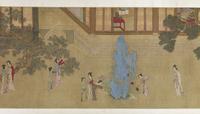
Spring Morning in the Han Palace (View D)
Qiu Ying
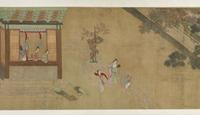
Spring Morning in the Han Palace (View B)
Qiu Ying
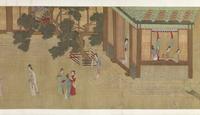
Spring Morning in the Han Palace (View C)
Qiu Ying
圣贤事迹2
Qian Xuan
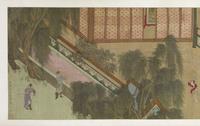
Spring Morning in the Han Palace (View J)
Qiu Ying
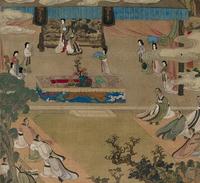
Lady Xuanwen Jun Giving Instructions on the Classics (detail)
Chen Hongshou
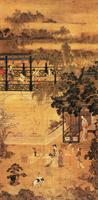
Untitled
Tang Yin
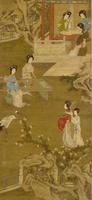
Making the Bride's Gown (anonymous copy after Tang Yin)
Tang Yin
圣贤事迹1
Qian Xuan
挥扇仕女图
Qian Xuan
赏画图
Qian Xuan
Konghou Player in a Pavillion
Qiu Ying
倣唐人仕女圖
Tang Yin
A Night Banquet at Peach and Plum Garden in Spring
Huang Shen