Expert analysis of Charles Lapicque’s L'orage sur Bréhât
Style: Fauvism · Genre: landscape
Expert Analysis: "L'orage sur Bréhât" by Charles Lapicque
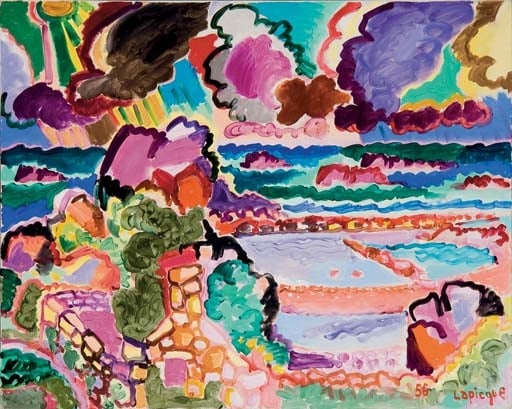
Charles Lapicque’s "L'orage sur Bréhât" is a striking example of Fauvist landscape painting, created at a moment when the movement’s revolutionary use of color and expressive distortion was being adapted by a later generation of artists. While Fauvism is most closely associated with Henri Matisse and André Derain in the early 1900s, Lapicque reinvigorated its core principles in the 1930s and 1940s, infusing them with a more personal, almost abstract energy. This work captures a storm breaking over the island of Bréhât off the coast of Brittany—a subject that allows Lapicque to fully exploit the Fauvist palette’s emotional and sensory power.
Significance within Fauvism and Lapicque’s Oeuvre
-
Color as Emotional Force: True to Fauvist doctrine, "L'orage sur Bréhât" rejects naturalistic color in favor of hues that convey the raw, turbulent energy of the storm. Lapicque deploys violent clashes of deep violet, cadmium orange, and searing green to model the sky and sea, turning the meteorological event into a visual metaphor for unleashed emotion. The painting does not merely represent a storm—it enacts one through chromatic intensity.
-
Bridging Fauvism and Abstraction: Lapicque was a trained engineer and a pioneer of “color-shape” theory, where form is dictated by the emotional weight of color rather than optical reality. In this landscape, the horizon dissolves into broad, slashing brushstrokes; the island’s silhouette is reduced to a dark, almost geometric wedge. This pushes Fauvism toward a more structured abstraction, anticipating Lapicque’s later role in the Force Nouvelle movement and his influence on postwar French painting.
-
Dynamic Composition and Brushwork: Unlike the often-decorative flatness of early Fauvism, Lapicque’s handling here is aggressively gestural. Thick impasto and diagonal strokes create a visceral sense of wind and rain lashing across the canvas. The composition is tilted and compressed, with the storm’s eye—a livid yellow patch—serving as both focal point and destabilizing fulcrum. This kinetic energy is a hallmark of Lapicque’s best works, where landscape becomes a record of the painter’s physical and psychological engagement with nature.
-
Contextual Relevance: Painted in the interwar period, "L'orage sur Bréhât" can be read as an expression of the era’s existential unease. Lapicque’s Fauvism is darker, more brooding than that of the movement’s founders; the storm’s fury mirrors the approaching clouds of World War II. Yet it also celebrates the sublime—the way nature’s violence can be transformed into aesthetic rapture. This duality makes the work a significant contribution to the Fauvist tradition, proving that its radical color and form could be adapted to express modern anxieties while maintaining lyrical beauty.
In summary, "L'orage sur Bréhât" is not merely a landscape but a manifesto of Lapicque’s belief that color is the primary vehicle of emotional truth. It stands as a vital reinterpretation of Fauvism, demonstrating how the movement’s early 20th‑century innovations remained potent and relevant decades later.
Visually similar
20 works with related composition and palette
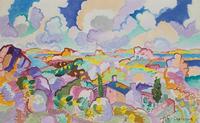
Printemps en Bretagne
Charles Lapicque
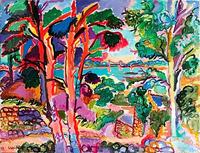
Le trieux a Lancerf
Charles Lapicque
Corfe Castle Village
Frances Hodgkins
Paysage
Charles Lapicque
Lagune bretonne
Charles Lapicque
Untitled
Charles Lapicque
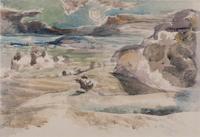
Nocturne, Landscape of the Vale
Paul Nash
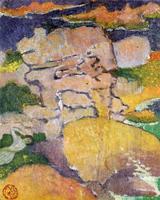
Rocks at Pouldu
Maurice Denis
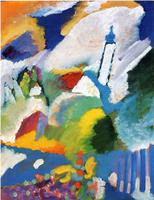
Murnau with a church
Wassily Kandinsky
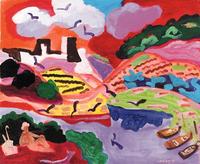
Avant L'orage
Charles Lapicque
Land by the Sea
Henri-Edmond Cross
Landscape, near Nice
Graham Sutherland
Landscape
Janos Mattis-Teutsch
Equinoxe à La Ciotat
Alexis Gritchenko
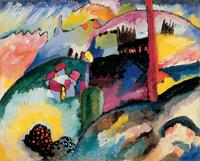
Landscape with factory chimney
Wassily Kandinsky
Composition #22
Yuri Zlotnikov
Marina
Ion Pacea
Bradford On Tone, Geoffrey Gorer’s Cottage
Frances Hodgkins
Road to Porthclais with Setting Sun
Graham Sutherland
Berkeley
Richard Diebenkorn