Compoisition surréaliste ou La main
Expert analysis of Leon Arthur Tutundjian’s Compoisition surréaliste ou La main
Style: Surrealism · Genre: symbolic painting
Expert Analysis: "Composition surréaliste ou La main" by Leon Arthur Tutundjian
Context and Style
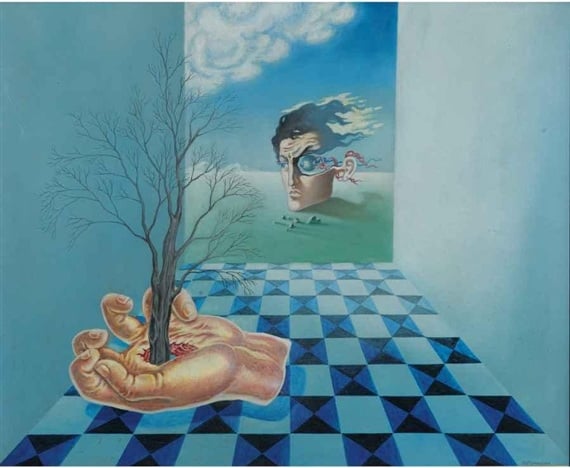
Leon Arthur Tutundjian (1905–1968), an Armenian-born French Surrealist, was a key figure in the movement’s exploration of biomorphic abstraction and subconscious imagery. True to the Surrealist style, this work rejects rational composition in favor of dreamlike, symbolic forms. The genre of symbolic painting here is not merely decorative; it functions as a visual riddle, inviting the viewer to decode hidden meanings through the lens of Freudian psychoanalysis—a cornerstone of Surrealist practice.
Significance Within Surrealism
The title itself, Composition surréaliste ou La main (“Surrealist Composition or The Hand”), already signals Tutundjian’s interest in the tension between abstraction and recognizable anatomy. The hand is a potent Surrealist motif: it represents creation, touch, and the unconscious guide of the artist’s own hand, which in automatic drawing is said to bypass rational control. By isolating the hand as a central symbol, Tutundjian aligns with Surrealist experiments in disembodied body parts (seen in works by Dalí, Magritte, and Bellmer), where familiar elements are defamiliarized to evoke anxiety or wonder.
Symbolic and Biomorphic Elements
The “hand” likely morphs into organic, flowing shapes typical of Tutundjian’s style—part anatomical, part vegetal or mineral. This hybridity echoes the Surrealist fascination with metamorphosis and the fluid boundary between the living and the inert. The composition’s supposed “irrational” arrangement forces the viewer to search for latent connections, embodying André Breton’s call for a “surer, more complete” reality—the sur-reality of dreams and the unconscious.
Why It Matters
Tutundjian’s work stands out within Surrealism for its archaic, almost talismanic quality, blending the primitive with the avant-garde. Composition surréaliste ou La main exemplifies how Surrealists used symbolic painting not to illustrate a story, but to unlock deep psychological associations. It is significant as a document of the movement’s shift from pure automatism toward a more constructed, enigmatic symbolism that still resists fixed interpretation—a hallmark of true Surrealist achievement.
Visually similar
20 works with related composition and palette
Illumined Pleasures
Salvador Dali
Dona i cap d’home
Angel Planells
Rhinocerotic Figure of Phidias' Illisos
Salvador Dali
Galatée
Salvador Dali
Corrosive
Salvador Dali
Herodias
Salvador Dali
Spellbound
Salvador Dali
Apparition of the Visage of Aphrodite of Cnidos in a Landscape
Salvador Dali
Tiger terrace
Leonid Sejka
Terasa Tigra
Leonid Šejka
The Three Ages
Salvador Dali
Hamlet
Angel Planells
The Twilight
Nina Tokhtaman Valetova
Dolor de mediodía
Angel Planells
Invisible Sleeping Woman, Horse, Lion
Salvador Dali
Composition (H.1327)
Francis Bott
Hell, copy after Hiernonymus Bosch
M.C. Escher
Untitled - Design for the ball in the dream sequence in 'Spellbound'
Salvador Dali
Barber Saddened by the Persistence of Good Weather (The Anguished Barber)
Salvador Dali
Study for a Backdrop
Salvador Dali