Analisi esperta di Pittura GR di Pino Pinelli
Stile: Minimalism · Genere: abstract
Expert Analysis: Pittura GR by Pino Pinelli
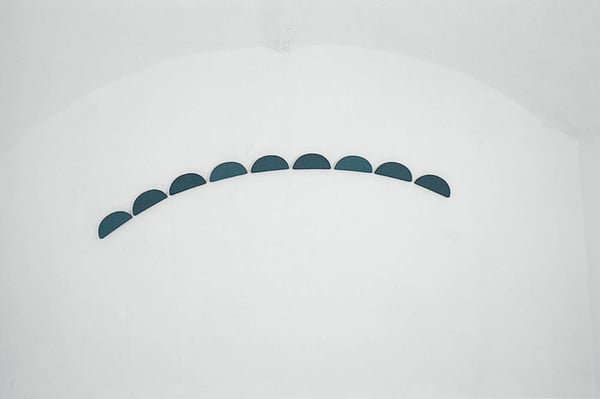
Within the rigorous framework of Minimalism, Pino Pinelli’s Pittura GR holds a distinct significance, exemplifying the Italian strain of the movement known as Pittura Analitica (Analytical Painting). Unlike the cool, industrial anonymity of American Minimalists, Pinelli’s work interrogates the very essence of painting itself—its objecthood, its material presence, and its relationship to the wall and the viewer.
Key aspects of its significance:
-
Deconstruction of the Support: Pinelli famously broke the rectangular canvas into multiple, autonomous fragments. Pittura GR likely consists of a scattered arrangement of small, irregularly shaped monochrome elements. This strategy undermines the traditional “window” onto space, forcing the painting to become a literal object in the room, not an illusion.
-
Monochrome as Pure Sensation: The “GR” in the title likely references a specific pigment or tone (e.g., grigio or a color code). Pinelli’s monochromes are never flat—they are highly tactile, built up with dense layers of acrylic or mixed media. The surface becomes a repository of gesture and time, inviting a prolonged, meditative gaze.
-
Challenging the Frame: By placing his painted forms directly on the wall—unglazed, unframed—Pinelli dissolves the boundary between the art object and its architectural context. The wall becomes an active part of the composition, and the painting’s “body” spreads into the space, resonating with the phenomenological concerns of Italian Arte Povera and early Conceptualism.
-
Radical Self-Reference: Pittura GR is ultimately a painting about painting. It strips away narrative, representation, and even the conventional shape of the support to focus on color, surface, and the elemental act of applying pigment. This makes it a crucial meditation on the limits and possibilities of the medium within the minimalist vocabulary.
In summary, Pittura GR is not merely a minimalist abstract work; it is a seminal example of how European artists pushed Minimalism toward a more existential and analytical dialogue with the history of painting itself, asserting that even in its most reduced state, painting remains a powerful, physical presence.
Genere
Stile
Visivamente simili
20 opere con composizione e palette affini
Intersuperficie curva bianca
Paolo Scheggi
Phases of the Moon
Maya Lin
Time
Alexander Liberman
Intersuperficie curva
Paolo Scheggi
Bliss Abyss
Amy Feldman
Trânsito Celeste
Eduardo Nery
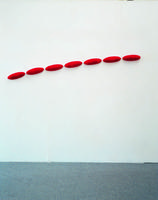
Pittura R
Pino Pinelli
Untitled
Marcelle Cahn
Constellation Twelve Circles
Leon Polk Smith
Untitled
John Armleder
Omega IX
Alexander Liberman
Blue and Orange
Ellsworth Kelly
Blue and Orange from Suite of Twenty-Seven Color Lithographs
Ellsworth Kelly
Phased Red
Thomas Downing
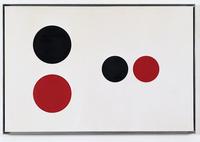
Revolving
Alexander Liberman
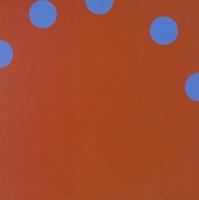
Hoop-La
Jeremy Moon
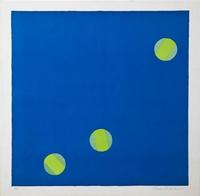
Untitled (blue with green circles)
Edward Avedisian
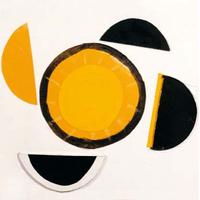
Yellow and Black
Terry Frost
Photo-souvenir: 1 carré = 1 cercle + 4 triangles, Hauts-reliefs situés H, travail situé
Daniel Buren
Omicron V
Alexander Liberman