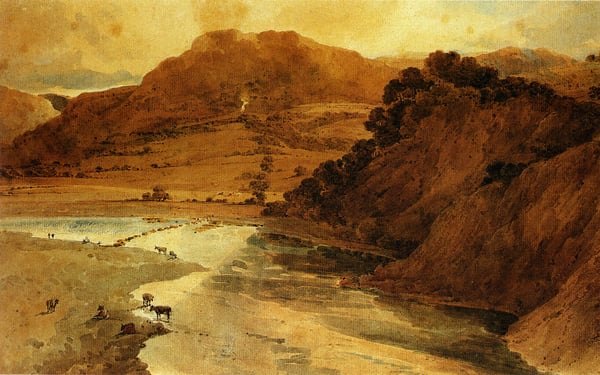
Near Bolton Abbey, Yorkshire
Expertenanalyse zu Thomas Girtins Near Bolton Abbey, Yorkshire
Stil: Romanticism · Genre: landscape
Expert Analysis: "Near Bolton Abbey, Yorkshire" by Thomas Girtin
Thomas Girtin’s Near Bolton Abbey, Yorkshire is a quintessential example of Romantic landscape painting, executed in the watercolor medium that Girtin helped elevate to a fine art in Britain. Though the scene depicts a specific location—the ruins of Bolton Abbey set within the sweeping Yorkshire countryside—Girtin’s treatment transcends topographical record. Instead, he transforms the landscape into a vessel for emotional and atmospheric expression, a hallmark of the Romantic spirit.
Significance of the Work
-
Pioneering Watercolor Technique: Girtin was a master of watercolor at a time when the medium was still often considered a secondary sketching tool. In this work, he uses broad, fluid washes of color—soft greens, muted blues, and warm earth tones—to capture the transient effects of light and weather. The ruins themselves are rendered with a delicate, almost suggestive touch, allowing the misty atmosphere to dominate. This approach challenged the more rigid, detailed topographical tradition and influenced contemporaries such as J.M.W. Turner, who famously said, “If Tom Girtin had lived, I should have starved.”
-
Romantic Sublime: The painting embodies the Romantic fascination with the sublime—a sense of awe mixed with gentle melancholy. The crumbling abbey stands as a weathered relic of medieval faith, now reclaimed by nature. Girtin’s soft, hazy treatment of the distant hills and the inclusion of a solitary figure (typical of his landscapes) invites the viewer to contemplate the passage of time, the fragility of human achievement, and the overwhelming beauty of the natural world. The composition draws the eye diagonally across the scene, guiding us from the shadowed ruins toward a luminous, open sky, creating a sense of spiritual yearning.
-
Emotional Landscape: Unlike earlier landscape art that often prioritized clarity and order, Girtin’s Near Bolton Abbey prioritizes mood. The palette is restrained yet rich, with a subtle harmony of greys, ochres, and sap greens that evoke a damp, atmospheric day. The lack of sharp outlines and the blending of earth and sky suggest that the landscape is not merely a backdrop but an active participant in an emotional narrative—one of solitude, reflection, and the quiet power of nature.
In summary, this work is significant not only for its technical innovation in watercolor but also for its embodiment of Romantic ideals: the elevation of emotion over fact, the celebration of nature’s grandeur, and the poetic evocation of history. Girtin’s delicate handling of light and atmosphere makes Near Bolton Abbey, Yorkshire a landmark in the development of the British Romantic landscape tradition.
Visuell ähnlich
20 Werke mit ähnlicher Komposition und Farbpalette
Matlock Tor by Daylight
Joseph Wright
Slate Quarries
John Crome
High Tor, Matlock
John Crome
Prudhoe Castle, Northumberland
J.M.W. Turner
View in Dovedale
Joseph Wright
Waterfalls at Tivoli
Franz Kaisermann
German landscape
Knud Baade
View in Matlock Dale, Looking Towards Black Rock Escarpment
Joseph Wright
Italian Landscape
Joseph Wright
Lake Scene, North Wales
David Cox
Southern Mountain Landscape
Adam Pynacker
Landscape with Sandpit
Thomas Gainsborough
Peace at Sunset (Evening in the White Mountains)
Thomas Cole
Flight into Egypt
Jan Asselijn
Classical Landscape
George Lambert
Ben Nevis and Mountain Stream
William Shayer
The Lledr Valley
David Bates
Passage at the ford
Hendrik Voogd
Shandaken Mountains
Asher Brown Durand
Landscape with Figures and a Tilted Cart, Matlock Hogh Tor in the Distance
Joseph Wright