Analisi esperta di A Dancer of Kyoto di Yamamura Toyonari
Stile: Sōsaku hanga · Genere: portrait
Expert Analysis: "A Dancer of Kyoto" by Yamamura Toyonari
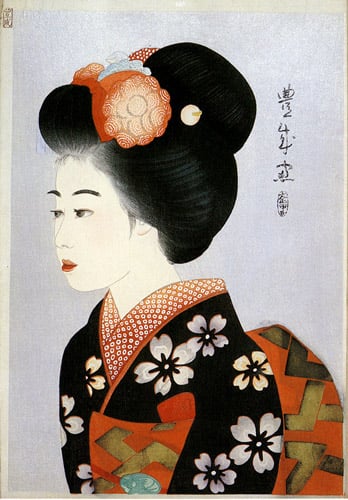
Yamamura Toyonari’s A Dancer of Kyoto is a seminal work within the Sōsaku hanga (creative print) movement, a modern Japanese printmaking style that emerged in the early 20th century. Unlike the traditional ukiyo‑e collaborative system (designer, carver, printer), Sōsaku hanga championed the artist as sole creator—carving and printing their own blocks to achieve a personal, expressive freedom. Toyonari, a central figure in this movement, brought a refined sensitivity to the portrait genre, blending the elegance of ukiyo‑e bijin‑ga (pictures of beautiful women) with a modern psychological depth.
Significance within the Style & Period
-
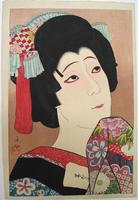
Innovation in Portraiture: Toyonari’s portrait transcends mere depiction. The dancer—likely a maiko or geiko of Kyoto—is rendered with delicate, subtle gradations of color and soft, almost impressionistic lines that convey not just her physical likeness but a sense of inner poise and quietude. This marks a departure from the more theatrical, idealized faces of earlier ukiyo‑e; Toyonari captures an individual moment of introspection, aligning with the Sōsaku hanga emphasis on personal expression.
-
Technical Mastery: The print demonstrates Toyonari’s expert command of kento registration and wood‑grain texture, hallmarks of self‑carved prints. His use of nuanced shading—particularly in the kimono’s layered patterns and the flesh tones—shows influence from Western chiaroscuro and Japonist soft‑focus photography, yet remains firmly rooted in Japanese material sensibility. This synthesis was pioneering in the 1920s–1930s, when Sōsaku hanga artists sought to modernize woodblock printing while retaining its tactile charm.
-
Cultural Bridging: Kyoto’s “dancer” evokes the city’s as‑aesthetic heritage, but Toyonari presents her free from nostalgic cliché. Instead, she becomes a symbol of quiet modernity—an embodiment of the movement’s goal to honor tradition while asserting the artist’s independent vision. In this way, A Dancer of Kyoto is both a refined portrait and a manifesto of artistic autonomy, making it a key work in the evolution of Japanese printmaking from craft to fine art.
Visivamente simili
20 opere con composizione e palette affini
Ichikawa Shocho II as Oman
Yamamura Toyonari
Sawamura Sonosuke I as Umegawa
Yamamura Toyonari
Misty Spring
Torii Kotondo
Bijin
Kiyokata Kaburagi
Geisha by Brazier
Shotei Takahashi
A Tipsy Geisha
Torii Kotondo
Preparing Her Sash
Torii Kotondo
Preparing Her Sash (blue variant)
Torii Kotondo
Bijin holding a flower pot
Toyohara Chikanobu
Gion no Nakako
Natori Shunsen
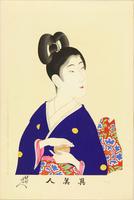
A beauty holding a ball
Toyohara Chikanobu
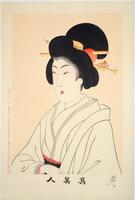
True Beauties
Toyohara Chikanobu
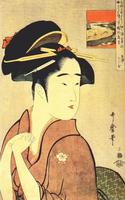
The geisha kamekichi
Kitagawa Utamaro
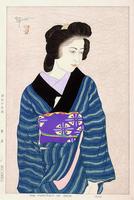
The Portrait of Okoi
Paul Jacoulet
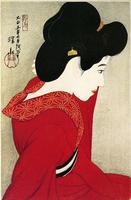
Before the Mirror
Ito Shinsui
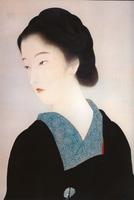
Untitled
Kiyokata Kaburagi
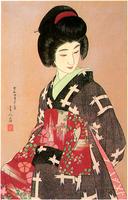
Preparing Her Sash (gray variant)
Torii Kotondo
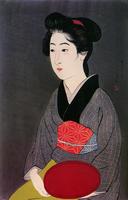
Woman Holding Tray
Goyo Hashiguchi
Nakamura Fukusuke as Ohan
Natori Shunsen
Large Head and Bust Portrait of Beauty
Kitagawa Utamaro