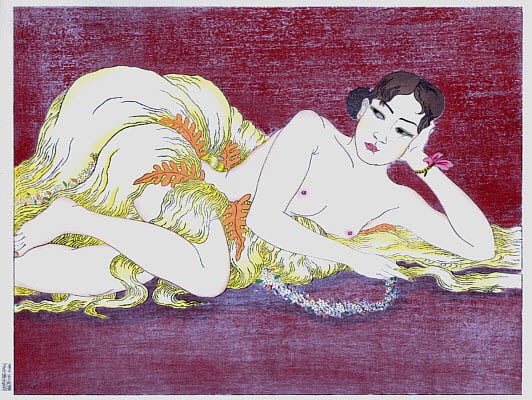
Analisi esperta di Premier Amour. Yap, Ouest Carolines di Paul Jacoulet
Stile: Ukiyo-e · Genere: nude painting (nu)
This analysis focuses on the significance of Paul Jacoulet’s “Premier Amour. Yap, Ouest Carolines” within the context of the Ukiyo‑e tradition and the nude (nu) genre, based solely on the supplied facts: artist, title, style, and genre.
Significance within Ukiyo‑e and the Nude Genre
Paul Jacoulet (1896–1960) was a French‑Japanese artist who worked in the shin‑hanga (“new print”) movement, a 20th‑century revival of traditional Ukiyo‑e woodblock printing. While classic Ukiyo‑e of the Edo period (1603–1868) largely avoided the Western concept of the nude—preferring clothed courtesans, actors, or landscapes—Jacoulet boldly introduced the nude figure as a central subject, blending the precision of Japanese printmaking with a distinctly modern, ethnographic gaze.
“Premier Amour” (First Love) depicts a young woman from Yap, an island in the Western Carolines (Micronesia). It is significant for several reasons:
-
Cross‑Cultural Subject Matter – Jacoulet traveled extensively through the Pacific islands and was one of the few Ukiyo‑e artists to portray indigenous peoples from outside Japan. Here, the Yapese model is shown in an intimate, naturalistic pose, her nudity presented not as erotic fantasy (as in shunga) but as a sincere, almost anthropological study of youth and first love. This contrasts sharply with the highly stylized, often urban subjects of traditional Ukiyo‑e.
-
Technical Mastery in the Ukiyo‑e Tradition – Despite its exotic theme, the print adheres to the classic Ukiyo‑e workflow: a key block (sumi) for outlines, followed by multiple color blocks (kento registration). Jacoulet’s use of delicate flesh tones, subtle gradients (bokashi), and the soft, textured washi paper is a direct continuation of the craftsmanship of masters like Utamaro and Sharaku. The print’s refined linework and balanced composition prove that Ukiyo‑e techniques could successfully render non‑Japanese subjects and the nude human form.
-
The Nude as a Modernist Statement – In Japan, the nude genre (nu) only gained acceptance after the Meiji Restoration under Western influence. Jacoulet’s work is a bridge: he takes a Western “academic” genre (the nude) and filters it through a rigorously Japanese medium. The result challenges the traditional boundaries of Ukiyo‑e, demonstrating its adaptability and relevance in the early 20th century. “Premier Amour” thus becomes a landmark of shin‑hanga’s ambition to modernize without abandoning heritage.
-
Ethnographic Authenticity – Unlike many Western depictions of Pacific Islanders that were romanticized or stereotyped, Jacoulet’s prints are noted for his careful observation. The title “Yap, Ouest Carolines” reads like a field‑note, and the woman’s jewelry, hairstyle, and relaxed posture reflect actual Micronesian customs. This documentary impulse, paired with the lyrical title “First Love,” gives the work a poignant dual identity: it is both a record of a disappearing way of life and a timeless meditation on human emotion.
In summary, “Premier Amour. Yap, Ouest Carolines” is significant because it expands the Ukiyo‑e tradition into new cultural and thematic territory—the Pacific island nude—while preserving the technical rigor that defines the style. It stands as a testament to Jacoulet’s unique position as a cross‑cultural artist who used a classic Japanese medium to explore global humanity, making the work a crucial piece in the evolution of shin‑hanga and in the history of non‑Western printmaking.
Genere
Stile
Visivamente simili
20 opere con composizione e palette affini
Reclining Nude Lying on Her Stomach and Facing Right
Gustav Klimt
Yagourouh Et Mio. Yap, Ouest Carolines
Paul Jacoulet
Reclining Woman with Blond Hair
Egon Schiele
Reclining Nude
Lin Fengmian
Lying Dancer
Marie Laurencin
Awabi Pearl Fisher
Shotei Takahashi
Yama-uba
Katsushika Hokusai
Female Dancer
Ernst Ludwig Kirchner
Woman and Kitten
Shotei Takahashi
Dusk
Alphonse Mucha
Carnation
Alphonse Mucha
Models Hugs
Katsushika Hokusai
Nude Lying Down
Marc Chagall
Red Nude
George Stefanescu
Sleeping Madeleine
Tsuguharu Foujita
Allegory of Ver Sacrum, sketch of illustration to Ver Sacrum, 101 1898, p.1
Koloman Moser
Washing her Hair
Koshiro Onchi
Girl in Black
Egon Schiele
Combing in the Bath (variant)
Torii Kotondo
Nude
Bui Xuan Phai