Expert analysis of Edward Wadsworth’s Satellitium
Style: Surrealism · Genre: landscape
Expert Analysis of Satellitium (c. 1935) by Edward Wadsworth
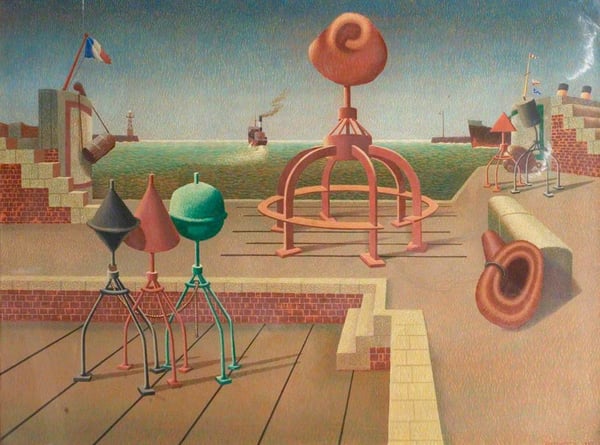
Edward Wadsworth’s Satellitium occupies a distinctive place within Surrealist landscape painting, bridging the mechanistic precision of his earlier Vorticist training with the dreamlike dislocations of the Surrealist movement. The work is significant for its fusion of industrial geometry and enigmatic cosmic imagery, a synthesis that sets it apart from the more overtly biomorphic or psychological Surrealism of contemporaries like Dalí or Miró.
Composition and Style: The landscape is rendered with Wadsworth’s hallmark technical mastery—the use of tempera on gesso ground yields a matte, luminous surface that suggests both the cold clarity of machinery and the eerie stillness of a hallucination. Known for his fascination with nautical and maritime forms (stemming from his World War I dazzle-camouflage work), Wadsworth here translates ship fittings, buoys, and astrolabes into a cryptic celestial theater. The title Satellitium (a Latin term for a group of satellites or attendants) implies a system of orbiting objects, each isolated yet held in a silent, gravitational tension. The composition likely arrays these hybrid forms across a barren, beach-like or lunar foreground under an icy sky—a landscape emptied of narrative but charged with the uncanny.
Significance within Surrealism: Wadsworth’s contribution lies in his industrial surrealism, where the unconscious is not revealed through organic mutation but through the detachment of precise, man-made objects from their function. Unlike the soft, melting clocks of Dalí, Wadsworth’s objects remain hard, rational, and tangible—yet their arrangement defies logic, creating a sterile, haunting poetry. This approach aligns with British Surrealism’s tendency toward cool, observed madness rather than continental exuberance. Satellitium also prefigures later developments in metaphysical and hyperrealist painting, where the tension between the real and the imagined is sustained by a flawless, cold technique.
Legacy: As one of the few British artists to embrace Surrealism without abandoning constructivist geometry, Wadsworth’s Satellitium demonstrates how the movement could absorb the aesthetics of modernity—naval architecture, navigation, and mechanical design—and transform them into portals to the irrational. The work remains a crucial example of Surrealism’s capacity to find the marvelous not in the exotic, but in the everyday made strange through exacting craftsmanship.
Genre
Style
Visually similar
20 works with related composition and palette
Signals
Edward Wadsworth
Departure
Edward Wadsworth
Hydrometric Demonstration
Max Ernst
Frontal Setting
Leonid Sejka
Frontalna Postavka
Leonid Šejka
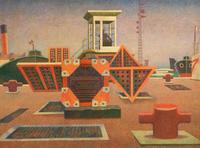
Imaginary Harbour II
Edward Wadsworth

The Alchemist
Salvador Dali
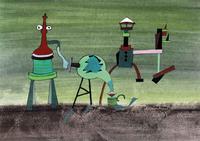
Harum-Scarum
Conroy Maddox
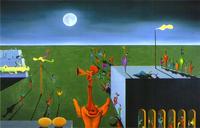
The Red Guard
Desmond Morris

Cicero
Rene Magritte
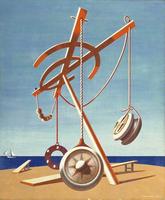
Souvenir of Fiumicino
Edward Wadsworth
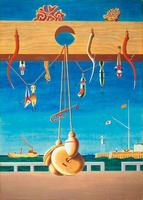
The First of the Ebb, the Sailor and the Sea
Edward Wadsworth
Flower of Dreams
Stanisław Szukalski

Marfruit
Modest Cuixart
Untitled
Leonid Sejka
The Mysterious Bath
Giorgio de Chirico

Sand Dune
Francis Bacon
Nine malice moulds
Marcel Duchamp
Rencontre mecanique
Jules Perahim
Figurines in Space: Study for the Triadic Ballet
Oskar Schlemmer