Expert analysis of James Barry’s Crowning the Victors at Olympia
Style: Neoclassicism · Genre: allegorical painting
Expert Analysis of Crowning the Victors at Olympia (c. 1777–1783) by James Barry
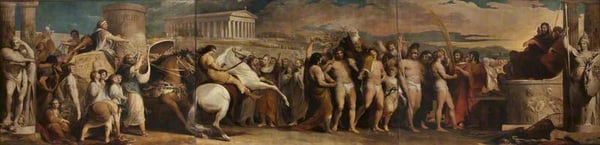
As a Neoclassical allegorical painting, Crowning the Victors at Olympia stands as a landmark of British history painting and a masterful synthesis of classical ideals, moral instruction, and civic humanism. James Barry, an Irish-born painter and fervent advocate for a grand style of art, created this work as part of his monumental series The Progress of Human Culture for the Great Room of the Royal Society of Arts in London. This ambitious cycle was intended to elevate the status of British art by rivaling the narrative cycles of the Italian Renaissance and the moral allegories of the French Neoclassicists.
Significance within Neoclassicism and the Period
Barry’s painting exemplifies the core Neoclassical preoccupation with antiquity as a source of timeless virtue and rational order. Crowning the Victors at Olympia depicts the ancient Greek Olympic games—an idealised scene from classical history—where athletes are crowned with laurel wreaths, surrounded by philosophers, poets, and citizens. The composition is rigorously structured: figures are arranged in a frieze-like manner across the foreground, evoking classical relief sculpture, while the architecture in the background echoes Doric temples. This geometric clarity and emphasis on contour over painterly atmosphere are hallmarks of the Neoclassical style, which Barry championed in opposition to the Rococo’s frivolity and the Baroque’s emotional excess.
What makes this work particularly significant is its overtly didactic purpose. Barry used allegory to convey the Enlightenment belief that the pursuit of excellence in arts, sciences, and athletics was essential to the progress of civilization. The victors are not merely athletes but symbols of human achievement rewarded by wise elders—including Socrates and Homer—thereby linking physical prowess to intellectual and moral virtue. This fusion of allegory with history painting was a deliberate strategy to educate the public and inspire civic duty, a central aim of Neoclassical art.
Barry’s Unique Contribution
Unlike many Neoclassical artists who looked to Rome or France for inspiration, Barry infused his allegories with a distinctly British republican spirit. Crowning the Victors at Olympia was painted at a time when Britain was debating national identity and the role of the arts in society. Barry’s series was unprecedented in scale and ambition for a British artist—he worked on the RSA cycle for seven years without pay, driven by a utopian belief in art’s power to reform society. The painting’s significance also lies in its defiance of the contemporary market: Barry rejected the portrait-painting that dominated British patronage in favor of complex historical allegories, a stance that aligned him with the radical ideals of the French Revolution era.
In summary, Crowning the Victors at Olympia is significant as a bold assertion of Neoclassicism’s moral and civic function, executed with rigorous classical form. It remains a testament to James Barry’s visionary attempt to fuse ancient Greek ideals with Enlightenment progress, making it a key work in the history of British allegorical painting and a vivid example of how Neoclassical art could serve as a vehicle for humanist reform.
Visually similar
20 works with related composition and palette
Jesus healing the servant of a Centurion
Paolo Veronese
Moses Striking Water from the Rock
Jacob Jordaens
Elysium, or the State of Final Retribution
James Barry
The Birth of the Virgin
Jacques Stella
The Martyrdom of St Lawrence
Palma il Giovane
Rinaldo and Armida
Nicolas Poussin
Let the little children come to me
Adam van Noort
Miracle of St. Francis
Peter Paul Rubens
L'imperatore Eraclio Riporta La Croce Al Calvario
Palma il Giovane
The Descent of Manna
Palma il Giovane
Moses on Mount Sinai
Daniele da Volterra
The Pool of Bethesda
William Hogarth
Battle of Asola
Tintoretto
The Passing of Venus
Edward Burne-Jones
The Miracle of St Agnes
Tintoretto
Sant'elena Ritrova La Vera Croce
Palma il Giovane
Christ's Charge to St. Peter (cartoon for the Sistine Chapel)
Raphael
Martyrdom of Saint George
Paolo Veronese
The Baptism of Constantine
Raphael
Court of Death
George Frederick Watts