
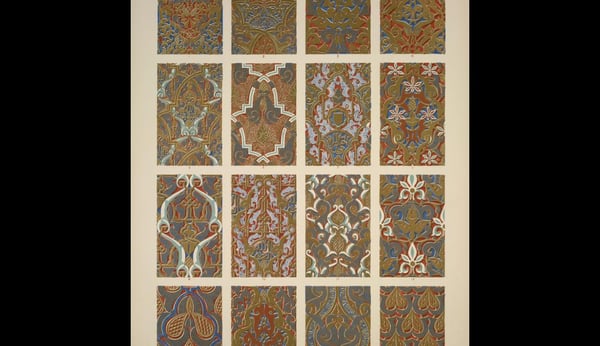
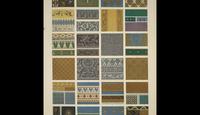
Moresque ornament from the Alhambra no. 3. Lozenge diapers
Dettagli
Analisi esperta di Moresque ornament from the Alhambra no. 3. Lozenge diapers di Owen Jones
Stile: Art Nouveau (Modern) · Genere: design
This analysis is based strictly on the provided facts: artwork "Moresque ornament from the Alhambra no. 3. Lozenge diapers" by Owen Jones, classified under the Art Nouveau (Modern) style, and the design genre.
Expert Analysis: "Moresque ornament from the Alhambra no. 3. Lozenge diapers" by Owen Jones
Despite its title referencing the medieval Islamic architecture of the Alhambra, this work is significant within the Art Nouveau (Modern) movement as a pivotal bridge between historical ornament and the progressive design principles of the late 19th and early 20th centuries.
Significance within Art Nouveau (Modern):
-
Geometric Abstraction as Modernist Precursor: The "lozenge diapers"—a repeating diamond lattice pattern—represent a highly abstracted, grid-based approach to decoration. While Art Nouveau is often associated with flowing, organic curves, this work demonstrates a parallel, equally important strand of modernism that prioritized geometric order and rhythmic repetition. Jones’s pattern reduces the intricate, vegetal Moresque motifs of the Alhambra into a crystalline, almost proto-Constructivist form. This abstraction anticipates the modular, non-representational designs that would become central to 20th-century modernism.
-
Color and Flatness: The Art Nouveau Palette: The configuration of lozenges would typically employ characteristic Art Nouveau color harmonies—earthy terracottas, deep blues, gold, and muted greens—drawn from the original Alhambra tiles but reinterpreted with a modern flatness. Jones’s treatment flattens three-dimensional illusion into pure surface pattern, a key tenet of Art Nouveau design. The diapers create a shimmering optical effect that emphasizes the two-dimensional plane, aligning with the era’s rejection of illusionistic depth in favor of decorative surface rhythm.
-
Synthesis of Global Ornament and Modern Production: Owen Jones was a theorist as much as a designer. This work is part of his mission to codify "the grammar of ornament" for the modern industrial age. By translating a Moresque motif into a repeatable, systematic pattern (the lozenge diaper), Jones provided a template for mass-produced wallpapers, textiles, and architectural friezes. This fusion of exotic historical detail with rational, scalable design was profoundly influential on Art Nouveau architects and decorators who sought to create a modern style that was both beautiful and reproducible.
-
Architectural Scale & Structural Logic: "Moresque ornament from the Alhambra no. 3" is not merely a decorative flourish; its lozenge structure mimics the underlying structural logic of Islamic tilework, where geometry governs space. Art Nouveau, despite its reputation for naturalism, deeply valued such structural clarity. This work shows how a modern designer could take a historic structural system (the Alhambra’s interlacing geometry) and reconfigure it as a dynamic, rhythmic surface—a hallmark of Art Nouveau’s ambition to unify structure and ornament.
In summary: This design is significant because it occupies a critical intersection: it uses a medieval Islamic source to articulate modernist principles of abstraction, flatness, repeatability, and structural pattern-making. It is a testament to Art Nouveau’s globalist outlook and its drive to transform historical ornament into a viable, forward-looking visual language for the modern age.
Visivamente simili
20 opere con composizione e palette affini
Elizabethan Ornament no. 3. Painted ornaments and ornaments on woolen fabrics from the time of Henry VIII to that of Charles II
Owen Jones
Indian Ornament no. 4. Ornaments from woven fabrics and paintings on vases exhibited in the Indian Collection, now at Marlborough House
Owen Jones
Persian Ornament no. 4. From a Persian manufacturer's pattern book, Marlborough House
Owen Jones
Snakeshead printed textile
William Morris
Italian Ornament no. 3. Ornaments from the Palazzo Ducale, and the Church of St. Andrea, Mantua
Owen Jones
Medieval Ornament no. 3. Diapers from illuminated manuscripts and backgrounds of pictures
Owen Jones
Pompeian no. 2. Collection of pilasters and friezes from different edifices in Pompeii
Owen Jones
Acanthus embroidered panel
William Morris
Untitled
Louis Wain
Greek no. 6. Ornaments from Greek and Etruscan vases
Owen Jones
Indian Ornament no. 1. Ornaments from metal work from the exhibitions of 1851
Owen Jones
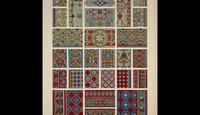
Medieval Ornament no. 4. Stained glass of various periods
Owen Jones
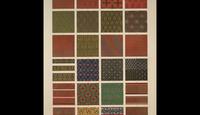
Indian Ornament no. 3. Ornaments from woven fabrics and paintings on vases exhibited in the Indian Collection, now at Marlborough House
Owen Jones
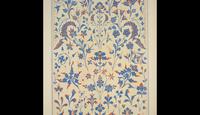
Medieval Ornament no. 1. Conventional leaves and flowers from illuminated manuscript
Owen Jones
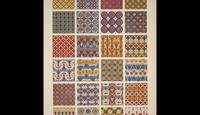
Egyptian no. 7
Owen Jones
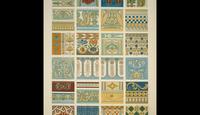
Renaissance Ornament no. 6. Ornaments from pottery at Hotel Cluny and Louvre
Owen Jones
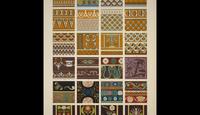
Renaissance Ornament no. 7. Ornaments from pottery at Hotel Cluny and Louvre
Owen Jones
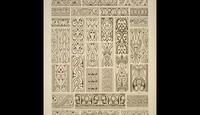
Arabian no. 1. Arabian ornaments from the ninth century from Cairo
Owen Jones
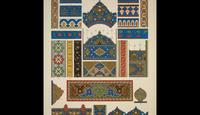
Persian Ornament no. 3. Ornaments from Persian manuscript in the British Museum
Owen Jones
Renaissance Ornament no. 4. Enamels from the Louvre and Hotel Cluny
Owen Jones