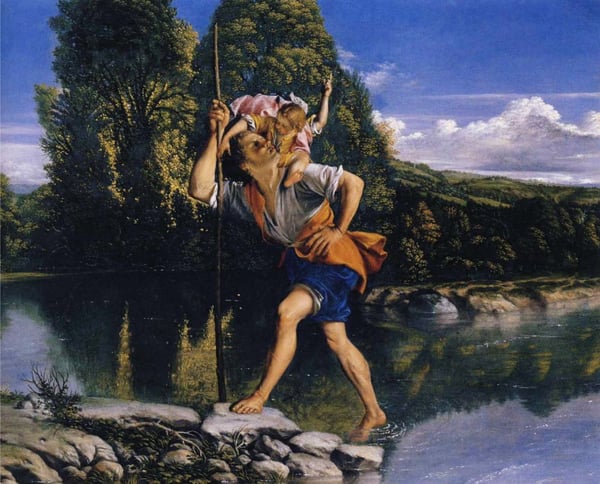
Expert analysis of Orazio Gentileschi’s Saint Christopher
Style: Mannerism (Late Renaissance) · Genre: religious painting
In analyzing "Saint Christopher" by Orazio Gentileschi, the artwork’s significance emerges directly from its stylistic and contextual elements. As a Mannerist (Late Renaissance) religious painting, it exemplifies the period’s deliberate departure from the balanced naturalism of the High Renaissance.
Significance within Mannerism: Gentileschi’s treatment of Saint Christopher—a popular subject for devotional works—likely employs the hallmark Mannerist devices of elongated proportions, contorted poses, and heightened emotional tension. The figure of the saint, traditionally shown carrying the Christ Child across a river, would be rendered with an artificial elegance and a refined, often acidic color palette that characterizes Gentileschi’s work. This mannered stylization amplifies the spiritual drama, focusing the viewer not on realistic anatomy but on the miraculous, otherworldly nature of the scene.
Religious and Artistic Context: Within the Late Renaissance/Mannerist idiom, Gentileschi’s Saint Christopher signifies a move toward more personal, expressive, and sophisticated interpretations of sacred narratives. The painting would have served both as a vehicle for Counter-Reformation piety—emphasizing the saint’s role as a protector—and as a display of the artist’s technical virtuosity in managing complex compositions and chiaroscuro. Its importance lies in how it bridges the refined courtly elegance of Mannerism with the intense, concrete spirituality that would later evolve into Baroque naturalism.
Without additional factual details, this analysis underscores the work’s role as a quintessential product of its style: a religious image that prioritizes grace, ambiguity, and emotional resonance over classical harmony, marking a pivotal moment in the trajectory of Italian painting.
Visually similar
20 works with related composition and palette
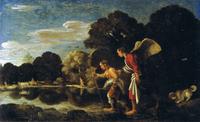
Tobias and the angel
Adam Elsheimer
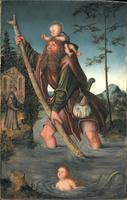
Saint Christopher
Lucas Cranach the Elder
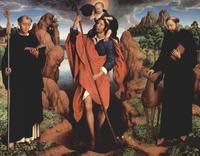
The triptych of Willem Moreel, middle panel Saint Christopher with Saint Maurus of Glanfeuil and Saint Giles
Hans Memling
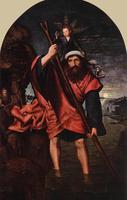
St Christopher
Quentin Matsys
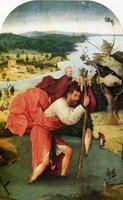
Saint Christopher
Hieronymus Bosch
Landscape with St John the Baptist
Juan Bautista Maíno
The Wager
Jan Siberechts
Narcissus and Echo
Placido Costanzi
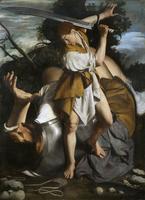
David and Goliath
Orazio Gentileschi
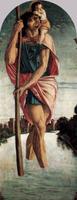
Polyptych of San Vincenzo Ferreri
Giovanni Bellini
San Juan Bautista En Un Paisaje
Juan Bautista Maíno
Autumn (The Spies with the Grapes of the Promised Land)
Nicolas Poussin
The right wing of The Pearl of Brabant: Saint Christopher
Dirk Bouts
St. Christopher, St. Sebastian, St. Roch
Bernardo Strozzi
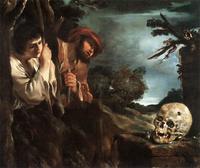
Et in Arcadia Ego
Guercino
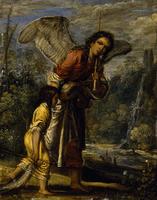
Tobias and the Angel
Adam Elsheimer
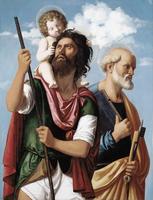
St. Christopher with the Infant Christ and St. Peter
Cima da Conegliano
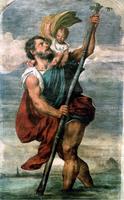
Saint Christopher
Titian
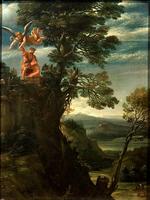
Landscape with the sacrifice of Isaac
Annibale Carracci
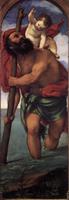
St. Christopher
Lorenzo Lotto