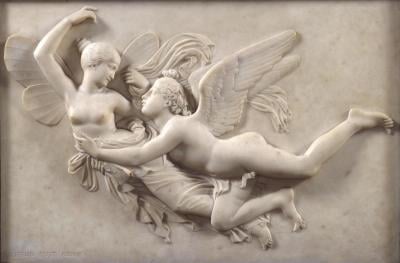
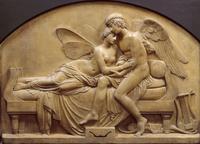
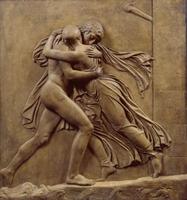
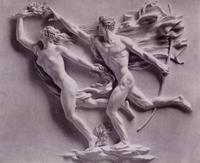
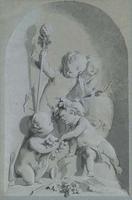
John Gibson’s Cupid pursuing Psyche is a significant example of Neoclassical sculpture, a style that sought to revive the clarity, order, and idealized beauty of classical antiquity. In this work, Gibson captures a mythological narrative—the god Cupid chasing the mortal Psyche—through a composition that balances dynamic movement with serene, restrained emotion, hallmarks of Neoclassicism. The sculpture’s importance lies in how it embodies the era’s ideals: a timeless, heroic subject rendered with polished surfaces, anatomical precision, and a sense of poised tension rather than theatrical drama. By focusing on a moment of pursuit rather than climax, Gibson demonstrates the Neoclassical emphasis on narrative restraint and formal harmony, elevating a mythological chase into a study of grace and idealized human form.