Expertenanalyse zu Paul Gauguins The cliffs of Le-Bouille
Stil: Impressionism · Genre: landscape
Expert Analysis: "The Cliffs of Le-Bouille" by Paul Gauguin
Style: Impressionism | Genre: Landscape | Period: Early Works
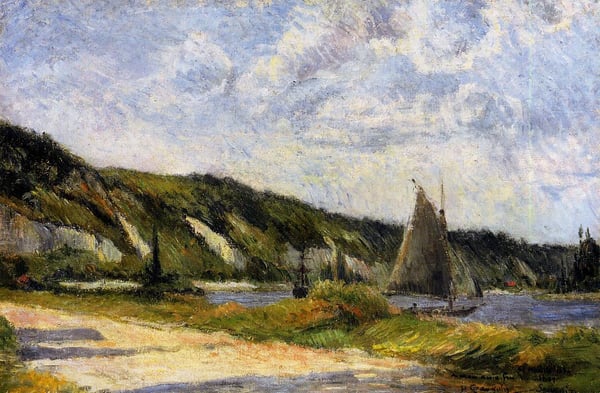
Paul Gauguin’s The Cliffs of Le-Bouille stands as a revealing early chapter in an artist who would later redefine modern painting. Executed during his formative years, this landscape encapsulates the core tenets of Impressionism—plein air observation, broken brushwork, and a luminous palette—while hinting at the expressive boldness to come.
Significance within Gauguin’s Early Period
At this stage, Gauguin was still absorbing the lessons of Camille Pissarro and the Impressionist circle, having left his career as a stockbroker to pursue painting full-time. The Cliffs of Le-Bouille demonstrates his commitment to capturing transient outdoor effects: the interplay of light on rocky coastal forms, the shifting tones of sea and sky, and the atmospheric moisture typical of the Normandy coast. The work is significant because it shows Gauguin mastering the Impressionist visual language—short, visible strokes, a high-key palette, and a focus on perceived sensation rather than academic detail—before he would later rebel against naturalism in favor of symbolic color and flattened form.
Art-Historical Context
As an early work, this painting helps trace Gauguin’s trajectory from the moderate Impressionism of the 1870s–1880s toward his eventual Post-Impressionist and Synthetist breakthroughs. It anchors his foundational training in direct observation, a discipline he would later transform into a vehicle for spiritual and emotional expression. The choice of a clifftop landscape also prefigures his lifelong attraction to rugged, elemental environments (Brittany, Martinique, Tahiti) as stages for exploring humanity’s connection to nature.
What Makes It Significant
- Transitional moment: Few early Gauguin landscapes survive, making this a valuable document of his initial artistic identity.
- Impressionist orthodoxy: The work perfectly exemplifies the style’s interest in fleeting atmospheric conditions and the dissolution of form into luminous color.
- Foreground of innovation: While not radical, it shows Gauguin’s swift absorption of the most progressive art of his time—a necessary prelude to his later rejection of naturalism.
In The Cliffs of Le-Bouille, we see an Impressionist work that is both a faithful product of its era and a quiet harbinger of the revolutionary artist Gauguin would soon become.
Museum / Gallery
Visuell ähnlich
20 Werke mit ähnlicher Komposition und Farbpalette
Fishing Boats by the Beach and the Cliffs of Pourville
Claude Monet
On the Hudson, near Dobb's Ferry
Louis Comfort Tiffany
Banks of a River with Barge
Camille Pissarro
The Dunes at Etaples
Eugene Boudin
Regatta at Sainte-Adresse
Claude Monet
The Estuary of the Siene
Claude Monet
The Banks of the Oise
Alfred Sisley
Alley near Pourville
Claude Monet
The fishing fleet of Veere
Jan Toorop
Cherbourg
Eugene Boudin
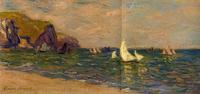
Sailboats at Sea, Pourville
Claude Monet
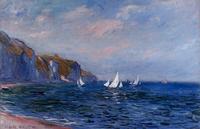
Cliffs and Sailboats at Pourville
Claude Monet
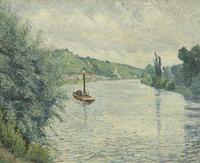
La Frette
Lucien Pissarro
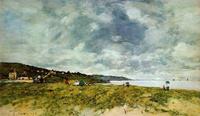
The Shore at Tourgeville
Eugene Boudin
The Seine at Saint Cloud
Alfred Sisley
Volga near Gorodets
Aleksey Savrasov
Sailboats at Argenteuil
Pierre-Auguste Renoir
The Port of Trouville
Eugene Boudin
The Fisherman, Low Tide
Eugene Boudin
Riverbank at Veneux
Alfred Sisley