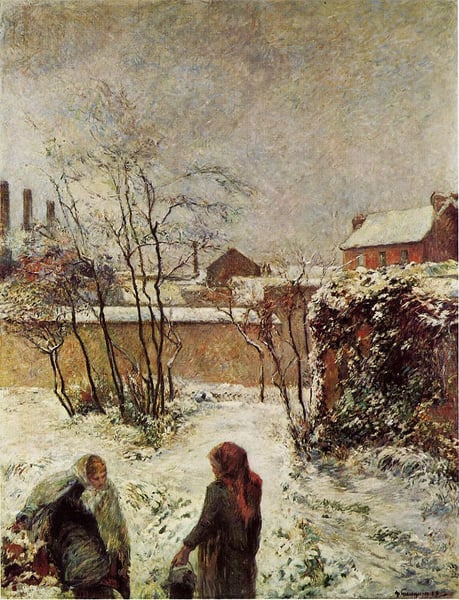
The garden in winter, rue Carcel
Details
Expertenanalyse zu Paul Gauguins The garden in winter, rue Carcel
Stil: Impressionism · Genre: cityscape
Expert Analysis: "The garden in winter, rue Carcel" by Paul Gauguin
Style: Impressionism | Genre: Cityscape | Period: Early Works
This early work by Paul Gauguin – painted while he was still a part-time artist working as a stockbroker – offers a rare glimpse into his formative years before he abandoned Paris for the South Seas. Created around the time Gauguin was absorbing Impressionist principles under the mentorship of Camille Pissarro, the painting depicts a winter view from his home on Rue Carcel in the quiet 14th arrondissement.
What makes it significant:
-
A bridge between Impressionism and Gauguin’s later symbolism.
The subject – a modest city garden in winter – is thoroughly Impressionist in its focus on everyday urban life and atmospheric effects. Yet Gauguin already shows a tendency toward flattening space and simplifying forms, particularly in the stark bare trees and the muted, almost melancholic palette of grays, browns, and pale blue-greens. This hints at the synthetic style he would develop in Pont-Aven and later in Tahiti. -
Early evidence of Gauguin’s distinctive color handling.
Unlike the bright, broken brushwork of his contemporaries Monet or Renoir, Gauguin applies color in broader, more even patches. The snow-covered ground is rendered in off-white and pale lavender, while the shadowed areas of the garden wall are compressed into deep violet. This prefigures his later use of color not to imitate nature but to express mood and structure. -
A rare document of Gauguin’s domestic environment.
The painting records the actual view from his home at 8 Rue Carcel, a modest house with a garden that Gauguin maintained while working in finance. It is one of the few surviving cityscapes from his early period, offering insight into the transitional moment when he was still balancing bourgeois life with artistic ambition. -
Demonstrates the influence of Pissarro and Cézanne.
The structured layout of the garden – with its clear foreground, midground garden wall, and soft, hazy background – reflects Pissarro’s influence on Gauguin’s sense of composition. At the same time, the geometric simplification of the house and the dense, unmodulated brushwork in the foliage echo Cézanne’s early approach to landscape, foreshadowing Gauguin’s eventual shift toward flat, symbolic imagery.
In context:
“The garden in winter, rue Carcel” stands as a crucial early marker in Gauguin’s evolution. It shows an artist still rooted in Impressionist observation but already pushing toward a more abstract, emotive use of line and color. The work is significant not for its breakthrough innovation but for revealing the embryonic stage of one of modern art’s most influential figures – a painter on the cusp of leaving behind the city garden for the mythic South Seas.
Museum / Gallery
Visuell ähnlich
20 Werke mit ähnlicher Komposition und Farbpalette
The Effect of Snow at Montfoucault
Camille Pissarro
The Parsonage Garden at Nuenen in the Snow
Vincent van Gogh
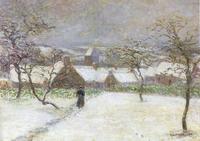
Path in the Snow
Gustave Loiseau
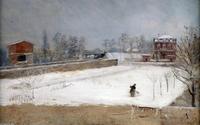
Winter landscape
Giuseppe De Nittis
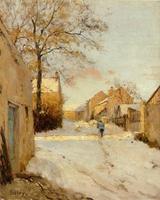
A Village Street in Winter
Alfred Sisley
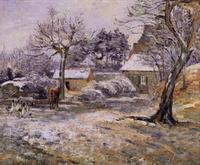
Snow at Montfoucault
Camille Pissarro
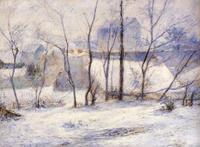
Winter Landscape
Paul Gauguin
Snow Effect with Setting Sun
Claude Monet
Snow Effect with Setting Sun
Claude Monet
A Cottage in the Snow
Camille Pissarro
Lower Norwood
Camille Pissarro
House in Snow
John Henry Twachtman
Garden in Louveciennes in the Snow
Alfred Sisley
Snow Effect, The Street in Argentuil
Claude Monet
The Road from Versailles to Saint Germain, Louveciennes. Snow Effect
Camille Pissarro
Winter at Barbizon
Ion Andreescu
Louveciennes Road Snow Effect
Camille Pissarro
The Road from Versalles to Saint Germain at Louveciennes
Camille Pissarro
Snow Scene at Argenteuil
Claude Monet
Garden under Snow
Paul Gauguin