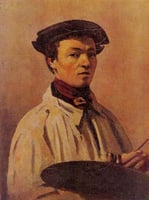
Head of Bearded Man (Study for The Baptism of Christ )
Details
Expertenanalyse zu Camille Corots Head of Bearded Man (Study for The Baptism of Christ )
Stil: Romanticism · Genre: landscape
Analysis of "Head of Bearded Man (Study for The Baptism of Christ)" by Camille Corot
This work presents a fascinating intersection of apparent contradictions—a figure study by an artist celebrated for landscapes, executed within the Romantic tradition yet serving as preparation for a religious composition. Despite the supplied genre note of "landscape," the painting itself is a focused portrait study, which highlights Corot’s meticulous preparatory process and his ability to imbue even a fragmentary sketch with emotional weight.
Significance within Romanticism
Romanticism prized subjective emotion, the sublime, and the artist’s personal vision over rigid classical ideals. Corot’s study exemplifies these values in several ways:
- Expressive handling of light and shadow: The bearded man’s face is modeled with soft, atmospheric chiaroscuro that suggests inner contemplation rather than heroic clarity. The play of light across the brow and beard evokes a sense of reverie—a hallmark of Romantic introspection.
- Emphasis on human vulnerability: Rather than presenting an idealized Christ or saint, Corot captures a weathered, mortal face. The furrowed brows and shadowed eyes convey weariness and spiritual depth, aligning with Romanticism’s fascination with the individual’s struggle and transcendence.
- Sketch-like immediacy: The loose, visible brushwork and unfinished quality preserve the energy of a live study. This spontaneity was prized by Romantic artists who saw raw technique as a window into the artist’s emotional state.
Context within Corot’s Career
Corot is best known as a pioneering landscape painter of the Barbizon school, but this study for The Baptism of Christ (a religious commission) reveals his versatility. The work is significant because it demonstrates how Corot—often classified as a proto-Realist or Romantic landscapist—approached narrative painting. The bearded head is likely a study for a saint or John the Baptist, and its earthy humanity anticipates the naturalism that would later define his landscapes. The transition from figure study to landscape is not a contradiction but a consistent search for truth: Corot treats the human face with the same sensitivity to atmosphere and light as he would a tree or a hill.
Art Historical Importance
This study offers a rare glimpse into Corot’s working method. Unlike his polished, silvery finished landscapes, this head is boldly painted with thick impasto and vigorous strokes. It shows the artist practicing the very core of Romantic expression—the belief that a single, thoughtful face can carry the weight of an entire biblical narrative. In its intimate scale and haunting gaze, the Head of Bearded Man stands as a testament to Corot’s ability to find the universal in the particular, bridging the gap between landscape’s atmospheric calm and Romanticism’s emotional urgency.
Museum / Gallery
Visuell ähnlich
20 Werke mit ähnlicher Komposition und Farbpalette
Ravine near Branchville
Julian Alden Weir
Fontainebleau Black Oaks of Bas Breau
Camille Corot
Trees and Rocks at La Serpentara
Camille Corot
Landscape
Paul Cezanne
Landscape from Bortniki Upon Dniester
Henryk Rodakowski
Wild grass
Arkhyp Kuindzhi
Wind
Konstantin Korovin
Branchville
John Henry Twachtman
Landscape, Sunset
Frederick George Cotman
Landscape with Animals
Salvador Dali
Lonesome Valley
Camille Corot

Homer and the Shepherds in a Landscape
Camille Corot

Sunlit Hillside
Robert Julian Onderdonk
Olives in Spain
Augustus John
Dark Trees, Cincinnati
John Henry Twachtman
Rocky Landscape
Adolphe Joseph Thomas Monticelli
Banks of the River
Pierre-Auguste Renoir
Bend in the River
Paul Cezanne
Sand pit
Paula Modersohn-Becker
Berény Róbert, Bozótos
Berény Róbert