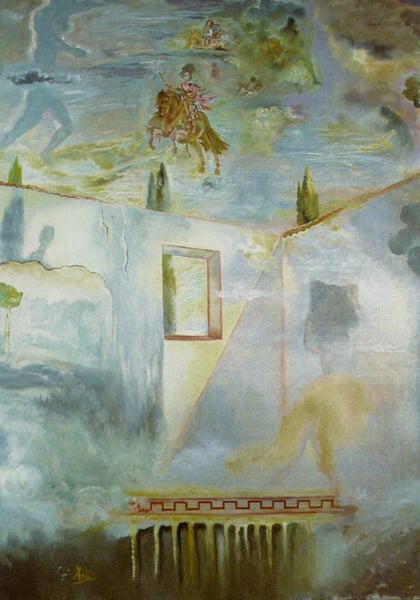
Gala in a Patio Watching the Sky, Where the Equestrian Figure of Prince Baltasar Carlos and Several Constellations (All) Appear, after Velazquez
Details
Expertenanalyse zu Salvador Dalis Gala in a Patio Watching the Sky, Where the Equestrian Figure of Prince Baltasar Carlos and Several Constellations (All) Appear, after Velazquez
Stil: Surrealism · Genre: symbolic painting
Expert Analysis of Salvador Dalí’s "Gala in a Patio Watching the Sky, Where the Equestrian Figure of Prince Baltasar Carlos and Several Constellations (All) Appear, after Velazquez"
This painting, executed during Dalí’s Classic Period (1941–1989) , stands as a monumental synthesis of the artist’s dual passions: the irrational, dream-driven freedom of Surrealism and his profound reverence for the Old Masters. Its significance lies in how Dalí uses symbolic painting to layer his own private mythology over a canonical Spanish masterpiece, creating a meta-dialogue between past and present.
Key Elements of Significance:
-
Homage and Transformation of Velázquez: The title explicitly references Diego Velázquez’s Prince Baltasar Carlos on Horseback (c. 1635), a masterpiece of Baroque portraiture. Dalí does not simply quote the equestrian figure; he reinscribes it into a surreal, cosmic landscape. By placing the prince—a symbol of royal power and mortality (he died young)—in a nocturnal sky studded with constellations, Dalí elevates historical portraiture to a timeless, astral plane. This reflects his “paranoiac-critical method,” where he deliberately reinterprets classical imagery to unlock hidden, irrational meanings.
-
Gala as Cosmic Witness: Dalí’s wife and muse, Gala, occupies the foreground patio, serving as the bridge between the earthly and the celestial. In Dalí’s symbolic system, Gala often represents the eternal feminine, the muse, and the observer of the surreal. Her presence anchors the viewer: she watches the sky not as passive appreciation, but as a participant in the alchemical fusion of history (the prince) and the infinite (constellations). This makes the work a religious-scientific allegory typical of Dalí’s Classic Period, blending Catholicism, astronomy, and psychology.
-
Surrealist Reimagining of the Sublime: While the composition retains Velázquez’s sense of grandeur, Dalí subverts it with dreamlike incongruities. The patio is rendered with crisp, hyperrealistic detail (a hallmark of his later work), yet the sky becomes a stage for impossible juxtapositions: a 17th-century prince rides through a star chart. This tension between the real and the imagined is the core of Surrealism’s symbolic power—the familiar world becomes a doorway to the unconscious. Dalí’s precise draftsmanship heightens the disorientation, as if the supernatural has been photographed.
Conclusion:
This painting is significant as a culmination of Dalí’s lifelong project to reconcile Surrealism with tradition. It is not a mere pastiche but a symbolic poem: Gala mediates between the human and the cosmic, while the ghostly prince and constellations evoke the eternal recurrence of history and myth. In Dalí’s hands, Velázquez’s royal portrait becomes a vision of the psyche—timeless, ambiguous, and deeply personal.
Genre
Stil
Visuell ähnlich
20 Werke mit ähnlicher Komposition und Farbpalette
Passing Train
Albert Bloch
Spring walk
Georgy Yakulov
The Spectre and the Phantom
Salvador Dali
Scherzo (Sonata of the Summer)
Mikalojus Konstantinas Ciurlionis
The Gaseous Swan
Salvador Dali
Untitled (Composition - Courtyard of the Escorial with Figure and Sebastian De Morra, Veldzquez's Dwarf)
Salvador Dali
Landscape with Rock in the Shape of a Triumphal Arch
Salvador Dali
Deluge (VIII)
Mikalojus Konstantinas Ciurlionis
Berény Róbert, IV Jelenet
Berény Róbert
Nocturne, Temple d'Amour
Edward Jean Steichen
The Column
Horia Bernea
Zaratustra, Visitaciones
Vlady
Hero and Leander's farewell
J.M.W. Turner
Medea or Jason Taking Possession of the Golden Fleece
Salvador Dali
Cemetery among the cypress
Vasily Polenov
Nymphs in a Romantic, Garden
Salvador Dali
Fate
Carlos Schwabe
The Sunken Cathedral
Sirak Skitnik
Rest
Marc Chagall
The Crown
Odilon Redon