The first flowers
Dettagli
Analisi esperta di The first flowers di Paul Gauguin
Stile: Post-Impressionism · Genere: landscape
Expert Analysis: "The First Flowers" by Paul Gauguin
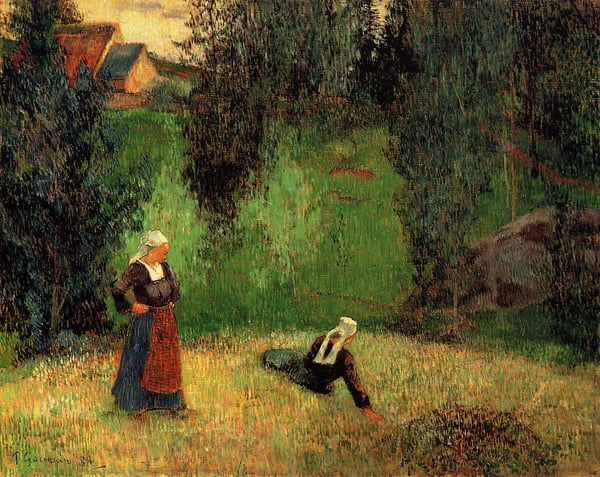
Painted during Gauguin’s formative Breton period (circa 1888–1891), "The First Flowers" stands as a pivotal work in the evolution of Post-Impressionism. In this landscape, Gauguin decisively abandons the naturalistic observations of Impressionism in favor of a more synthetic, symbolic approach—a hallmark of his style developed in Pont-Aven.
The scene—likely depicting early spring in the Breton countryside—is not a mere transcription of nature but a deliberate reordering of reality. Gauguin flattens perspective, using bold outlines and broad patches of unmodulated color (a technique later called Cloisonnism, after medieval enamel work). The “first flowers” themselves become emblems of renewal and rustic simplicity, aligning with Gauguin’s romanticized view of Brittany as a pristine, primitive refuge from industrial Paris.
What makes this work significant:
- Break from Impressionist spontaneity: The composition is carefully arranged, with strong contours and a rhythmic, almost tapestry-like surface.
- Symbolic use of color: Gauguin employs high-key, non-naturalistic hues (e.g., mauve shadows, golden earth) to express emotional and spiritual resonance rather than optical accuracy.
- Proto-primitivist vision: The simplified, almost naïve treatment of the landscape reflects Gauguin’s search for an authentic, pre-modern essence—a project that would culminate in his Tahitian works.
In “The First Flowers,” we see Gauguin not only innovating within Post-Impressionism but also laying foundational ideas for Symbolism and Primitivism. The painting is a quiet manifesto: art should not copy nature but distill its inner meaning through pure form and color.
Museum / Gallery
Visivamente simili
20 opere con composizione e palette affini
Women Gathering Grass
Camille Pissarro
The Tedder
Camille Pissarro
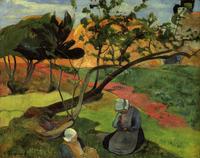
Landscape with two breton women
Paul Gauguin
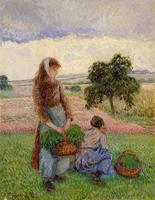
Peasant Woman Carrying a Basket
Camille Pissarro
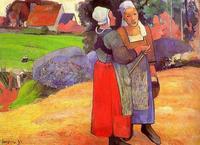
Paysannes bretones
Paul Gauguin
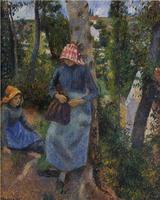
Two Young Peasants Chatting under the Trees
Camille Pissarro
Seated Peasant Girl
Camille Pissarro
Peasant Woman and Child Harvesting the Fields, Pontoise
Camille Pissarro
The Siesin the Fields
Camille Pissarro
Landscape at Epping
Lucien Pissarro
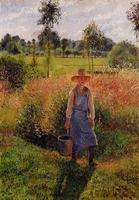
The Gardener, Afternoon Sun, Eragny
Camille Pissarro
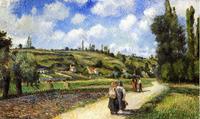
Landscape near Pontoise, the Auvers Road
Camille Pissarro
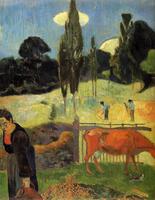
The red cow
Paul Gauguin
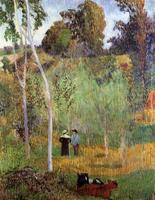
Sheperd and sheperdess in a meadow
Paul Gauguin
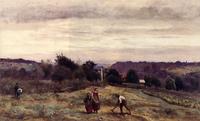
Ville d'Avray the Heights Peasants Working in a Field
Camille Corot
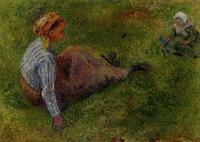
Peasant Sitting with Infant
Camille Pissarro
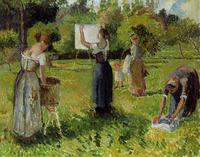
Laundresses at Eragny
Camille Pissarro
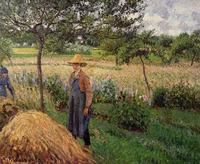
Grey Weather, Morning with Figures, Eragny
Camille Pissarro
Picking Peas
Camille Pissarro
The Fern Harvesters in the Boid d'Amour at Pont Aven
Paul Serusier