Analisi esperta di A Widow di James Tissot
Stile: Realism · Genere: genre painting
Expert Analysis: "A Widow" by James Tissot (Realism / Genre Painting)
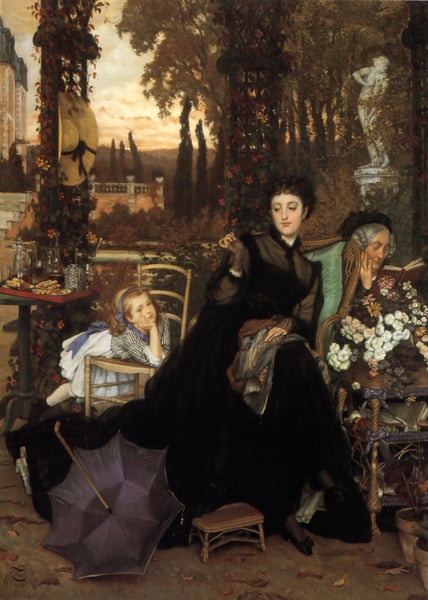
James Tissot’s A Widow stands as a masterful example of Realist genre painting, distinguished by its unflinching yet empathetic portrayal of a woman navigating the rigid social codes of 19th-century mourning. The work’s significance lies in its ability to transform a conventional subject—widowhood—into a nuanced commentary on private grief versus public expectation.
Realist Precision and Psychological Depth
Tissot employs the hallmark techniques of Realism: meticulous attention to costume, texture, and setting. The widow’s black dress, widow’s cap, and somber accessories are rendered with documentary accuracy, grounding the painting in the lived experience of Victorian ritual. Yet beyond mere detail, Tissot infuses the scene with psychological weight. The widow’s posture—often slightly turned away from the viewer, her gaze distant or downcast—suggests an interior world of loss that resists sentimental idealization. This marks a departure from earlier, more theatrical depictions of mourning.
Social Commentary within Genre Conventions
As a genre scene, A Widow operates on two levels: it depicts a private moment (or staged domestic interior) while also reflecting broader societal structures. Tissot, known for his sharp observations of Parisian and London life, uses the widow’s isolation to challenge the notion that mourning was a purely dignified, passive state. The painting subtly critiques the performative aspects of grief—how society required widows to embody a prescribed role—while affirming the authenticity of personal sorrow.
Significance in Tissot’s Oeuvre
This work exemplifies Tissot’s transition from the polished society portraits of his early career to a more psychologically compelling Realism. By focusing on a widow—a figure often relegated to the margins of Victorian art—he elevates a marginalized experience into a subject worthy of serious artistic treatment. The painting’s quiet power lies in its refusal to moralize or sensationalize, instead inviting the viewer to contemplate the resilience and solitude of a woman whose identity has been redefined by loss.
In sum, A Widow is significant for its fusion of Realist fidelity with emotional restraint, offering a profound meditation on grief that remains relevant in its human truth.
Museum / Gallery
Visivamente simili
20 opere con composizione e palette affini
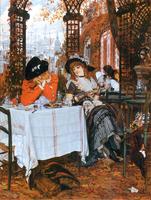
A Luncheon
James Tissot
A drink At The Ale House
John Absolon

The End Of The Story
Marcus Stone

The Garden Bench
James Tissot

Two’s Company, Three’s None
Marcus Stone
In a Black Coat
Lovis Corinth

The Confidence
James Tissot
The friends
Anton Romako
Woman with a Parrot (Henriette Darras)
Pierre-Auguste Renoir
In the living room
Umberto Veruda
A Family Group, The Artist's Wife and Children, 'Papa Painting!'
Solomon Joseph Solomon
Twilight on the terrace, Paris
Julius LeBlanc Stewart
Conversation in the Jardin Du Luxembourg
Vittorio Corcos
On the terrace
Pierre-Auguste Renoir
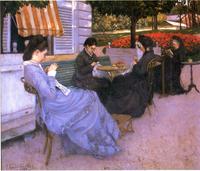
Portraits in the Countryside
Gustave Caillebotte

Nanny with a Child
Eva Gonzales

Girl and Roses
Auguste Toulmouche

The Fan
James Tissot

The 70th birthday of Kommerzienrat Valentin Manheimer (1815-1889)
Anton von Werner

The letter
Carl Zewy