Analisi esperta di At The Louvre di James Tissot
Stile: Realism · Genere: genre painting
Expert Analysis: "At The Louvre" by James Tissot
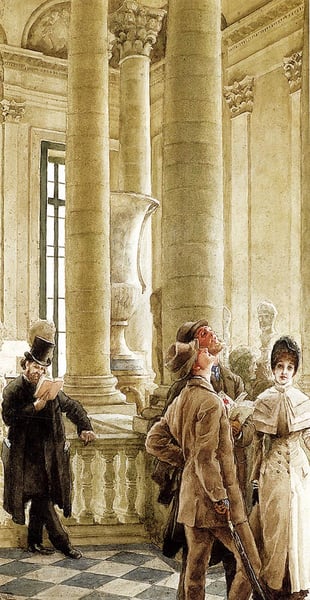
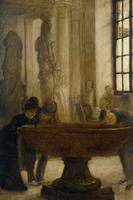
James Tissot’s "At The Louvre" is a masterful example of Realist genre painting, capturing a seemingly ordinary moment in one of the world’s most iconic museums. The work’s significance lies in its unflinching commitment to the Realist ethos: the truthful, unidealized depiction of contemporary life.
Subject and Composition
The painting portrays elegantly dressed visitors—likely upper-class Parisians—strolling through the Louvre’s grand galleries. Tissot treats the scene not as a heroic or allegorical tableau, but as a slice of modern leisure, emphasizing the casual interaction between people, art, and architecture. The museum itself becomes a stage for social observation rather than a sacred temple of culture.
Realist Innovation
- Authenticity of Setting: By choosing a real, accessible public space (the Louvre) over a mythical or historical locale, Tissot aligns with Realism’s rejection of Romantic escapism.
- Attention to Detail: Tissot’s meticulous rendering of period costumes, gallery lighting, and the texture of artworks on the walls reflects the Realist fascination with precise, empirical observation.
- Social Commentary: The painting subtly scrutinizes the manners and rituals of the bourgeoisie, showing how art consumption itself becomes a performance of class identity.
Why It Matters
"At The Louvre" exemplifies how Realist genre painting elevated the mundane—a casual museum visit—into a subject worthy of serious artistic study. Tissot’s work bridges the gap between documentary realism and the emerging interest in modern life, foreshadowing the Impressionists’ focus on contemporary Parisian scenes. It remains significant as a vivid, unvarnished record of 19th-century social habits and the evolving role of public museums in urban leisure culture.
Museum / Gallery
Visivamente simili
20 opere con composizione e palette affini
The Woman of Fashion (La Mondaine)
James Tissot
Le menuet
Sebastien Leclerc II
Hall in the Magic Castle
Vasily Polenov
At The Louvre
James Tissot
GRUPPENPORTRAIT EINER FAMILIE IM INNENHOF EINER SCHLOSSANLAGE
Peter Jacob Horemans
Scena d’interno
Carlo Bossoli
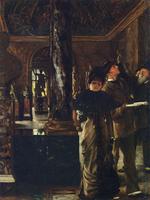
Foreign Visitors at the Louvre
James Tissot
The Vestibule Of The Palazzo Pisani
Xavier Mellery
In the living room in Moscow in 1840's
Boris Kustodiev
The choice of the model
Marià Fortuny
In the Temple
Sir Lawrence Alma-Tadema
The Banquet of Cleopatra
Giovanni Battista Tiepolo
Architectural fantasy
Ferdinando Galli Bibiena
The Gallery of the Muses, in the Royal Museum at the Royal Palace, Stockholm
Pehr Hillestrom
Travel plans
Adolph Menzel
Mortuary in a palace
Rudolf von Alt
The Circle of the Rue Royale
James Tissot
The Ides of March
Edward Poynter
Vue nocturne de l'intérieur d'un temple protestant Panneau de chêne, trois planches, non parqueté
Anthonie Palamedesz.
Alexander the Great Cutting the Gordian Knot
Giovanni Paolo Panini