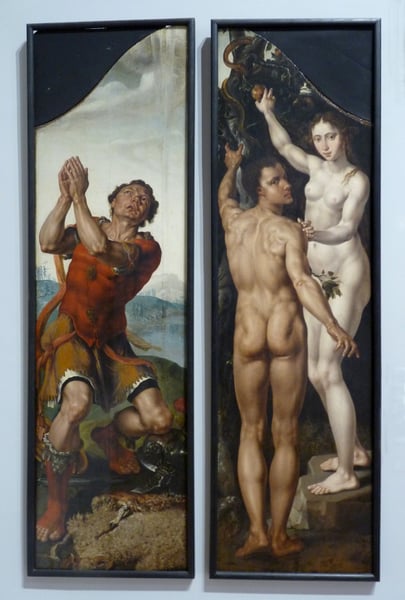
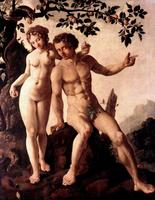
The double-narrative composition of Maerten van Heemskerck's Gideon / Adam and Eve exemplifies the intellectual ambition and formal complexity of Northern Mannerism. By collapsing the Old Testament story of Gideon (Judges 6–8) with the Genesis account of the Fall, van Heemskerck creates a typological juxtaposition typical of Late Renaissance religious allegory: Gideon’s fleece—a sign of divine favor—prefigures the Virgin Mary’s purity, while Adam and Eve’s sin introduces the need for redemption. In true Mannerist fashion, the figures are elongated and contorted, arranged in a crowded, non-naturalistic space that prioritizes decorative elegance over perspective realism. The muscular, anatomically exaggerated bodies and sharp, artificial color scheme reflect van Heemskerck’s synthesis of Italianate influences (particularly Michelangelo and Giulio Romano) with the meticulous detail of Netherlandish painting. The significance lies in how the work uses visual density and biblical parallelism to engage the viewer in an intellectual puzzle, pushing against High Renaissance harmony in favor of the tension, sophistication, and spiritual complexity that define the Mannerist style.