Description
Tarz: Futurism · Tür: figurative
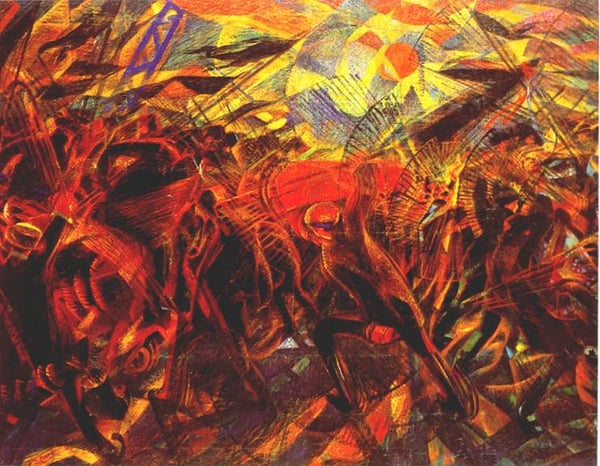
The Funeral of the Anarchist Galli (Il Funerale dell’anarchico Galli) is a painting by Italian painter Carlo Carrà. It was finished in 1911, during the artist's futurist phase. It currently resides in New York City's Museum of Modern Art.
The subject of the work is the funeral of Italian anarchist Angelo Galli, killed by police during a general strike in 1904. The Italian State feared that the funeral would become a de facto political demonstration and refused the mourning anarchists entrance into the cemetery itself. When anarchists resisted, the police responded with force and a violent scuffle ensued.
Carlo Carrà was present. His work embodies the tension and chaos of the scene: the movement of the bodies, the clashing of anarchists and police, the black flags flying in the air. He reflects in a later memoir:
”I saw before me the bier, covered with red carnations, wavering dangerously on the shoulders of the pallbearers. I saw the horses becoming restive, and clubs and lances clashing, so that it seemed to me that at any moment the corpse would fall to the ground and be trampled by the horses…” (Carrà, La Mia Vita, 1943)
Museum / Gallery
Görsel olarak benzer
İlişkili kompozisyon ve renk paletine sahip 20 eser
The Charge of the Lancers
Umberto Boccioni
The battle of Issus (fragment)
Albrecht Altdorfer
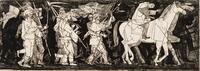
Kondor Béla, Dózsa Legényei
Kondor Béla
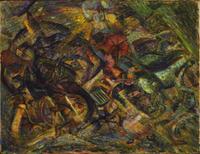
Jolts of a Cab
Carlo Carra
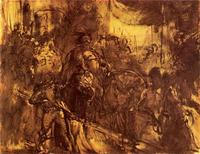
Jan III at Vienna
Jan Matejko
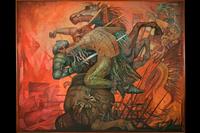
La fusión de dos culturas
Jorge González Camarena
Study for 'The Battle of Tetuan'
Salvador Dali
The Entry of Joan of Arc into Orleans
Luc-Olivier Merson
The four horsemen of the Apocalypse
Arturo Souto
Battle of Tétouan
Salvador Dali
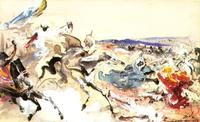
Arabs. Study for 'The Battle of Tetuan'
Salvador Dali
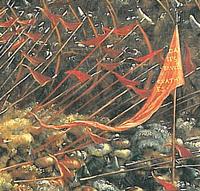
The battle of Issus(fragment)
Albrecht Altdorfer
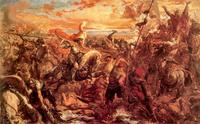
Varna
Jan Matejko
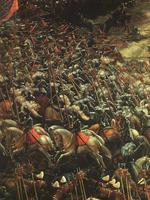
The battle of Issus (fragment)
Albrecht Altdorfer
The City Rises
Umberto Boccioni
Untitled
Zdzislaw Beksinski
Capturing the Ottoman Flag
George Stefanescu
Exode - en longeur
Theophile Steinlen
Sobieski Sending Message of Victory to the Pope
Jan Matejko
Untitled
Zdzislaw Beksinski