
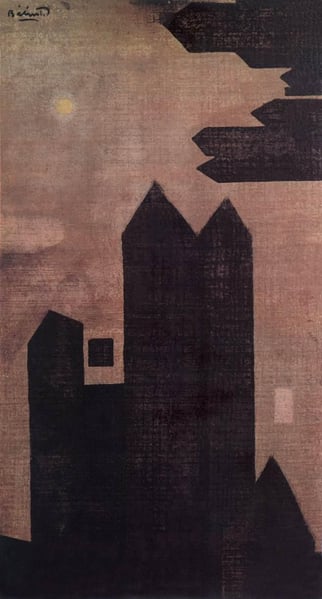
Endre Balint sanatçısının Houses at Hastings eseri hakkında uzman analizi
Tarz: Expressionism · Tür: symbolic painting
Expert Analysis: "Houses at Hastings" by Endre Balint
Endre Balint’s Houses at Hastings is a compelling example of mid-20th-century Expressionism, where the artist transforms a seemingly ordinary coastal subject into a charged symbolic landscape. Painted during a period of personal and historical upheaval—Balint was a Hungarian modernist who lived through war and exile—the work uses the expressive potential of color, distortion, and architectural form to convey emotional and psychological depth.
Significance within Expressionism
True to Expressionist principles, Balint prioritizes subjective experience over naturalistic depiction. The houses at Hastings are not rendered with topographic accuracy; instead, their tilted angles, compressed space, and jarring hues (likely deep blues, ochres, and muted reds) evoke a sense of precariousness and internal tension. This approach aligns with the movement’s mission to externalize inner states—here, perhaps a feeling of displacement or fragmented memory. The sea and sky, often symbols of vastness in Romantic painting, are reduced to claustrophobic patches, framing the houses as isolated, almost fortress-like presences.
Symbolic Painting and Interpretation
The genre of symbolic painting allows Balint to layer meaning beyond the literal. Houses traditionally represent shelter, stability, and domesticity; in Houses at Hastings, their warped forms and harsh outlines suggest vulnerability rather than safety. Hastings, an English seaside town, may serve as a personal anchor for Balint (who lived in England during WWII), but the symbolic treatment transforms it into a universal metaphor for dislocation and the fragility of home. The composition’s stark contrasts and flattened perspective further echo the alienation central to existentialist art of the era.
Legacy and Context
Balint’s work bridges Hungarian Expressionism and the broader European avant-garde. Houses at Hastings stands out for its restrained yet potent symbolism—avoiding overt narrative while compelling the viewer to confront an architecture of anxiety. It exemplifies how Expressionism, even in a quiet, unpopulated scene, can distill the turmoil of a generation. The painting’s significance lies in its ability to make the familiar unfamiliar, turning a row of seaside houses into a mirror of modern unease.
Görsel olarak benzer
İlişkili kompozisyon ve renk paletine sahip 20 eser
Ad Parnassum
Paul Klee
Composition rouge
Serge Poliakoff
Highway and byways
Paul Klee
Vertical Plains Blue and Red
Frantisek Kupka
Rug
Francis Bacon
Rug
Francis Bacon
Untitled
Nasreen Mohamedi
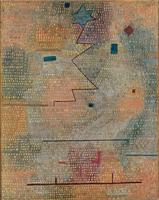
Rising Star
Paul Klee
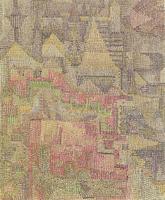
Castle Garden
Paul Klee

Carpet
M. H. Maxy
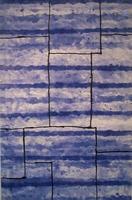
Canto V, 3
Jurgen Partenheimer
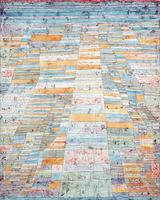
Main path and byways
Paul Klee
Rug
Francis Bacon
In the Current Six Thresholds
Paul Klee
Cacodemonic
Paul Klee
Ville toride
Gustave Singier
Necropolis
Paul Klee
Orange over Violet
Mark Rothko
Small Landscape with the village church
Paul Klee
Vision at Rouen
Endre Balint