The crown jewels of Renaissance art in the heart of Florence
CE
Caleido Editorial TeamJune 9, 202620 min read0 views
The Galleria degli Uffizi in Florence is the birthplace of the modern art museum and home to the world's finest collection of Italian Renaissance painting. Housed in a 16th-century palace designed by Giorgio Vasari for the Medici family, the Uffizi contains masterpieces that trace the evolution of Western art from medieval icons to the full flowering of the Renaissance.
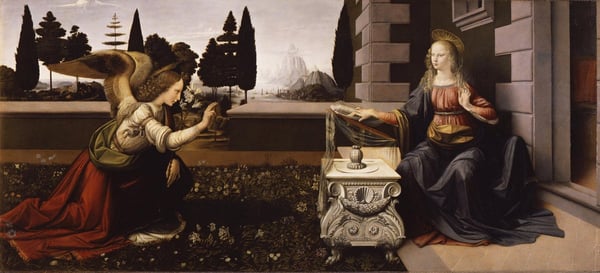
This guide highlights 25 of the gallery's most celebrated works, from Botticelli's ethereal Birth of Venus and Primavera to Caravaggio's visceral Medusa and Leonardo's early Annunciation. Along the way you'll encounter Raphael, Titian, Michelangelo, and the other titans who made Florence the creative capital of the world.
Use the checklist below to track which Uffizi masterpieces you've seen in person.
Sandro Botticelli · Early Renaissance · mythological painting
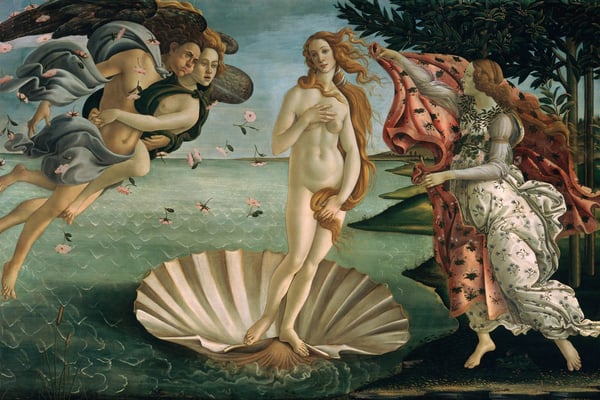
[i]The Birth of Venus[/i], painted by Sandro Botticelli in the 1480s, is one of the most famous paintings in the world: it is a celebrated work of art and the high point of a visit to the Uffizi Gallery in Florence. It is also a commercial icon and a line mark of European Art.
The real subject of the painting and its meaning is a mystery under discussion. Over the centuries, many theories and ...
Mikhail Vrubel · Art Nouveau (Modern), Symbolism · portrait
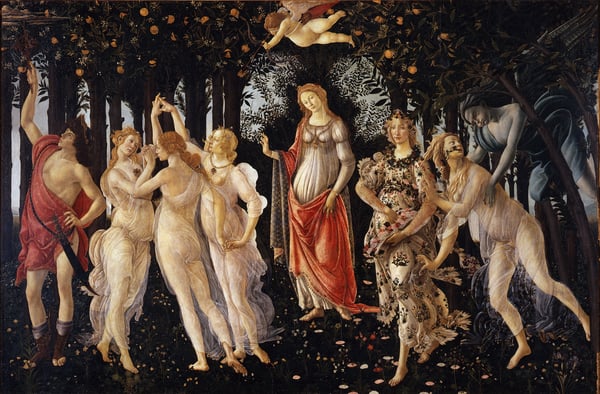
Primavera is a large panel painting in tempera paint by the Italian Renaissance painter Sandro Botticelli made in the late 1470s or early 1480s. It has been described as "one of the most written about, and most controversial paintings in the world", and also "one of the most popular paintings in Western art".
Jacopo Bellini · Early Renaissance · religious painting
Created in 1444, this painting is one of the mature works of Jacopo Bellini. Annunciation is a panel, which is a permanent part of the exhibition of Sant Allesandro, Brescia, along with many other works from the early Renaissance period. This painting is a beautiful example of Bellini’s incorporation of Byzantine and Gothic techniques with the new style of Renaissance painting, which included t...
Sandro Botticelli · Early Renaissance · religious painting
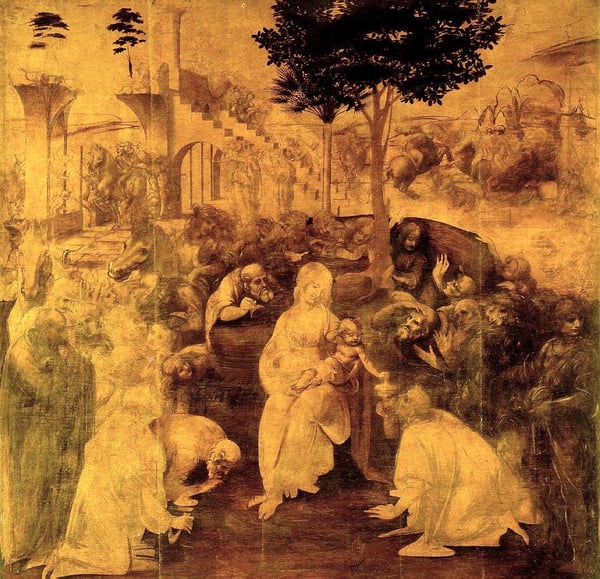
The Adoration of the Magi is an unfinished early painting by the Italian Renaissance artist Leonardo da Vinci. Leonardo was given the commission by the Augustinian monks of San Donato in Scopeto in Florence in 1481, but he departed for Milan the following year, leaving merely more than the preparatory underdrawing in charcoal, ink and watercolor. It has been in the Uffizi Gallery in Florence si...
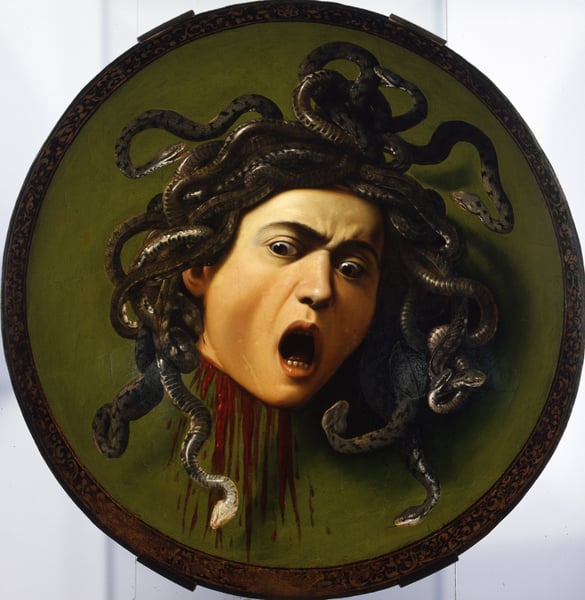
Caravaggio (1571-1610) painted two versions of the Head of Medusa. The first in 1596 and the other presumably in 1597/8. The first version also known as Murtula, due to the poet who wrote about it (48x55 cm) is signed Michel A F, (Michel Angelo Fecit) and was found on the painter’s studio only after his dead. Nowadays it belongs to a private collection whilst the second version, slightly bigger...
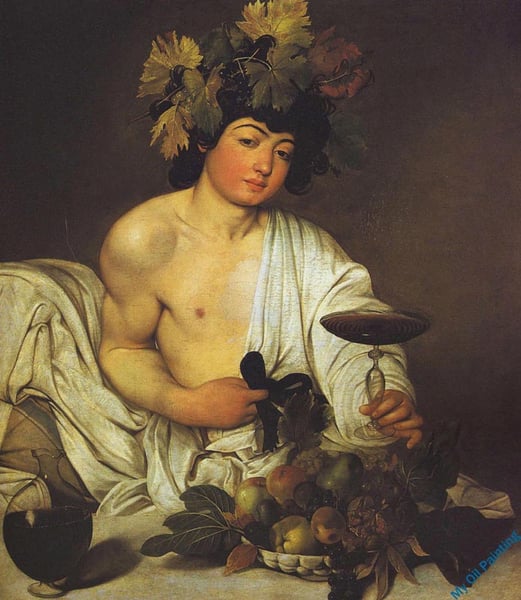
Bacchus is an oil painting by Italian Baroque master Michelangelo Merisi da Caravaggio (1571–1610) commissioned by Cardinal Francesco Maria del Monte. The painting shows a youthful Bacchus reclining in classical fashion with grapes and vine leaves in his hair, fingering the drawstring of his loosely draped robe. On a stone table in front of him is a bowl of fruit and a large carafe of red wine....
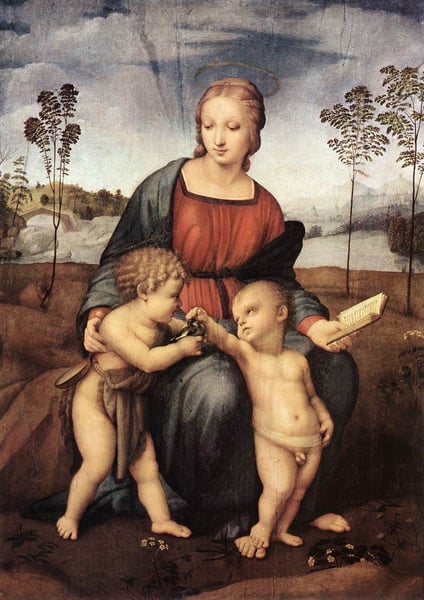
The Madonna del cardellino or Madonna of the Goldfinch is an oil on wood painting by the Italian Renaissance artist Raphael, from c. 1505–1506. A 10-year restoration process was completed in 2008, after which the painting was returned to its home at the Uffizi in Florence. During the restoration, an antique copy replaced the painting in the gallery.
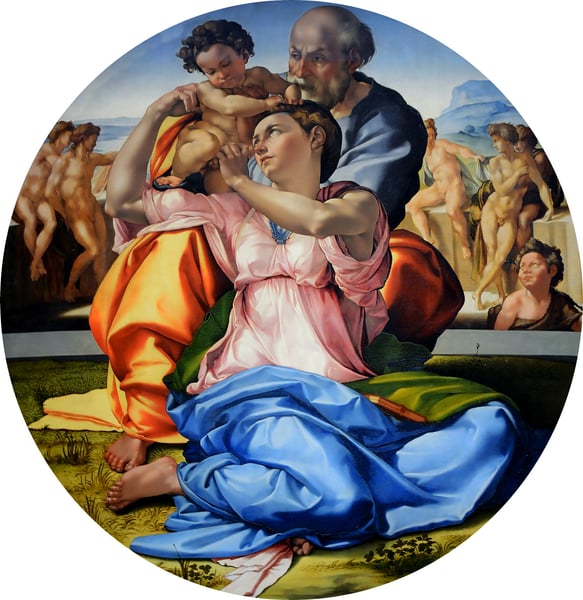
The Doni Tondo or Doni Madonna is the only finished panel painting by the mature Michelangelo to survive. Now in the Uffizi in Florence, Italy, and still in its original frame, the Doni Tondo commissioned by Agnolo Doni, probably to commemorate his marriage to Maddalena Strozzi, the daughter of a powerful Tuscan family. The painting is in the form of a tondo, meaning in Italian 'round', a shape...
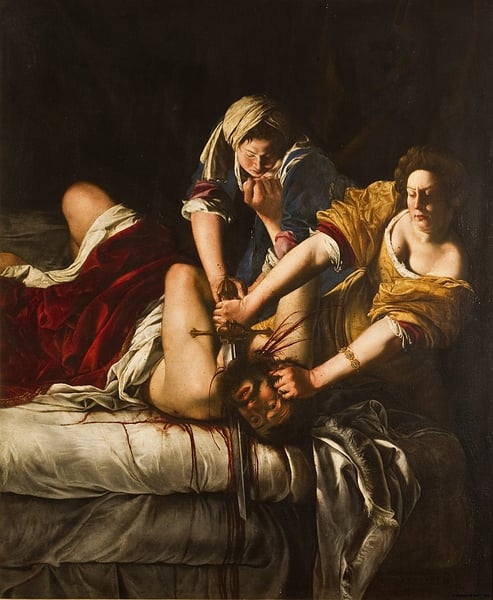
Judith Slaying Holofernes is a painting by the Italian early Baroque artist Artemisia Gentileschi, completed in 1612–13 and now at the Museo Capodimonte, Naples, Italy.
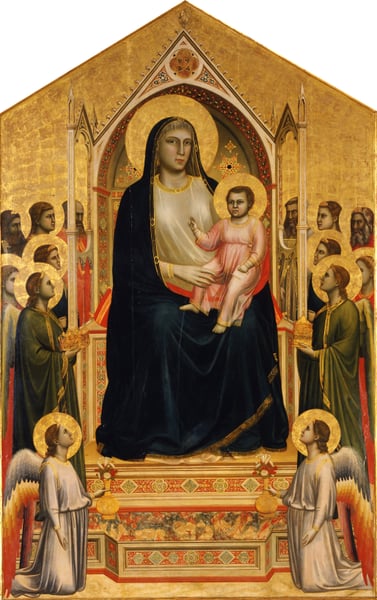
Madonna Enthroned, also known as the Ognissanti Madonna or Madonna Ognissanti, is a painting in tempera on wood panel by the Italian late medieval artist Giotto di Bondone, now in the Uffizi Gallery of Florence, Italy.
Fra Angelico · Early Renaissance · religious painting
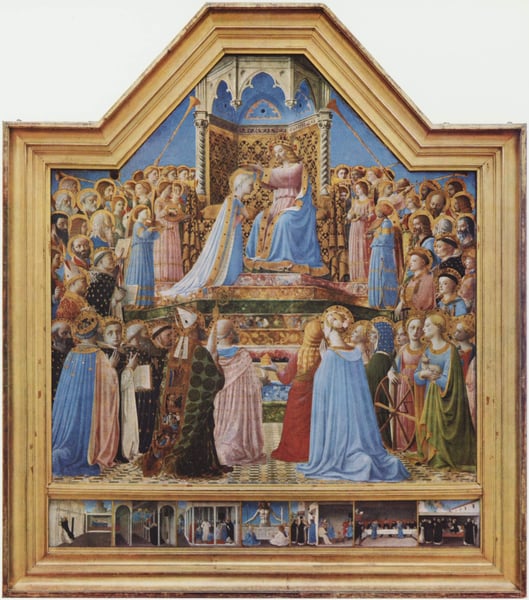
The Coronation of the Virgin, painted by Fra Angelico in 1435, is an Early Renaissance religious work depicting the coronation of the Virgin Mary. The painting employs the visual and spiritual conventions of its period to render this theological subject, characteristic of the artist's approach to religious narrative in the fifteenth century.
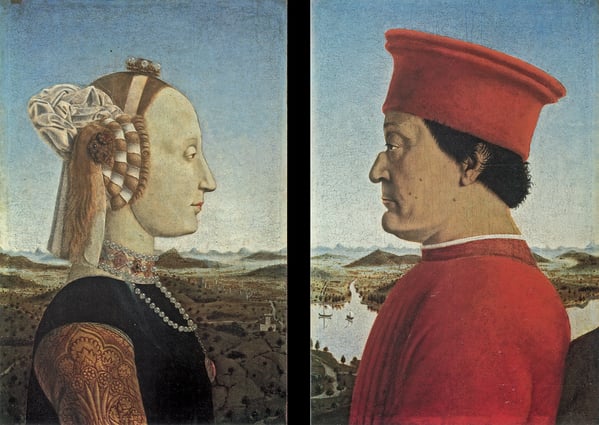
The Diptych of Federico da Montefeltro and Battista Sforza are two oil paintings by Italian artist Piero della Francesca, dated to 1473–1475. This famed double portrait is often mistitled The Duke and Duchess of Urbino—as it appears on the website of the Uffizi Gallery, which owns it. Since Battista Sforza died in 1472 and Federico da Montefeltro was not made duke until 1474, Battista never att...
Sandro Botticelli · Early Renaissance · religious painting
Virgin and Child with Two Angels may refer to one of these paintings:Virgin and Child with Two Angels, by Sandro Botticelli, in Naples
Virgin and Child with Two Angels, by Sandro Botticelli, in Strasbourg
Virgin and Child with Two Angels, by Cimabue, in National Gallery, UK
Virgin and Child with Two Angels, by Andrea del Verrocchio, in National Gallery, UK
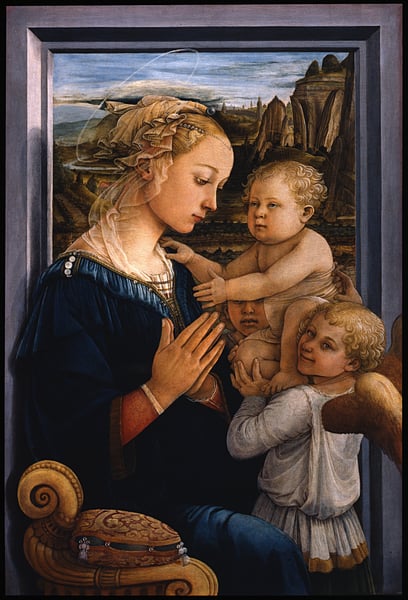
Madonna and Child, by Filippo Lippi, i...
Rogier van der Weyden · Northern Renaissance · religious painting
The Annunciation by Rogier van der Weyden is a Northern Renaissance religious painting depicting the biblical moment when the angel Gabriel announces to the Virgin Mary that she will bear Christ.
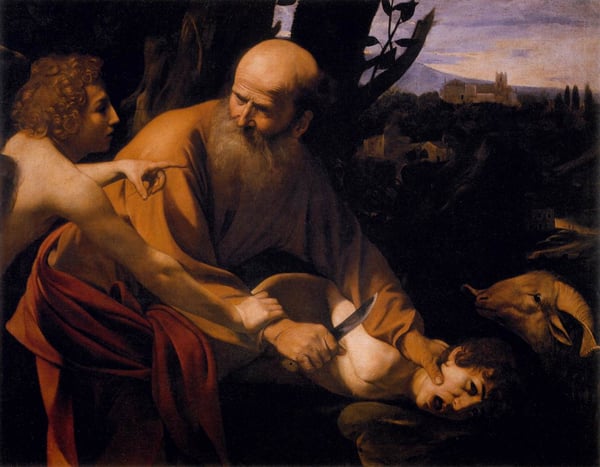
Isaac's Sacrifice depicts the biblical moment of Abraham's near-sacrifice of his son, rendered in Caravaggio's characteristic use of dramatic light and shadow. The composition employs chiaroscuro to heighten the narrative tension of the scene.
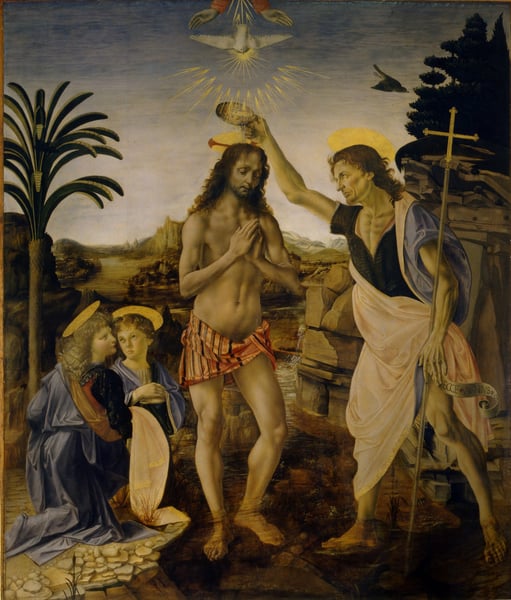
The Baptism of Christ is a religious painting by Giotto, created in 1305 and exemplifying the proto-Renaissance style. The work depicts the baptism of Christ, the titular subject drawn directly from Christian scripture.
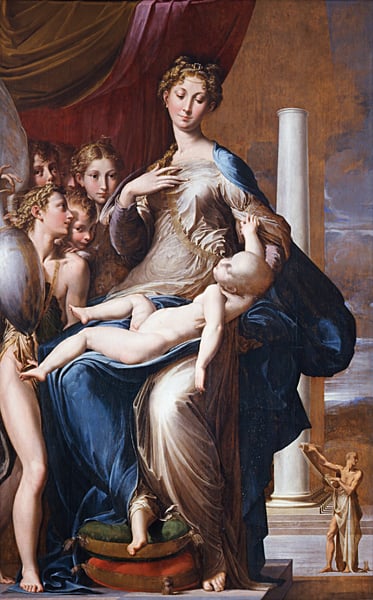
The Madonna with the Long Neck, also known as Madonna and Long Child with Angels and St. Jerome, is an Italian Mannerist oil painting by Parmigianino, dating from c. 1535-1540 and depicting Madonna and Child with angels. The painting began in 1534 for the funerary chapel of Francesco Tagliaferri in Parma, but remained incomplete on Parmigianino's death in 1540. Ferdinando de' Medici, Grand Prin...
Lucas Cranach the Elder · Northern RenaissanceArtwork
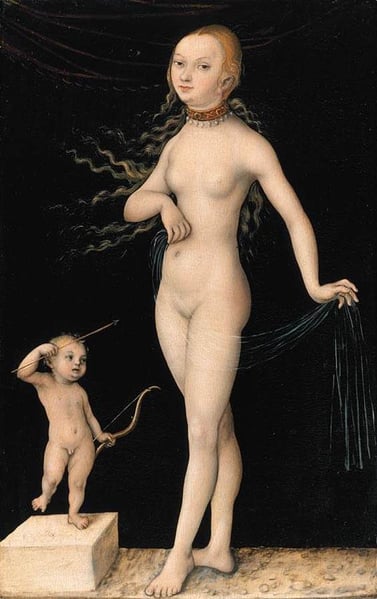
Lucas Cranach the Elder · Northern Renaissance · mythological painting
Venus and Cupid is a mythological painting by Lucas Cranach the Elder from 1525, executed in the Northern Renaissance style. The work depicts the two figures named in its title.
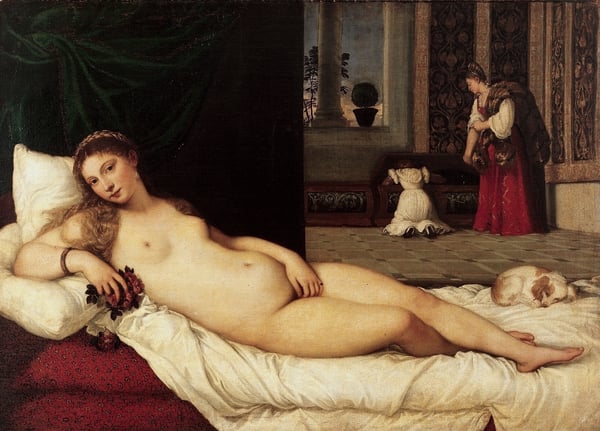
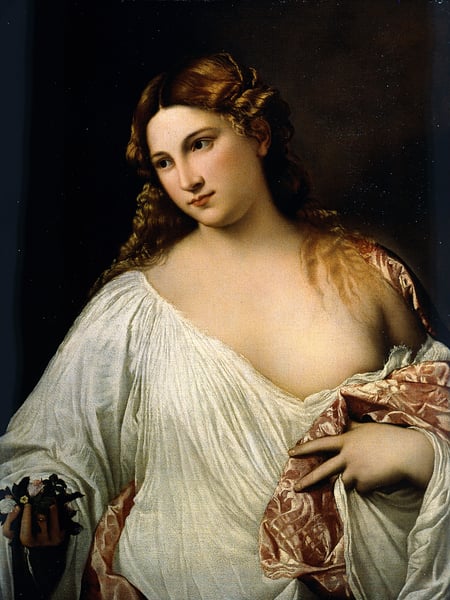
Flora is a mythological painting by Titian from 1515, executed in the High Renaissance style. The work depicts the figure named in its title, rendered according to the conventions of Renaissance painting of that period.
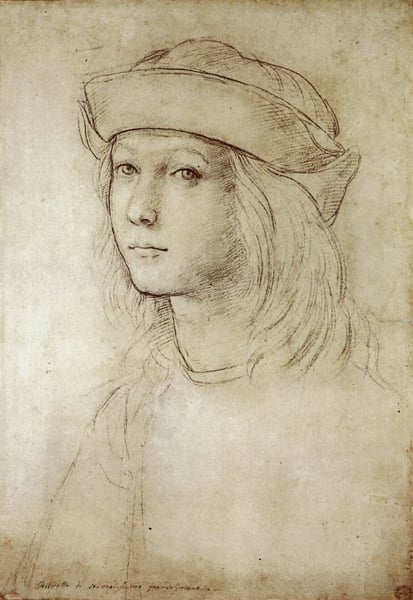
Giuseppe Arcimboldo · Mannerism (Late Renaissance) · self-portrait
Self-portraits are portraits artists make of themselves. Although self-portraits have been made since the earliest times, it is not until the mid-15th century that artists can be frequently identified depicting themselves, as either the main subject or important characters in their work. With better and cheaper mirrors, and the advent of the panel portrait, many painters, sculptors and printmak...
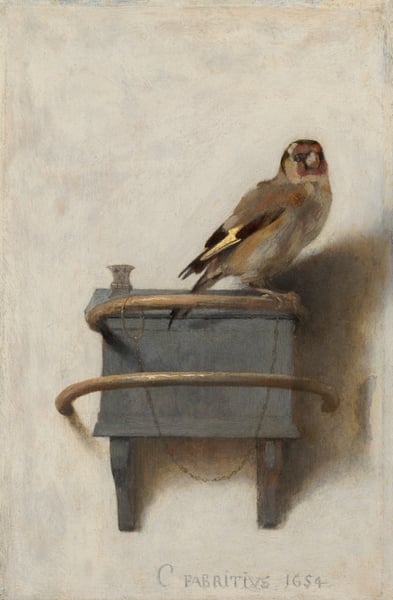
This small painting depicts a European goldfinch, painted to scale at about four inches long, perched on its feedbox, to which it is attached by a fine gold chain looped on the brass ring that holds the box in place. The bird, shown in profile, turns toward the viewer with an alert, evocative expression.
Known for his innovative painting of the effects of light, here Fabritius used light and s...
No comments yet — be the first.