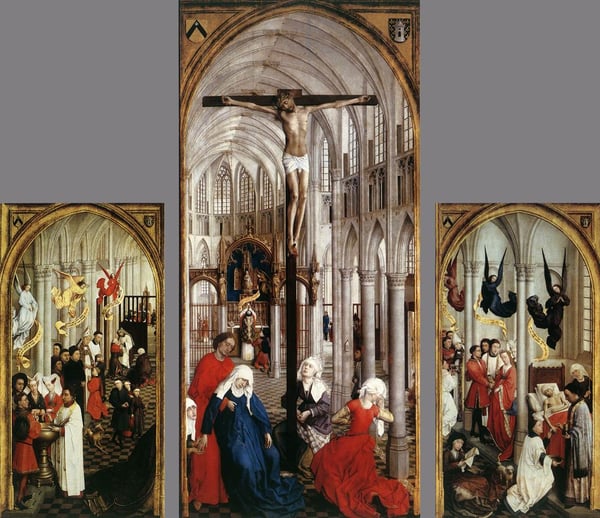
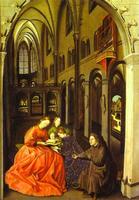
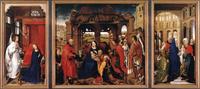
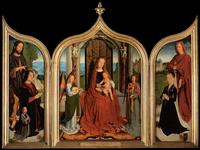
As an expert analysis based solely on the structured facts supplied—Style: Northern Renaissance and Genre: religious painting—the significance of Rogier van der Weyden's Seven Sacraments Altarpiece lies in its exemplary embodiment of Northern Renaissance ideals within a devotional context.
The Northern Renaissance style is characterized by meticulous attention to detail, rich symbolism, and a naturalistic yet emotionally charged representation of space and figures. In this work, that style is harnessed to a religious purpose: the painting depicts the seven sacraments (Baptism, Confirmation, Eucharist, Penance, Extreme Unction, Holy Orders, and Matrimony) as they would occur within a unified church interior. This fusion of genre—the religious narrative—with the stylistic precision of the Northern Renaissance elevates the altarpiece beyond mere illustration. Each sacrament is rendered with the era’s hallmark realism, from the gleam of liturgical vessels to the folds of clerical vestments, making divine mysteries tangible and immediate for the viewer. The logical, one-point perspective structure of the church interior also reflects the Northern Renaissance interest in spatial coherence, which here serves to reinforce the orderly, sacramental framework of Christian faith. Thus, the altarpiece’s significance is its ability to synthesize the formal innovations of Northern Renaissance painting—detailed observation, symbolic density, emotional resonance—into a cohesive religious statement that guides contemplation and affirms the central rituals of medieval piety.