Analisi esperta di The Madonna in the Church di Jan van Eyck
Stile: Northern Renaissance · Genere: religious painting
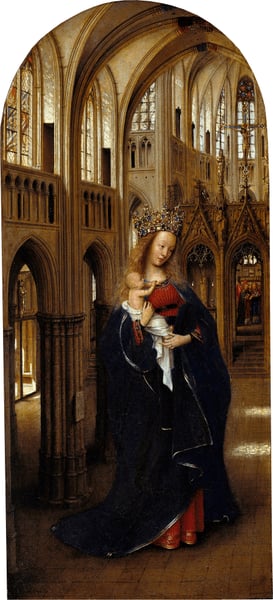
Jan van Eyck’s The Madonna in the Church is a seminal work of the Northern Renaissance, a period renowned for its revolutionary adoption of oil painting, meticulous naturalism, and layered symbolism. Executed as a religious painting, the work reimagines the traditional Virgin and Child theme with unprecedented spatial and spiritual depth.
Significance within the Northern Renaissance:
Van Eyck’s mastery of oil glazes creates a luminous, almost ethereal atmosphere. The church interior is rendered with extraordinary precision—from the carved capitals and stained glass to the flickering candlelight—yet the architecture is an idealized, composite space rather than a literal church. This fusion of hyper-realism and symbolic abstraction defines Northern Renaissance innovation.
The composition reinforces Mary’s role as both Queen of Heaven and tangible human mother. She stands before the choir screen, her figure disproportionately large compared to the surrounding architecture—a deliberate visual device that aligns her with the sacred stature of a monumental altarpiece figure, while the intimate scale of the panel itself invites close devotional contemplation. Light streams through the windows, falling on Mary and the Christ child, symbolizing divine presence. Van Eyck even includes a tiny glimpse of the outside world through an open door, connecting the sacred interior with everyday life—a hallmark of the Northern Renaissance’s integration of the spiritual with the material.
Genre and Iconographic Significance:
As a religious painting, it departs from earlier Gothic or Byzantine models by setting the Madonna in a recognizable, contemporary space rather than a flat gold ground. The church is not merely a setting but a metaphor: Mary herself is the “living temple,” and the light passing through the stained glass—without breaking the panes—echoes the Virgin Birth. Van Eyck’s ability to weave complex theology into a seemingly naturalistic scene makes this work a touchstone of Northern Renaissance piety and artistic ambition. It demonstrates how oil paint could capture both the texture of stone and the ineffable mystery of faith, cementing van Eyck’s legacy as a founder of modern pictorial realism.
Museum / Gallery
Visivamente simili
20 opere con composizione e palette affini
Madonna and Saints in a Church
Konrad Witz
The Presentation in the Temple
Hans Memling
Seven Sacraments Altarpiece
Rogier van der Weyden
Dresden Triptych (Virgin and Child with St. Michael and St. Catherine and a Donor)
Jan van Eyck
Virgin and Child
Jean Fouquet
The Annunciation
Jan van Eyck
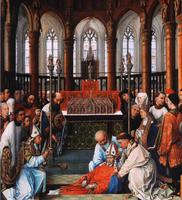
Exhumation of Saint Hubert
Rogier van der Weyden
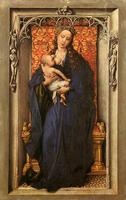
Madonna and Child
Rogier van der Weyden
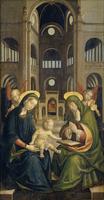
The Virgin and Child with St. Anne
Defendente Ferrari
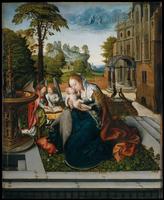
Virgin and Child with Angels
Bernard Van Orley
Virgin and Child with Four Angels
Gerard David
Virgin and Child near a Fountain
Bernard Van Orley
The Annunciation ((Polyptych of the Virgin, the wing)
Dirk Bouts
The Holy Kinship
Geertgen tot Sint Jans
St. Ursula Shrine: Virgin and Child
Hans Memling
The Virgin and Child Enthroned, with Four Angels
Quentin Matsys
Wings of a Triptych
Hans Memling
Adoration of the Magi: Right wing of triptych, depicting the Presentation in the Temple, c.1470-72 (oil on panel)
Hans Memling
Virgin and Child Enthroned with two Musical Angels
Hans Memling
Madonna and Child
Rogier van der Weyden