Expert analysis of Pietro Perugino’s The Annunciation of Mary
Style: Early Renaissance · Genre: religious painting
Expert Analysis: "The Annunciation of Mary" by Pietro Perugino
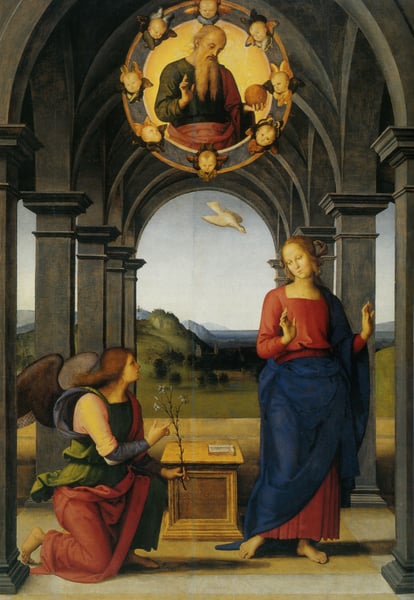
As a defining work of the Early Renaissance, Pietro Perugino’s The Annunciation of Mary embodies the period’s shift toward naturalism, spatial clarity, and serene devotional gravity. Painted within the religious genre, the work transforms a familiar biblical episode into a masterclass in compositional harmony and atmospheric perspective—hallmarks of Perugino’s mature style and his profound influence on the trajectory of Renaissance art.
Significance within the Early Renaissance
Perugino, a central figure of the Umbrian school, was celebrated for his ability to merge linear perspective with lyrical grace. In this Annunciation, the setting is likely an open loggia or a carefully structured architectural space, a device that allows the artist to demonstrate his command of one-point perspective—a revolutionary achievement of the Early Renaissance. The orthogonal lines of the floor, pilasters, and ceiling draw the viewer’s eye toward the vanishing point, often placed at the horizon or the central figures of Mary and the angel Gabriel. This rational organization of space reflects the era’s intellectual ambition to unite sacred narrative with mathematical order.
Yet Perugino transcends mere technical display. The composition is balanced with a quiet, almost meditative symmetry: the angel on the left, Mary on the right, both framed by a luminous landscape that recedes into a soft, blue-green distance—a signature sfumato of atmosphere that anticipates the High Renaissance. The figures themselves are rendered with delicate, idealized features; their gestures (Mary’s modest acceptance, the angel’s elegant salute) are calibrated to convey spiritual humility without overt emotion. This restraint is key to Perugino’s significance: he prioritizes clarity and grace over dramatic tension, setting a standard for the calm, idealized religious painting that would later influence his most famous pupil, Raphael.
Conclusion
The Annunciation of Mary stands as a pivotal document of the Early Renaissance, where sacred subject matter meets humanist precision. Perugino’s mastery of perspective, his harmonious color palette, and his serene figural style not only define the Umbrian school but also pave the way for the monumental achievements of the High Renaissance. In this work, the viewer witnesses the moment when religious painting becomes a vehicle for perfect visual order—a testament to the period’s belief that divine truth could be revealed through earthly beauty and reason.
Visually similar
20 works with related composition and palette
The Annunciation
Mariotto Albertinelli
Pala di Fano (Annunciation)
Pietro Perugino
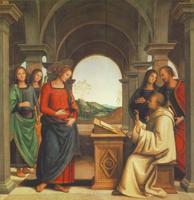
The vision of St. Bernard
Pietro Perugino
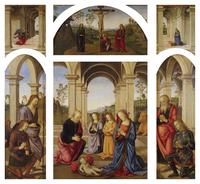
Polyptych Albani Torlonia
Pietro Perugino
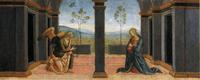
Pala di Corciano (Annunciation)
Pietro Perugino
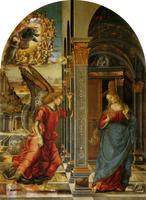
Annunciation
Luca Signorelli
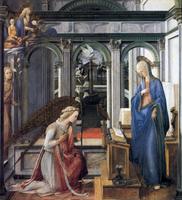
Annunciation
Filippo Lippi
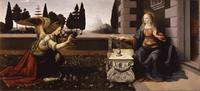
Annunciation
Leonardo da Vinci
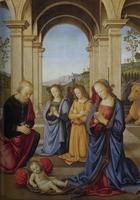
Polyptych Albani Torlonia (particular detail)
Pietro Perugino
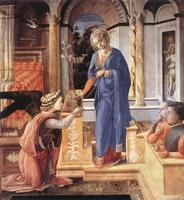
The Annunciation with two Kneeling Donors
Filippo Lippi
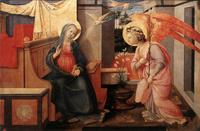
Annunciation
Filippo Lippi
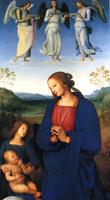
The Virgin and Child with an Angel
Pietro Perugino
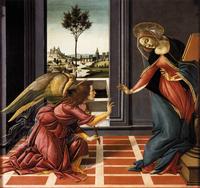
The Cestello Annunciation
Sandro Botticelli
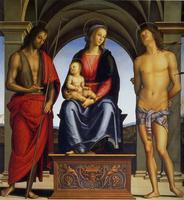
Madonna and Child with St. John the Baptist and St. Sebastian
Pietro Perugino
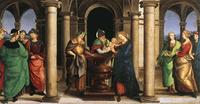
The Presentation in the Temple
Raphael
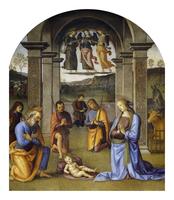
Nativity
Pietro Perugino
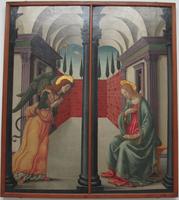
Annunciazione
Francesco Botticini
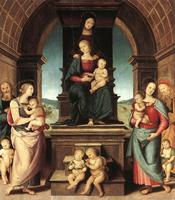
The Family of the Madonna
Pietro Perugino
Annunciation
Filippo Lippi
The Annunciation
Raphael