
Analisi esperta di The Coronation of the Virgin (Altarpiece of St. Mark) di Sandro Botticelli
Stile: Early Renaissance · Genere: religious painting
Analysis of "The Coronation of the Virgin (Altarpiece of St. Mark)" by Sandro Botticelli
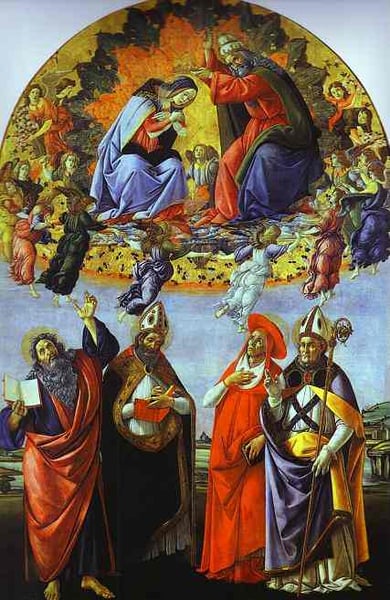
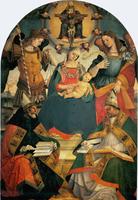
As an Early Renaissance religious painting, Botticelli's The Coronation of the Virgin (Altarpiece of St. Mark) embodies the period's transition from medieval formalism toward naturalism and human emotion, while still retaining a deep spiritual symbolism. Executed for the church of San Marco in Florence, the work is significant for its synthesis of two key Early Renaissance concerns: the celebration of divine hierarchy through linear perspective and the infusion of sacred narrative with lyrical, almost ethereal beauty.
Stylistic Significance within the Early Renaissance
Botticelli here demonstrates the era's mastery of space and composition. The altarpiece is structured around a symmetrical, pyramidal arrangement: at the apex, Christ crowns the Virgin Mary, while angels, saints, and heavenly figures radiate outward. This clear geometric order reflects the Renaissance interest in rational clarity, yet Botticelli softens it with sinuous, flowing lines—a hallmark of his personal style. The figures are not static icons but possess graceful, swaying contours that convey a sense of celestial movement, hinting at the emotional expressiveness that would later characterize the High Renaissance.
Religious Iconography and Humanist Influence
The coronation itself is a traditional subject, but Botticelli infuses it with a tender, intimate piety. Unlike earlier Gothic altarpieces that emphasized remote, otherworldly glory, this painting brings the divine down to a human scale. The Virgin's downward gaze and modest gesture, combined with Christ's gentle placement of the crown, evoke a quiet, reciprocal love. This humanization of sacred figures—making them accessible and emotionally resonant—was a defining achievement of Early Renaissance religious art, influenced by contemporary humanist thought that sought to reconcile faith with human experience.
Color, Light, and Symbolic Detail
Botticelli's palette—rich blues, deep reds, and luminous golds—is both decorative and symbolic. The blue of the Virgin's robe signifies her purity and heavenly status, while the gold background (a relic of Byzantine tradition) anchors the scene in timeless divinity. Yet the soft modeling of faces and drapery, achieved through subtle chiaroscuro, introduces a natural light that makes the figures appear tangible. This balance of symbolic convention and empirical observation places the altarpiece at a pivotal moment: it looks backward to medieval iconography and forward to the volumetric realism of later Renaissance masters.
Contextual Importance
As an altarpiece for St. Mark's, this work also reflects the civic and religious identity of Florence. The inclusion of local saints (likely St. Mark and others) ties the celestial coronation to the city's spiritual patrons, reinforcing the idea of Florence as a new Jerusalem under divine protection. Botticelli's ability to merge private devotion with public statement—while maintaining the refined, linear grace that defines his oeuvre—makes this painting a quintessential example of Early Renaissance religious art, where faith and artistic innovation exist in perfect harmony.
Museum / Gallery
Visivamente simili
20 opere con composizione e palette affini
The Virgin and Child among Angels and Saints
Luca Signorelli
Coronation of the Virgin
Domenico Ghirlandaio
Madonna and Child with Saints
Luca Signorelli
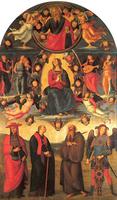
The Virgin enthroned, with angels and saints, Vallombrosa Alterpiece
Pietro Perugino
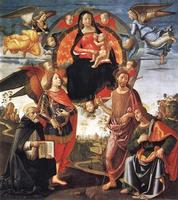
Madonna in Glory with Saints
Domenico Ghirlandaio
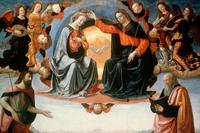
The Coronation of the Virgin
Domenico Ghirlandaio
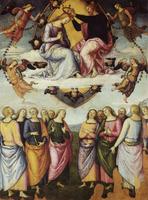
Pala di San Francesco al Monte (The Coronation of the Virgin)
Pietro Perugino
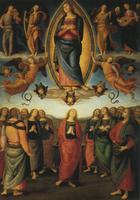
Polyptych Annunziata (Assumption of Mary)
Pietro Perugino
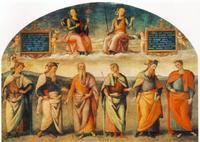
Prudence and Justice with Six Antique Wisemen
Pietro Perugino
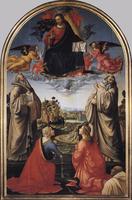
Christ in Glory with St. Benedict (c.480-547), St. Romuald (c.952-1027), St. Attinia, St. Grecinia and the donor, abbot Buonvicini
Domenico Ghirlandaio
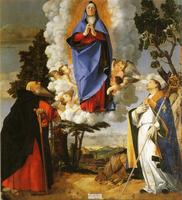
Asolo Altarpiece, main panel: Scene of the Assumption with St. Anthony the Abbot and St. Louis of Toulouse
Lorenzo Lotto
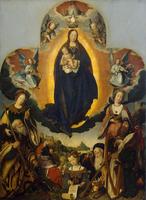
The Virgin Mary in Glory
Jan Provoost
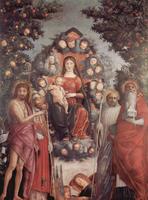
Madonna with saints St. John theBaptist, St. Gregory I the Great, St. Benedict
Andrea Mantegna
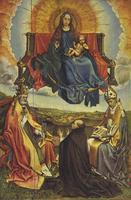
Holy Virgin in Glory
Robert Campin
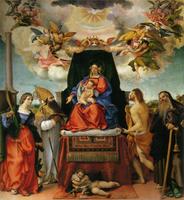
Enthroned Madonna with Angels and Saints, St. Catherine of Alexandria and St. Augustine on the left, St. Sebastian and St. Anthony the Abbot on the right
Lorenzo Lotto
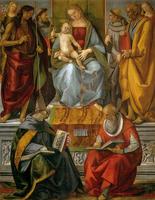
Virgin Enthroned with Saints
Luca Signorelli
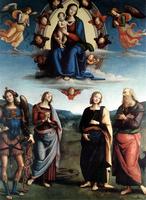
Madonna in Glory with the Child and Saints
Pietro Perugino
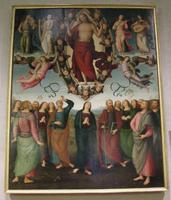
Cathedral of Sansepolcro Internal
Pietro Perugino
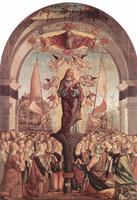
Glorification of St. Ursula and her Companions
Vittore Carpaccio
The Trinity, the Virgin and Two Saints
Luca Signorelli