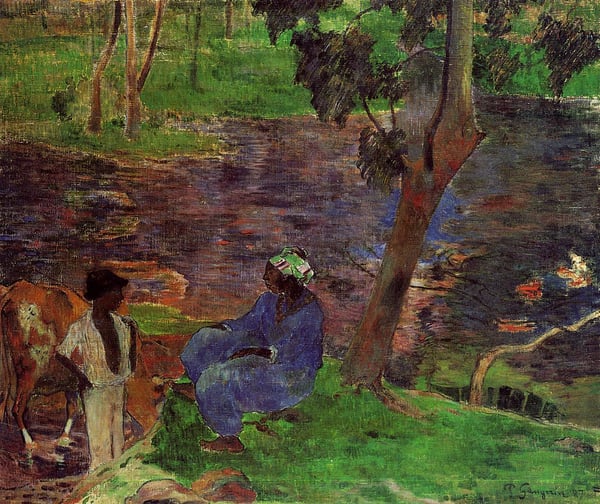
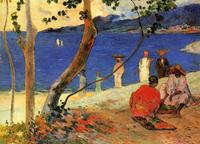
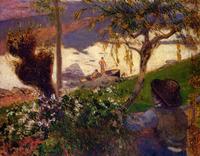
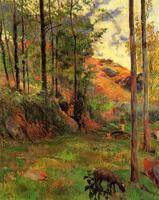
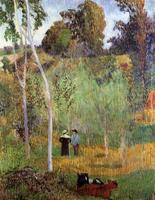
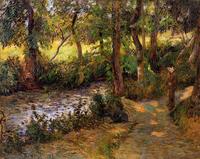
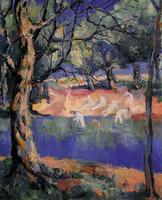
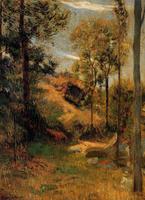
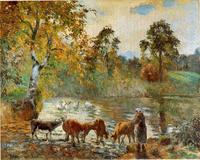
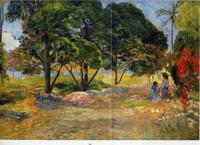
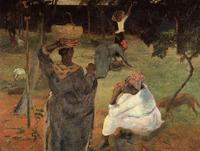
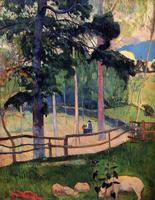
“At the Pond” exemplifies Paul Gauguin’s transformative Breton period, a crucial phase in which he abandoned Impressionist naturalism in favor of the symbolic, synthesized style that would define Post-Impressionism. The work reflects Gauguin’s quest for “the primitive” through simplified forms, bold outlines (Cloisonnism), and flat patches of color—techniques he developed in Pont-Aven.
As a genre painting of rural Breton life, it moves beyond mere observation: the pond, the figures, and the landscape are charged with a quiet, almost ritualistic stillness. Gauguin uses non-naturalistic hues (often deep blues, greens, and earthy reds) to evoke a timeless, spiritual connection to the countryside. This departure from optical reality—prioritizing emotion and symbolic meaning over accurate representation—marks the work as a bridge between Impressionism and the avant-garde movements of the 20th century.
“At the Pond” is significant not only as a record of Gauguin’s evolving style but also as an early assertion that art should convey inner truth through deliberate distortion and decorative harmony—a core principle of Post-Impressionism.