Analisi esperta di The Swing di Francisco Goya
Stile: Romanticism · Genere: genre painting
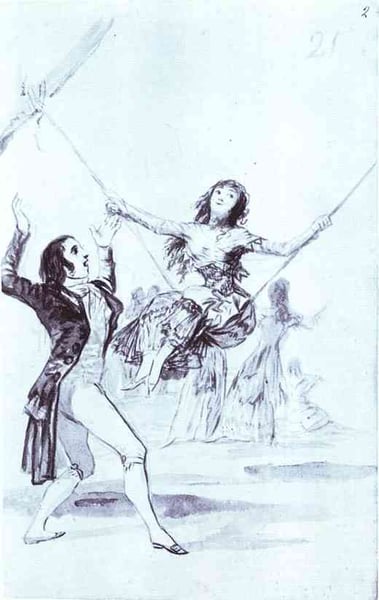
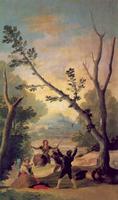
Francisco Goya’s The Swing (c. 1787) is a compelling example of Romanticism channeled through the accessible lens of genre painting. While the subject—a young woman on a swing—recalls the frivolous Rococo scenes of Jean-Honoré Fragonard, Goya transforms the motif into something distinctly earthier and more psychologically resonant.
Significance within Romanticism:
This work marks a crucial step away from the polished artificiality of the 18th century toward Romanticism’s embrace of raw emotion, naturalism, and the sublime in everyday life. Unlike Fragonard’s idealized, pastel-hued The Swing, Goya’s figures are grounded in a rustic Spanish landscape. The woman’s dynamic pose, the vigorous arc of the swing, and the rough-hewn tree branches convey a sense of physical energy and spontaneity—hallmarks of the Romantic fascination with untamed nature and human vitality. The darkened sky and barren foreground hint at a melancholic undercurrent, a Romantic acknowledgment of transience and mortality beneath the surface gaiety.
Genre Painting as Social Commentary:
As a genre painting—a scene of ordinary people—The Swing documents the customs of Spanish rural life while subtly critiquing class dynamics. The men in shadowy conversation, the woman’s carefree abandon, and the conspicuous absence of aristocratic refinement reflect Goya’s interest in the authentic, sometimes gritty realities of his time. The swing becomes a metaphor for the precariousness of pleasure and innocence, a theme Goya would later explore with darker intensity in his Caprichos prints.
Artistic Technique:
Goya employs loose, expressive brushwork and a restrained palette of ochres, grays, and deep greens, rejecting the slick finish of Rococo for a more tactile, atmospheric surface. This technique anticipates the painterly freedom of later Romantic masters like Delacroix. The diagonal composition—from the swinging figure to the straining rope—creates a dynamic tension that pulls the viewer into the scene’s fleeting, charged moment.
In summary, The Swing is significant as a transitional work that reimagines a traditional subject through a Romantic lens, infusing genre painting with psychological depth and social awareness. It demonstrates Goya’s early genius for capturing the spirit of an era poised between Enlightenment reason and Romantic passion.
Museum / Gallery
Visivamente simili
20 opere con composizione e palette affini
Woman battered with a cane
Francisco Goya
Get Married, Gentlemen That Would Come in Very Handy
Pavel Fedotov
Le Bon Genre
Carle Vernet
Even so he cannot make her out
Francisco Goya
Robert Macaire Bureau of Military Replacements
Honore Daumier
Mr. Fezziwig’s Ball
John Leech
Couple with Parasol on the Paseo
Francisco Goya
The First Kiss of Love
Pierre-Paul Prud'hon
Spanking Douglas
Currier and Ives
Illustration to "A Week of Kindness"
Max Ernst
Winter in the park
Eduardo Zamacois
The Swing
Francisco Goya
Young Witch Flying with a Rope
Francisco Goya
History of Lauretta
Paul Revere
Illustration to "A Week of Kindness"
Max Ernst
Meo Patacca receives money from the gentlemen for the the parties he wants to do (Plate ??/52)
Bartolomeo Pinelli
The Night of the Return
John Leech
The Italian Theatre
Eugene Delacroix
Illustration to "A Week of Kindness"
Max Ernst
Love and Death
Francisco Goya