Analisi esperta di Nest of Owls di Hieronymus Bosch
Stile: Northern Renaissance · Genere: sketch and study
Expert Analysis: "Nest of Owls" by Hieronymus Bosch
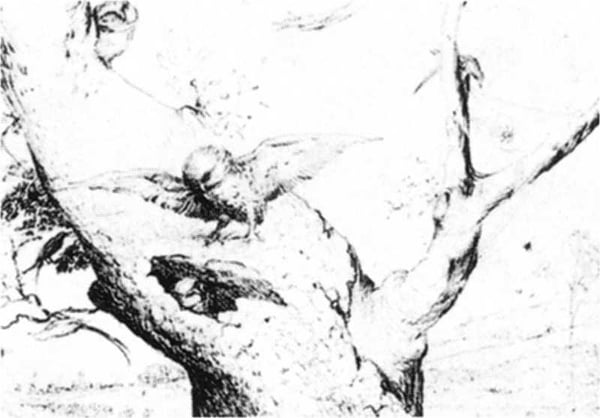
As a sketch and study within the Northern Renaissance, "Nest of Owls" offers a rare and revealing glimpse into the preparatory process of Hieronymus Bosch—an artist whose fantastical, moralizing visions continue to puzzle and fascinate. Unlike his highly finished, densely populated altarpieces (such as The Garden of Earthly Delights), this work is a stripped-down exploration of compositional and symbolic ideas, underscoring the significance of the artist’s working methods.
Significance within Style and Period
-
Insight into Bosch’s Creative Process
Finished paintings by Bosch are notoriously intricate, laden with hybrid creatures and layered allegories. "Nest of Owls" functions as a conceptual seed: a rapid, gestural study that likely served as a reference for a larger composition. In the Northern Renaissance tradition, such preparatory sketches were uncommon for highly detailed panel painters; their existence here demonstrates that Bosch, like Italian contemporaries, valued spontaneity and iterative design. -
Symbolic Economy
Owls in Bosch’s oeuvre are potent symbols—typically representing folly, evil, or heretical wisdom (the owl was often a stand-in for the “Jewish Synagogue” in medieval Christian iconography, or for nocturnal sin). By isolating the nest and its owl inhabitants, Bosch focuses the viewer’s attention on a core moral emblem. This sketch’s significance lies in its directness: without the distraction of elaborate grotesques or landscape, the owl’s predatory, watchful nature becomes the sole subject, emphasizing the artist’s didactic intent through minimal means. -
Evidence of Northern Renaissance Naturalism and Fantasy
The sketch balances observational accuracy (the birds’ forms are recognizable) with an uncanny, almost sinister atmosphere. This duality is a hallmark of the period: artists combined meticulous naturalistic detail with symbolic or fantastical elements. "Nest of Owls" demonstrates how Bosch could distill that tension into a swift, expressive drawing—making it a key document for understanding the intersection of study and imagination in Northern Renaissance art.
In sum, "Nest of Owls" is significant not as a finished masterpiece, but as a window into Bosch’s workshop practice, his use of emblems, and the preparatory thinking that underpinned the most enigmatic paintings of the era.
Museum / Gallery
Visivamente simili
20 opere con composizione e palette affini
The Hearing Forest and the Seeing Field
Hieronymus Bosch
Alice and Pigeon
Arthur Rackham
St. Jerome beside a pollard willow
Rembrandt
Illustration to Dante's Divine Comedy, Hell
William Blake
The Hapies' Wood
Gustave Dore
Untitled (Forest)
Georges Ribemont-Dessaignes
Fighting
Wilhelm Kotarbinski
Landscape
Esaias van de Velde
Group of deciduous trees and stones
Ivan Shishkin
The Fall
Lucas van Leyden
Jacob Finds Rest in a Rugged Landscape and Dreams of a Ladder
Salvator Rosa
Abandoned position near neuville
Otto Dix
The Suicides II
Gustave Dore
The Fugitive
John Steuart Curry
Roman Augurs Interpreting the Flight of Birds
Salvator Rosa
The Suicides
Gustave Dore
The Inferno, Canto 13
Gustave Dore
Illustration to "A Week of Kindness"
Max Ernst
Concert Of Birds
Frans Snyders
Christ on the Mount of Olives
Albrecht Durer