Analisi esperta di The album "Circus" di Fernand Leger
Stile: Purism · Genere: sketch and study
Expert Analysis: "The album 'Circus'" by Fernand Léger
Significance Within Purism and Léger's Oeuvre
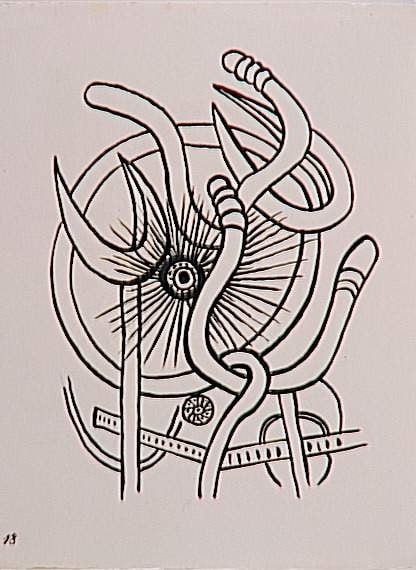
Fernand Léger’s “The album ‘Circus’” is a seminal work that crystallizes the core tenets of Purism—a post-Cubist movement co-founded by Léger and Amédée Ozenfant in the 1920s. Purism rejected the decorative fragmentation of Cubism in favor of clear, precise, and machine-like forms, celebrating the visual harmony of modern industrial life. Léger’s circus album is a sketch and study, offering a rare glimpse into his creative process of distilling dynamic, popular entertainment into purified, geometric essences.
What Makes It Significant
-
Fusion of Movement and Mechanical Precision
Unlike static Purist still lifes, Léger’s circus sketches capture the kinetic energy of acrobats, clowns, and animals. He translates their gestures into bold, simplified cylinders, arcs, and primary colors—treating the human figure as a machine of motion. This aligns with Purism’s ideal of a “mechanical aesthetic” while celebrating the human element of performance. -
Sketch as Finished Statement
The album’s status as a sketch and study is integral to its significance. Léger deliberately embraced the unfinished, direct quality of drawing to emphasize line, shape, and contrast over illusionistic detail. This aligns with Purism’s search for “universal” visual language—a grammar of basic forms that could be understood by anyone, regardless of cultural sophistication. -
Celebration of Popular Culture
By choosing the circus—a working-class entertainment—Léger broke with high-art subjects. The album bridges the gap between avant-garde formalism and everyday life, a key Purist goal. It prefigures Léger’s later monumental murals and his belief that art should be accessible, like a circus parade. -
Proto-Pop and Abstract Tendencies
The stark outlines, flat areas of pure color, and rhythmic repetition in these studies anticipate both Pop Art and Abstract Expressionism. Léger compresses the circus’s chaos into a controlled, almost graphic design, making the work a vital link between Cubist structure and postwar abstraction.
Critical Context
Produced during a period when Léger was increasingly focused on the harmony of “contrasts of forms” (his own term), “The album ‘Circus’” stands as a manifesto-in-miniature. It demonstrates how Purism could animate the modern city’s pulse—its noise, speed, and spectacle—through disciplined simplification. The work remains a touchstone for understanding how Léger transformed observational studies into iconic, timeless compositions that continue to influence graphic design and modern art.
Museum / Gallery
Visivamente simili
20 opere con composizione e palette affini
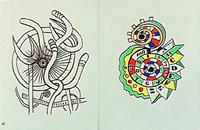
The album "Circus"
Fernand Leger
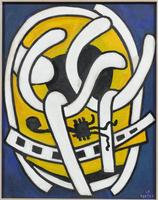
Both handlebars
Fernand Leger
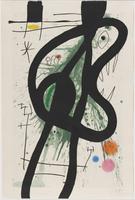
The Great Carnivore
Joan Miro
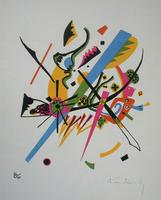
Small worlds
Wassily Kandinsky
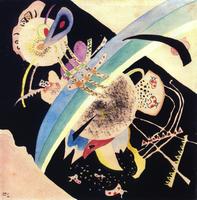
Study for "Circles on Black"
Wassily Kandinsky
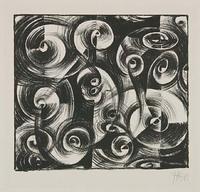
Linienrhythmus
Johannes Itten
Untitled
Mikey William Cheung
Stars and Disasters (Astres et Désastres)
Pierre Alechinsky
Women and Birds in the Night
Joan Miro
Labyrinth
George Stefanescu
Plate III from the portfolio Ceremonial Labyrinths (Labyrinthes d'apparat)
Pierre Alechinsky
Small Worlds VII
Wassily Kandinsky
Miro
Darwin Stead
The polychrome Fleur
Fernand Leger
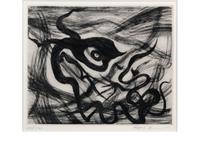
Untitled
Taro Okamoto
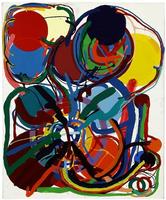
Untitled
Atsuko Tanaka
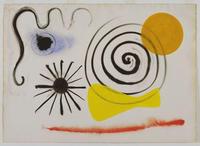
Untitled
Alexander Calder
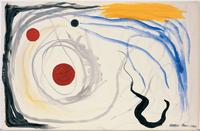
Untitled
Alexander Calder
Woman and Bird in the Night
Joan Miro
Untitled
Julius Evola