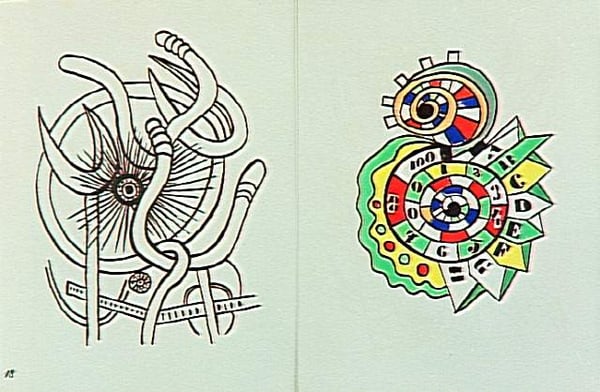
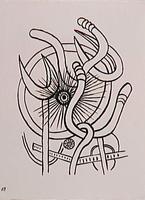
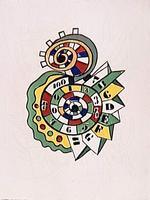
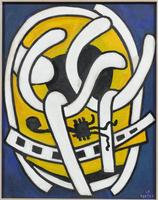
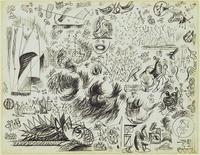
The significance of Fernand Léger’s The album “Circus” lies in how it applies the principles of Purism—a movement that championed machined precision, geometric simplification, and idealized order—to the lively, chaotic world of the circus. As a sketch and study, this work is not a polished finished painting but a working document that reveals Léger’s process of distilling human figures, animals, and performance into Purist vocabulary: clean arcs, cylinders, primary colors, and balanced planar compositions.
Within Purism’s brief, rigorous history (co-founded by Amédée Ozenfant and Le Corbusier), Léger stood out for his insistence on including everyday human activities. Here, the circus becomes a perfect laboratory: acrobats, horses and clowns are rendered without sentimentality, reduced to dynamic mechanical forms that echo the era’s fascination with industry and movement. The album format—a series of rapid sketches—emphasizes sequence and rhythm, mirroring the circus acts’ choreography.
This work is significant because it pushes Purism beyond still-life and architecture into a genre traditionally associated with expressionistic color and irregularity (e.g., Seurat, Rouault). Léger instead demonstrates that even the most whimsical spectacle can be rationalized into clear, monumental shapes—a key step toward his later, fully realized “machine aesthetic” of the 1920s–30s.