
Expertenanalyse zu Ivan Aivazovskys Battle of Sinop
Stil: Romanticism · Genre: battle painting
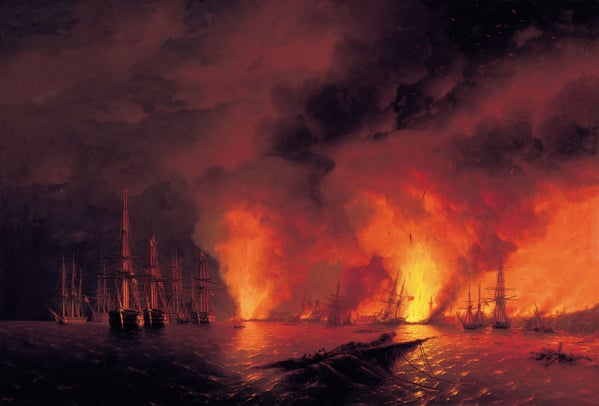
Expert Analysis of Ivan Aivazovsky’s Battle of Sinop (1853)
Style & Context:
As a quintessential Romantic battle painting, Aivazovsky’s Battle of Sinop transforms a historical naval engagement—the Russian victory over the Ottoman fleet during the Crimean War—into a sublime spectacle of natural and human fury. The work embodies Romanticism’s fascination with the sublime: the overwhelming power of nature (stormy seas, fiery skies) dwarfing human endeavor, while simultaneously celebrating heroic resilience.
Composition & Technique:
Aivazovsky masterfully juxtaposes chaos and structure. The diagonal sweep of listing masts and smoke contrasts with the stable horizontal of the sea horizon, creating dynamic tension. His signature luminous palette—crimson flames reflected in black-green water, sulfurous clouds lit by moonlight—imbues the scene with both documentary precision and emotional intensity. The viewer is placed mid-battle, as if aboard a ship, emphasizing the Romantic ideal of immersive, visceral experience.
Significance:
-
Historical & National Identity:
Painted shortly after the actual battle (November 30, 1853), the work served as a patriotic icon in Russia, memorializing the Black Sea Fleet’s triumph. Aivazovsky, the official painter of the Russian Navy, combined eyewitness accuracy (he interviewed sailors and studied naval reports) with Romantic allegory, elevating a tactical victory into a mythic moment. -
Innovation in Marine Battle Painting:
Unlike earlier battle painters who focused on clustered figures, Aivazovsky prioritizes the sea itself as protagonist. The waves are sculpted with oily impasto, the fires rendered in thin glazes—a technique that makes the ocean feel alive, reflecting the Romantic belief that nature mirrors human conflict. This approach influenced later Russian and Soviet marine artists. -
Emotional & Thematic Depth:
The painting avoids one-dimensional propaganda. While Russian ships dominate, the sinking Ottoman vessels are not demonized; they burn with the same wild beauty. This ambiguity—celebrating victory while acknowledging war’s devastation—aligns with Romanticism’s interest in human frailty and the cost of glory.
Conclusion:
Battle of Sinop is significant not merely as a record of a specific battle, but as a Romantic synthesis of history, nature, and emotion. Aivazovsky’s ability to make fire, water, and smoke feel palpable—while embedding them in a grand narrative of national pride and existential struggle—secures this work as a key example of how 19th-century Romanticism transformed battle painting into a medium for sublime experience and cultural memory.
Visuell ähnlich
20 Werke mit ähnlicher Komposition und Farbpalette
The Battle of Sinop on 18th November 1853 Night After Battle
Ivan Aivazovsky
Battle of Cesme at Night
Ivan Aivazovsky
Russian-Turkish Sea Battle of Sinop on 18th November 1853
Ivan Aivazovsky
Battle of Chesma
Ivan Aivazovsky
The Battle of Grand Port
Anton Melbye
Burning of the Frigate Philadelphia in the Harbor of Tripoli
Edward Moran
Bombardment of Algiers
Thomas Luny
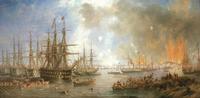
The Bombardment of Sveaborg, 9 August 1855
John Wilson Carmichael
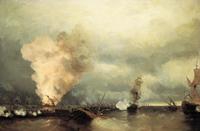
Sea battle near Vyborg
Ivan Aivazovsky
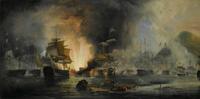
The Battle of Navarino, 20 October 1827
George Philip Reinagle

Lunar night on Capri
Ivan Aivazovsky
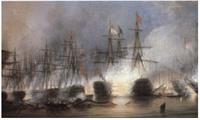
The Battle of Navarino
George Philip Reinagle
Combat Naval En Vue Des Îles De Loz, 7 Février 1813
Louis-Philippe Crépin
Turkish steamships attack 44 gun fregate Flora
Alexey Bogolyubov
The Battle of Navarino
Ivan Aivazovsky
The capture of Sevastopol
Ivan Aivazovsky

Gibraltar by Night
Ivan Aivazovsky
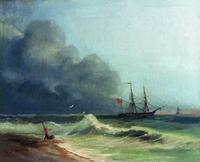
Sea before storm
Ivan Aivazovsky

Tempest
Ivan Aivazovsky

Tempest by Sounion
Ivan Aivazovsky