
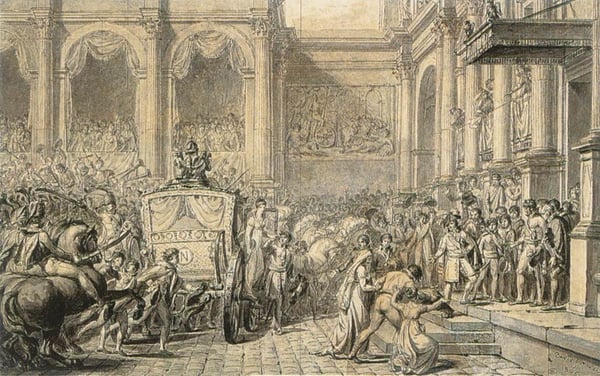
Expert analysis of Jacques-Louis David’s The Arrival at the Hôtel de Ville
Style: Neoclassicism · Genre: cityscape
Jacques-Louis David’s The Arrival at the Hôtel de Ville is a significant—if unexpected—work within the Neoclassical canon. While David is celebrated for his monumental history paintings and portraits, this cityscape demonstrates the same rigorous principles that define his style: clarity of line, rational composition, and a sense of civic order.
The painting’s importance lies in its application of Neoclassical ideals to an urban scene. Instead of a mythological or ancient setting, David turns his attention to a contemporary Parisian landmark, the Hôtel de Ville. The work likely depicts a ceremonial or political moment, reinforcing Neoclassicism’s emphasis on public virtue and civic duty. The architecture is rendered with precise, balanced geometry, and the figures are arranged with the same clarity found in David’s historical canvases, creating a sense of dignified stillness.
As a cityscape, this piece expands the Neoclassical vocabulary, proving that the style could ennoble contemporary life through the same disciplined, harmonious structure used for the heroism of antiquity. It stands as a rare but potent example of how Neoclassical order could be imposed on the modern city, making the everyday seem as timeless and significant as a scene from Rome.
Visually similar
20 works with related composition and palette
Study for the Distribution of the Eagle Standards
Jacques-Louis David
The triumph of Mordechai
Rembrandt
The Triumph and Vespasian de Titus
Andrea Mantegna
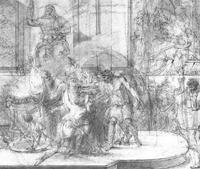
Pagan priests killing the first Kyivan Christians in the temple of Perun
Orest Kiprensky
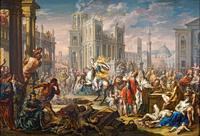
Marcus Curtius
Johann Georg Platzer
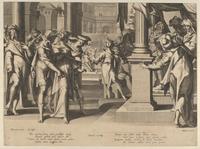
Susanna before Daniel
Willem van Swanenburg
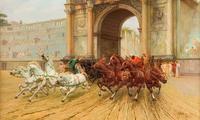
Racing Chariots Entering The Circus Maximus
Ettore Forti
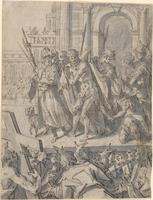
Ecce Homo
Hans von Aachen
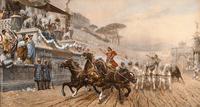
Chariot Racing
Ettore Forti
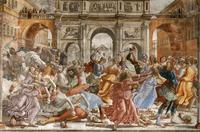
Slaughter of the Innocents
Domenico Ghirlandaio
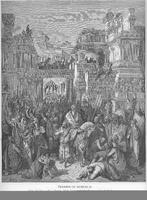
The Triumph of Mordecai
Gustave Dore
The Cross of Christ
Albrecht Durer
Don Juan Tenorio
Carlos Saenz de Tejada
The Adoration of the Magi
Maerten van Heemskerck
Torture of Waldensians, Forcing Them to Hold a Red Hot Iron Bar, AD 1214
Jan Luyken
The Coronation of Esther
Carlo Urbino
The rape of the Sabine Women
Vincenzo Camuccini
Triumph of Venus
Heinrich Schonfeld
Allegory in Honor of Ranuccio Farnese
Francesco de' Rossi (Francesco Salviati), "Cecchino"
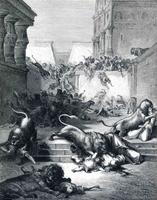
Foreign Nations Are Slain by Lions in Samaria
Gustave Dore