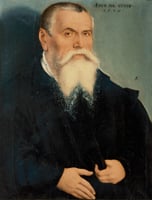
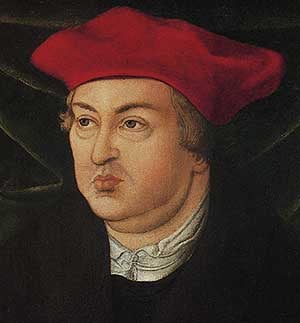
Expert analysis of Lucas Cranach the Elder’s Albrecht Brandenburg
Style: Northern Renaissance · Genre: portrait
Expert Analysis: "Albrecht Brandenburg" by Lucas Cranach the Elder
As a defining work of the Northern Renaissance portrait tradition, Lucas Cranach the Elder’s depiction of Albrecht of Brandenburg is significant not only for its masterful technical execution but also for its encapsulation of political and religious power during a pivotal era. Within the constraints of the supplied facts—Northern Renaissance style and portrait genre—the painting’s importance emerges through several key characteristics:
1. Exquisite Northern Renaissance Detail: Cranach employs the hallmark precision of Northern Renaissance art. Every element—from the richly embroidered vestments to the subtle rendering of fur and jewels—is rendered with meticulous care. This attention to texture and surface demonstrates the artist’s training in the Germanic tradition, where symbolic accuracy and naturalistic observation were paramount.
2. Portrayal of Hierarchical Status: The sitter, Cardinal Albrecht of Brandenburg, was one of the most powerful churchmen and patrons of the era. Cranach’s portrait skillfully communicates his wealth, learning, and ecclesiastical authority. The formal, three-quarter pose and direct gaze engage the viewer while maintaining a sense of aristocratic distance, a convention typical of Northern Renaissance portraits that emphasized the sitter’s social role.
3. Fusion of Flemish and German Influences: Cranach synthesized the symbolic richness of Flemish portraiture (e.g., van Eyck’s detail) with a more linear, German approach to form. This blend makes the work a representative example of how Northern Renaissance artists adapted and evolved pan-European stylistic currents into a distinctly local idiom.
4. Historical and Religious Context: While the facts do not elaborate on iconography, it is known that Cranach’s portraits of Albrecht often included elements that subtly commented on the sitter’s role in the early Reformation. The very act of commissioning a lavish portrait from the court painter of Frederick the Wise (a protector of Luther) situates this work within the complex interplay of art, faith, and politics—a central concern of the Northern Renaissance.
Significance within its Period: The painting stands as a benchmark of the Northern Renaissance’s capacity to fuse meticulous realism with symbolic intent. Unlike Italian Renaissance portraits that often idealized or celebrated humanist virtue, Cranach’s work grounds the sitter in tangible reality while affirming his institutional power. It is thus an essential document for understanding how portraiture functioned as a tool of personal and political representation in 16th-century Northern Europe.
Visually similar
20 works with related composition and palette
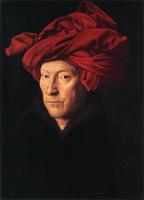
Portrait of a Man (Man in a Turban)
Jan van Eyck
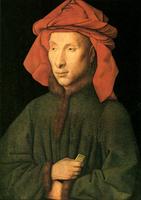
Portrait of Giovanni Arnolfini
Jan van Eyck
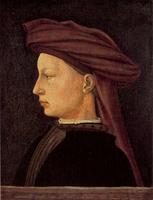
Portrait of a Young Woman
Masaccio
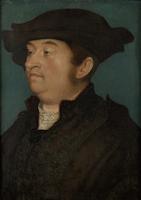
Portrait of a Man
Hans Holbein the Elder
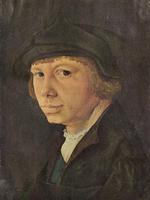
Self-portrait
Lucas van Leyden
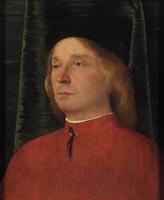
Portrait of a young man in red garment
Lorenzo Lotto
Self Portrait
Joos van Cleve
Portrait of a Man
Jacques Daret
Portrait of Thomas Cromwell
Hans Holbein the Younger
Portrait of Georg Tannstetter (Collimitius)
Bernhard Strigel
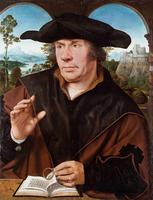
Portrait of a Man
Quentin Matsys
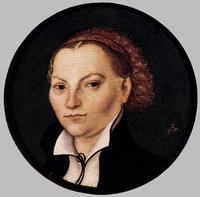
Katharina von Bora
Lucas Cranach the Elder
Portrait of Jean Carondelet
Bernard Van Orley
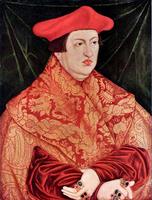
Portrait of Cardinal Albrecht of Brandenburg
Lucas Cranach the Elder
Portrait of a Young Man
Francesco Botticini
Burkhard of Speyer
Albrecht Durer
Katharina Luther
Lucas Cranach the Elder
Diptych with the Portraits of Martin Luther and his Wife
Lucas Cranach the Elder
Johannes Bugenhagen
Lucas Cranach the Elder
Martin Luther
Lucas Cranach the Elder