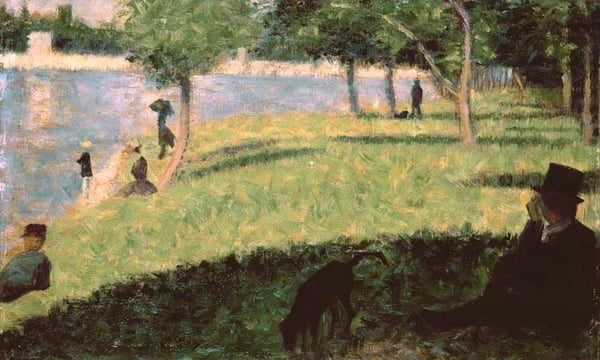
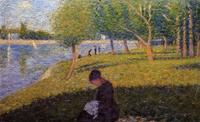
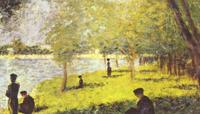
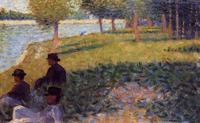
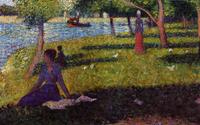
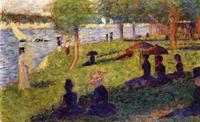
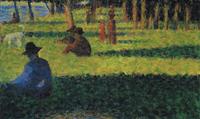
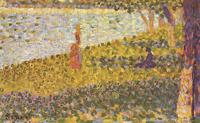
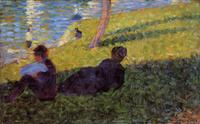
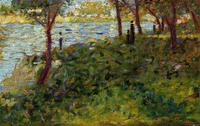
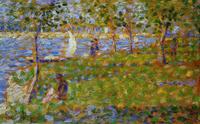
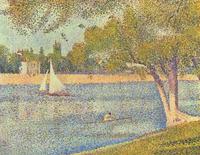
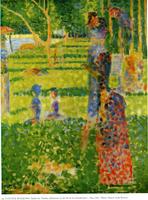
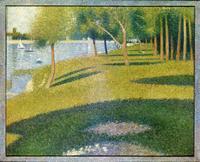
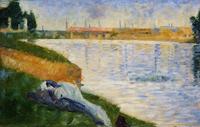
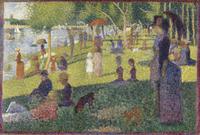
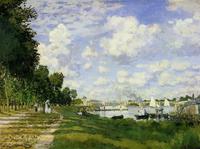
This work is a preparatory oil sketch for Georges Seurat’s monumental masterpiece A Sunday on La Grande Jatte—1884. As a study, it occupies a crucial position in the evolution of Post-Impressionism and the birth of Neo-Impressionism.
Significance within Style and Period:
- Proto-Pointillist Technique: Unlike the fully realized La Grande Jatte with its meticulous dot application, this study reveals Seurat’s early, more painterly handling of the scene. Broad, visible brushstrokes and dashes of color demonstrate his shift from Impressionist spontaneity toward the systematic, scientific division of color that would define Neo-Impressionism.
- Color Theory in Practice: Seurat applies complementary color juxtapositions (e.g., warm ochres against cool blues) and optical mixing – a hallmark of his method. The study allows us to see him testing his theories of luminance and contrast before committing to the larger canvas.
- Compositional Blueprint: The landscape is carefully structured using classical geometry (horizontals, verticals, diagonals) that anchors the leisurely park scene. Seurat’s balancing of figures, trees, and water in this study predicts the iconic, almost static frieze-like arrangement of the final painting.
- Bridge from Impressionism to Modernism: This study embodies the transition from Impressionism’s fleeting light effects to a more disciplined, intellectual approach that influenced later movements (Fauvism, Cubism). It shows Seurat treating landscape not as a spontaneous impression but as a carefully orchestrated harmony of color and form.
Artistic Value:
As a preparatory work, it offers rare insight into Seurat’s creative process – the raw experimentation that underpins one of the most celebrated paintings of the 19th century. Its significance lies in documenting the artist’s methodical journey from a vivid sketch to a revolutionary statement in modern art.