Expert Analysis:
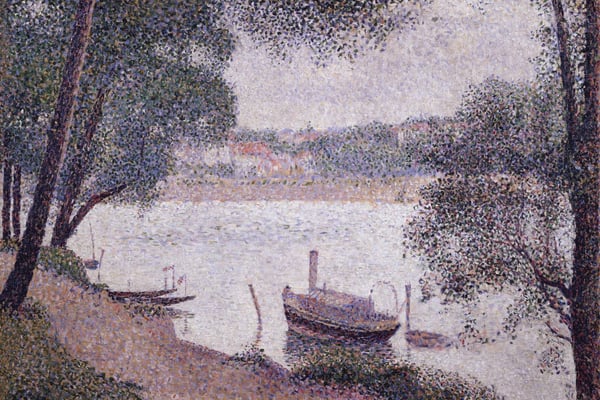
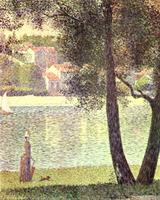
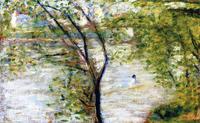
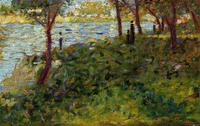
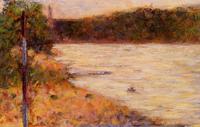
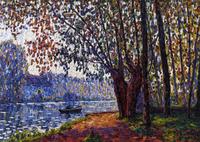
Georges Seurat’s River Landscape with a Boat exemplifies the revolutionary technique of Pointillism, a cornerstone of Neo-Impressionism. Rather than blending pigments on a palette, Seurat applied countless tiny dots of pure, unmixed color directly to the canvas. When viewed from a distance, these dots optically merge in the viewer’s eye—a process called “optical mixing”—producing luminous, vibrant tones that surpass traditional blended paint.
In this landscape, the water, sky, and foliage are built from systematic, scientific color contrasts: complementary blues and oranges enliven the river’s surface, while carefully placed greens and yellows define the boat and banks. This method allowed Seurat to capture fleeting effects of light and atmosphere with unprecedented precision and calm stability.
Significance within Style/Period:
As a leading work of Neo-Impressionism, this painting demonstrates Seurat’s break from Impressionism’s spontaneity toward a more structured, almost mathematical approach to color and form. The deliberate dot technique and harmonious composition mark a turning point in modern art, influencing later movements such as Fauvism and Divisionism. River Landscape with a Boat is not merely a scene of nature but a controlled study in optical science and aesthetic order—a testament to Seurat’s ambition to make art both sensory and systematic.