Expertenanalyse zu Pietro Peruginos Sepulcrum Christi
Stil: High Renaissance · Genre: religious painting
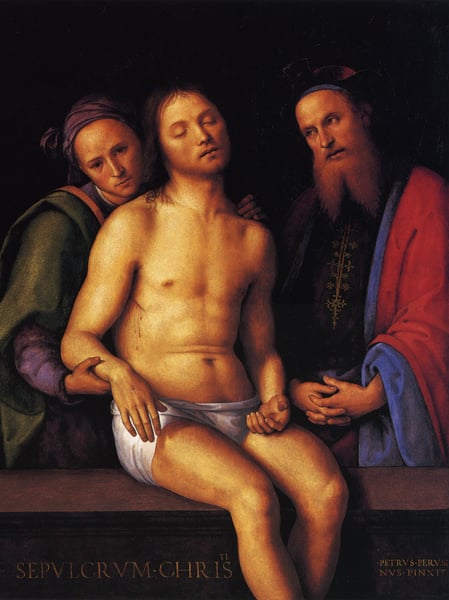
Expert Analysis: "Sepulcrum Christi" by Pietro Perugino
As a quintessential work of the High Renaissance, Pietro Perugino’s Sepulcrum Christi (The Tomb of Christ) embodies the era’s pursuit of harmonious composition, spatial clarity, and serene devotional intensity. Executed in the late 15th or early 16th century, the painting reflects Perugino’s masterful synthesis of perspective, balanced figure grouping, and atmospheric landscape—qualities that directly influenced his pupil Raphael.
Stylistic & Period Significance
The work is a landmark of the High Renaissance religious genre, showcasing Perugino’s signature use of symmetrical arrangement and measured gestures. The figures—likely including the Virgin Mary, John the Evangelist, and Mary Magdalene—are arranged around Christ’s tomb in a frieze-like composition, their poses imbued with calm grief rather than dramatic emotion. This restraint aligns with the period’s ideal of decorum and spiritual clarity, avoiding the agitated pathos of earlier Renaissance works. The soft, diffused light and muted palette create a timeless, meditative atmosphere, while the landscape recedes in precise linear perspective, leading the eye toward a distant, luminous horizon—a hallmark of Perugino’s Umbrian style.
Innovative Features
Perugino achieves a seamless fusion of architectural and natural settings. The tomb itself is rendered as a classical sarcophagus, its clean geometry echoing the rationality of ancient Roman forms, which High Renaissance artists revered. The handling of drapery—simple, flowing folds that reveal the body’s structure—demonstrates his study of anatomical naturalism without overt muscular tension. Most notably, the painting’s emotional core lies in the interplay of gazes and small, restrained gestures (e.g., a hand touching the shroud), inviting quiet contemplation rather than theatrical piety.
Influence & Legacy
Sepulcrum Christi exemplifies why Perugino was considered the leading painter in Rome before Raphael’s rise. His ability to unite multiple figures in a clear, readable space—each with distinct but harmonized roles—set a standard for religious narrative painting. The work’s serene, balanced composition directly prefigures Raphael’s Entombment and Madonna of the Meadow, while its use of light and landscape anticipates the atmospheric tonalities of the later High Renaissance. In this painting, Perugino distilled the era’s core ambition: to render the divine as an orderly, beautiful, and approachable reality.
Visuell ähnlich
20 Werke mit ähnlicher Komposition und Farbpalette
Lamentation over the Dead Christ
Bernardino Luini
Dead Christ Supported by Madonna and St. John
Giovanni Bellini
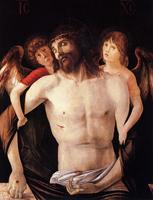
The Dead Christ Supported by Two Angels
Giovanni Bellini
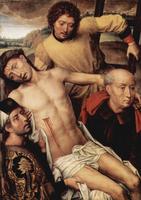
Descent from the Cross, left hand panel from the Deposition Diptych
Hans Memling
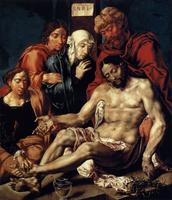
Lamentation of Christ
Maerten van Heemskerck
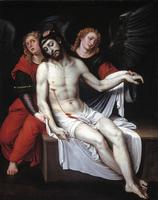
The Dead Christ Supported by Angels
Francesco Ribalta
Cristo Muerto Sostenido Por Dos Ángeles
Francesco Ribalta
Deposition (left wing of a diptych)
Hans Memling
Ecce Homo
Caravaggio
Man of Sorrow
Mabuse
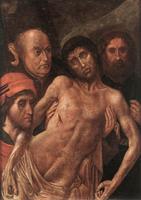
Deposition Diptych (Small Deposition, left wing)
Hugo van der Goes
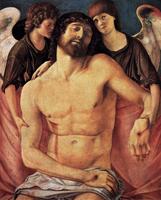
Dead Christ Supported by Angels
Giovanni Bellini
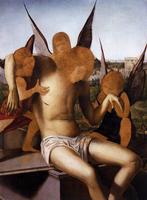
Pieta
Antonello da Messina
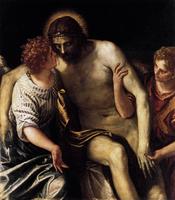
Dead Christ Supported by Two Angels
Paolo Veronese
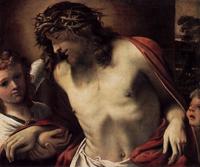
Christ Wearing the Crown of Thorns, Supported by Angels
Annibale Carracci
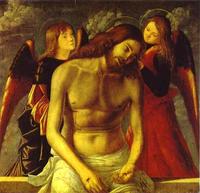
The Dead Christ Supported by Angels.
Vittore Carpaccio
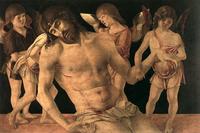
Dead Christ Supported by Angels
Giovanni Bellini
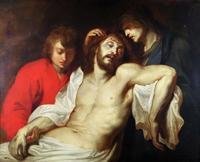
Lamentation of Christ by the Virgin Mary and St John
Peter Paul Rubens
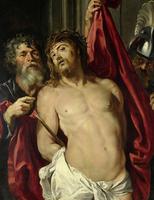
Ecce Homo
Peter Paul Rubens
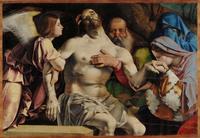
Altar of Recanati polyptych, crowning the main board: Angel Pietà
Lorenzo Lotto