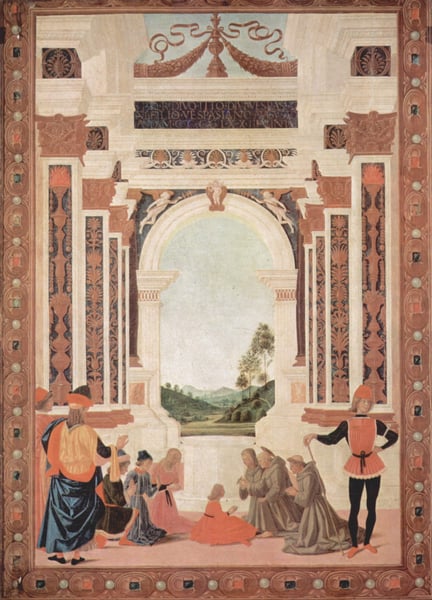
The Miracles of San Bernardino. The Healing of a Young
Details
Expertenanalyse zu Pietro Peruginos The Miracles of San Bernardino. The Healing of a Young
Stil: Early Renaissance · Genre: religious painting
As an expert in Early Renaissance art, I can provide the following analysis of Pietro Perugino's panel, "The Miracles of San Bernardino: The Healing of a Young [Man]."
Expert Analysis
Pietro Perugino, a leading master of the Umbrian School and the teacher of Raphael, created this work as part of a series of small panels—likely from a predella (the base of an altarpiece)—illustrating the posthumous miracles of Saint Bernardino of Siena. This specific scene depicts the saint healing a young boy. The work is profoundly significant for several reasons that define its place within the Early Renaissance.
Significance within the Early Renaissance
-
Mastery of Perspective and Spatial Clarity: Perugino exemplifies the Early Renaissance obsession with scientific perspective. The composition is built on a clear, stage-like setting defined by a loggia with receding arches. The orthogonals (lines converging into the distance) pull the viewer’s eye toward a serene landscape—a hallmark of Umbrian painting. This rational, geometric space was a revolutionary departure from the flat, gold-ground backgrounds of the Gothic era, grounding a sacred miracle in a believable, human-scaled world.
-
Harmony, Serenity, and Idealized Beauty: Perugino’s style is instantly recognizable for its calm, lyrical grace. The figures are arranged in a balanced, symmetrical composition, echoing the stability of the architecture. Their poses are gentle and restrained—no violent emotions, only quiet reverence. The faces share a sweet, idealized beauty (the dolce stil nuovo), and the landscape is a soft, luminous vista of feathery trees and distant hills. This creates an atmosphere of divine peace, making the miracle feel inevitable and harmonious rather than dramatic.
-
Narrative Economy and Focal Clarity: Perugino is a master of concise storytelling. The action is central and immediate: the healed youth stands, his mother kneels in gratitude, and two witnesses react with composed amazement. The saint’s presence is implied by a halo or the narrative context. Every figure and architectural element serves the story, with no distracting detail. This clarity reflects the humanist desire for order and legibility, making the spiritual message accessible to all viewers.
-
Influence on the High Renaissance: This work embodies the transitional moment when Early Renaissance experimentation with perspective and naturalism merged with a new, monumental serenity. Perugino’s balance of rational space and ethereal beauty directly shaped the early work of his pupil Raphael, who would perfect this style in the High Renaissance. The panel thus stands as a quiet but crucial stepping stone toward the classical perfection of the later 16th century.
In summary, "The Healing of a Young Man" is significant not as a dramatic spectacle, but as a masterpiece of refined balance—between science and spirituality, geometry and lyricism, narrative and stillness. It captures the essence of the Early Renaissance quest to depict the divine through the lens of a harmonious, ordered, and beautiful natural world.
Museum / Gallery
Visuell ähnlich
20 Werke mit ähnlicher Komposition und Farbpalette
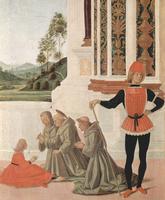
The Miracles of San Bernardino. The Healing of a Young (detail)
Pietro Perugino
Painting cycle for the miracles of St. Bernard, scene: Healing the blind and deaf Riccardo Micuzio dall 'Aquila
Pinturicchio
Portrait of the Donor Francesca Pitti Tornabuoni
Domenico Ghirlandaio
Angel Appearing to Zacharias
Domenico Ghirlandaio
Zacharias Writes Down the Name of His Son
Domenico Ghirlandaio
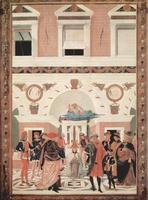
The Miracles of San Bernardino. The Healing of the blind and deaf Riccardo Micuzio
Pietro Perugino
Expulsion of Joachim
Domenico Ghirlandaio
Marriage of Mary
Domenico Ghirlandaio
The Story of Virginia
Sandro Botticelli
The Flagellation of Christ (detail)
Piero della Francesca
The Annunciation
Francesco del Cossa
Saint Luke painting the Virgin
Mabuse
The Annunciation
Vittore Carpaccio
Triptych of Virtue of Patience
Bernard Van Orley
The Annunciation
Pietro Perugino
Martyrdom of St. Sebastian
Pietro Perugino
Scenes from the Life of Saint Zenobius
Sandro Botticelli
Christ among the Doctors
Pinturicchio
The Annunciation
Piero della Francesca
Portrait of the Donor Giovanni Tornabuoni
Domenico Ghirlandaio