Expert Analysis of "The Miracles of San Bernardino. The Healing of the blind and deaf Riccardo Micuzio" by Pietro Perugino
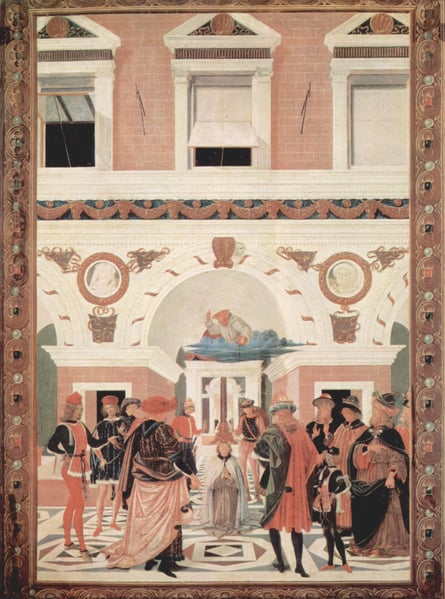
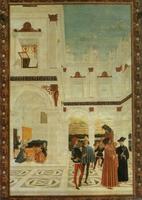
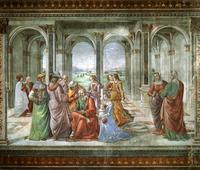
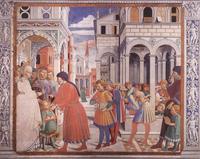
This panel, part of a series dedicated to the miracles of Saint Bernardino of Siena, exemplifies the core achievements of the Early Renaissance through the masterful hand of Pietro Perugino. The work is significant for its clear demonstration of two defining innovations of the period: the systematic use of linear perspective to create a credible, measured space, and the harmonious, humanistic portrayal of sacred narrative.
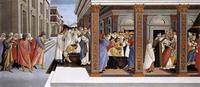
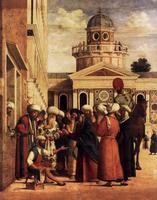
Perugino, a leading figure of the Umbrian school and teacher of Raphael, achieves a remarkable spatial coherence in this scene. The architectural setting—likely a piazza in Siena—recedes with geometric precision, its orthogonal lines drawing the eye toward the central miracle and the horizon. This structured backdrop supports the narrative without overwhelming it.
The painting's significance also lies in its emotional clarity. The healing of Riccardo Micuzio, a blind and deaf man, is rendered with restrained naturalism. The figures are arranged in a calm, balanced frieze-like composition—typical of Perugino’s style—with idealized, serene faces that express awe rather than dramatic agony. This reflects the Early Renaissance interest in human dignity and divine order, where even a miracle is depicted with elegant grace.
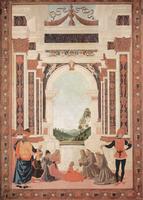
Furthermore, the work marks a transition from Gothic conventions: instead of flat gold grounds or crowded, symbolic space, Perugino employs a soft, luminous landscape and atmospheric perspective (the hills fading into a pale blue sky). The delicate handling of light and color—characteristic of Umbrian painting—imbues the scene with a spiritual, yet believable, atmosphere. In this panel, Perugino synthesizes narrative clarity, perspectival truth, and devotional harmony, making it a quintessential example of Early Renaissance religious painting.