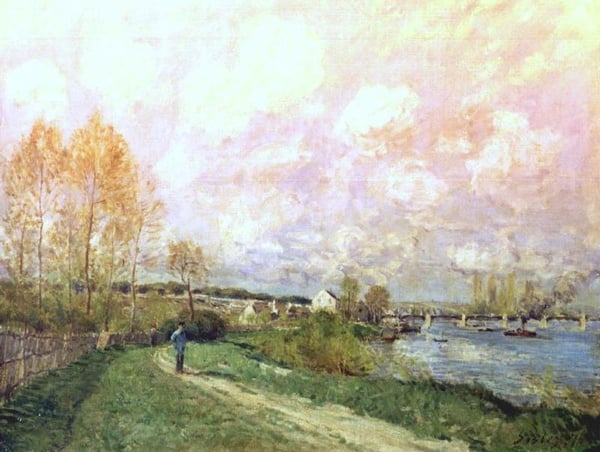
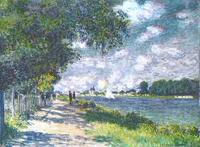
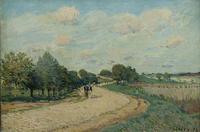
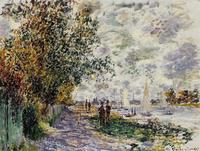
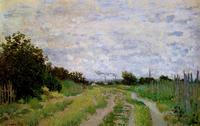
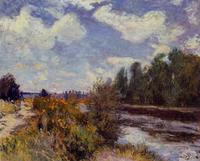
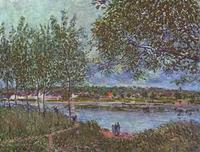
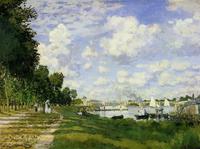
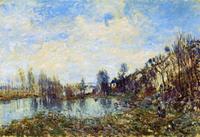
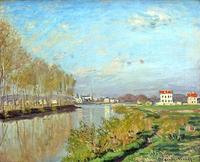
Alfred Sisley’s Summer at Bougival is a quintessential Impressionist landscape that embodies the movement’s core pursuit of capturing fleeting atmospheric effects. The work’s significance within the Impressionist period lies in its exemplary treatment of light and season: the title itself announces a specific moment—summer—and the suburb of Bougival on the Seine was a favored site for plein-air painting, allowing Sisley to study how sunlight interacts with water, foliage, and sky. As a landscape dedicated wholly to optical sensation rather than narrative, the painting reflects Impressionism’s radical shift away from historical or allegorical subjects toward the direct observation of nature. Sisley’s consistent focus on landscapes—never venturing into figure painting or still life—makes his oeuvre a pure test case for the Impressionist method, and Summer at Bougival is a prime example of his ability to render the transient play of light and color with loose, visible brushwork. In this, the work stands as a testament to the movement’s belief that the truth of a scene lies in its momentary, sensory impression.